

How Reinforcement Learning Works in Robotics: A Technical Beginner’s Guide

Table of Contents
- From Fixed Instructions to Adaptive Learning
- Understanding the Reinforcement Learning Framework
- States, Actions, Rewards, and Policies
- The Markov Decision Process
- Learning Through Exploration
- Value Functions and Policy Optimization
- Deep Reinforcement Learning
- Simulation as a Training Environment
- Challenges in Reward Design
- Current Applications in Robotics
- Looking Ahead
- Continue Learning with WiredWhite
For decades, robotics followed a relatively straightforward philosophy: engineers programmed machines by defining explicit rules for every task they were expected to perform. A robotic arm on an assembly line repeated the same sequence of movements thousands of times, while mobile robots navigated using carefully designed maps and predetermined decision trees. These systems proved remarkably effective in controlled environments, but they often struggled when confronted with uncertainty. A slightly misplaced object, an unexpected obstacle, or a change in lighting conditions could be enough to disrupt their performance.
Modern robotics increasingly relies on a different paradigm. Instead of attempting to anticipate every possible situation, researchers are building robots that learn through interaction with their environment. At the center of this shift is reinforcement learning (RL), a branch of machine learning in which intelligent agents discover effective behaviors through trial and error rather than explicit programming.
Reinforcement learning has become one of the most influential techniques in contemporary robotics because it addresses one of the field’s greatest challenges: enabling machines to operate in environments that cannot be completely modeled in advance. While the underlying mathematics can become highly sophisticated, the central concepts are surprisingly intuitive. A robot repeatedly interacts with its surroundings, receives feedback about its actions, and gradually improves its decision-making until it develops a strategy that consistently achieves its objective.
From Fixed Instructions to Adaptive Learning
Traditional robotic systems depend heavily on handcrafted algorithms. Engineers specify how sensors should be interpreted, how decisions should be made, and how motors should respond under particular circumstances. This methodology works well when every relevant variable can be predicted beforehand. Industrial automation, where robots repeatedly execute identical tasks within carefully controlled environments, remains a prime example.
However, many real-world environments are inherently unpredictable. Service robots encounter unfamiliar homes, warehouse robots must navigate changing layouts, agricultural robots operate under varying weather conditions, and humanoid robots constantly interact with dynamic human environments. In these situations, writing exhaustive rule-based software quickly becomes impractical.
Reinforcement learning approaches the problem differently. Rather than providing detailed instructions for every possible situation, engineers define an objective and allow the robot to discover its own solution through experience. The learning process resembles optimization rather than programming. Instead of asking, “What exact sequence of actions should the robot perform?” developers ask, “How can the robot maximize success while interacting with its environment?”
This distinction fundamentally changes the way robotic intelligence is developed.
Understanding the Reinforcement Learning Framework
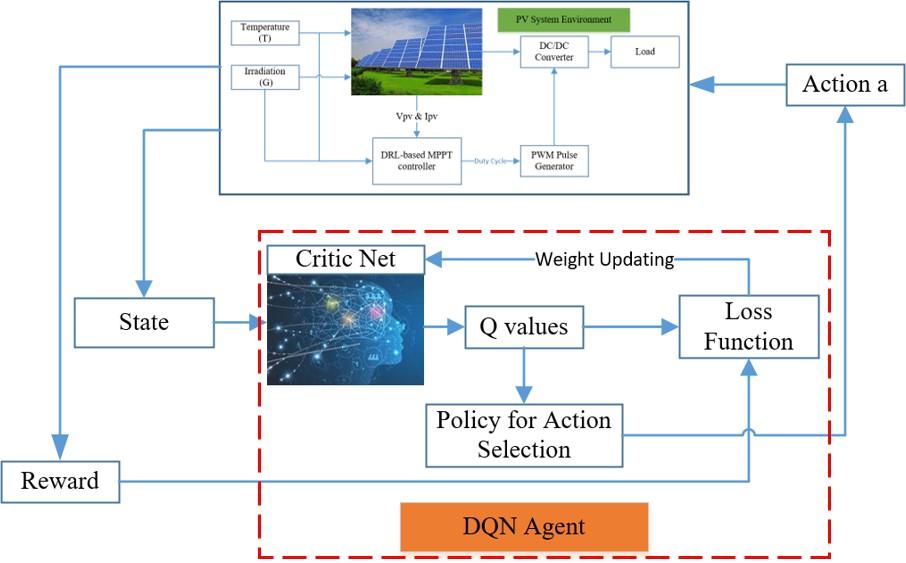
Every reinforcement learning problem can be described as a continuous interaction between an agent and its environment. In robotics, the agent is the robot itself or, more precisely, the software controller responsible for selecting actions.
At any moment, the robot observes the current state of the environment through its sensors. Depending on the application, this state may include camera images, LiDAR measurements, joint positions, velocities, force readings, GPS coordinates, or dozens of additional sensor inputs. The state provides the information the robot uses to determine its next action.
After observing the current state, the learning algorithm selects an action. This action might involve moving a robotic arm, rotating wheels, adjusting grip strength, changing flight direction, or applying torque to motors. Once the action is executed, the environment changes in response.
The robot then receives two important pieces of information. First, it observes a new state that reflects the consequences of its previous action. Second, it receives a numerical reward, which measures how beneficial the action was relative to the task objective.
This interaction repeats continuously throughout training. Over thousands or even millions of iterations, the robot gradually identifies which actions tend to produce higher long-term rewards.
Unlike supervised learning, reinforcement learning does not provide examples of correct behavior. Instead, the robot must infer successful strategies solely from experience.
| Characteristic | Supervised Learning | Reinforcement Learning |
| Training signal | Labeled examples | Reward signal |
| Objective | Predict correct output | Maximize cumulative reward |
| Learns from | Dataset | Interaction |
| Typical robotics use | Object detection, pose estimation | Navigation, locomotion, manipulation |
| Feedback time | Immediate | Often delayed |
States, Actions, Rewards, and Policies
Although reinforcement learning is often introduced through the concepts of states, actions, and rewards, these elements are only part of a broader mathematical framework.
The state space represents every situation the robot could potentially encounter. For a robotic manipulator, this may include joint angles, velocities, object positions, and camera observations. For an autonomous vehicle, the state might consist of road geometry, nearby traffic, vehicle speed, weather conditions, and sensor uncertainty.
The action space defines every possible control command available to the robot. In some systems, actions are discrete, such as choosing between moving left or right. Robotics more commonly involves continuous action spaces, where motor commands consist of real-valued torque, velocity, or position targets. Continuous control substantially increases learning complexity because the robot must determine not only which action is appropriate but also the precise magnitude of each control signal.
The reward function represents the designer’s objective. Rather than instructing the robot exactly how to perform a task, engineers assign numerical values to outcomes that reflect desirable behavior. Successfully grasping an object may produce a positive reward, while collisions, instability, or excessive energy consumption generate penalties.
The robot’s ultimate goal is not merely to maximize immediate rewards but to maximize cumulative future reward, commonly referred to as the expected return.
The strategy used by the robot to select actions is called its policy. During training, reinforcement learning algorithms continually improve this policy until it produces increasingly successful behavior across a wide range of situations.
The Markov Decision Process
Most reinforcement learning algorithms are built upon a mathematical model known as the Markov Decision Process (MDP).
An MDP describes sequential decision-making problems where future outcomes depend on the current state and selected action. Formally, it consists of a set of states, a set of actions, transition probabilities between states, a reward function, and a discount factor that determines how much future rewards influence current decisions.
The discount factor plays a particularly important role in robotics because many tasks require long-term planning. A robot navigating through a warehouse may temporarily move away from its destination in order to avoid congestion or obstacles. Although this decision sacrifices immediate progress, it ultimately produces a higher cumulative reward by reducing travel time.
This ability to optimize long-term performance distinguishes reinforcement learning from simpler optimization techniques that focus only on immediate outcomes.
Learning Through Exploration
One of the defining characteristics of reinforcement learning is exploration.
Initially, the robot possesses little or no knowledge about its environment. It therefore experiments with different actions, many of which are ineffective or even counterproductive. During this phase, failures are expected rather than avoided.
Consider a quadruped robot learning to walk. Early training often consists of unstable movements that cause repeated falls. Random motor commands produce awkward leg coordination, poor balance, and inefficient locomotion. Each unsuccessful attempt nevertheless contributes valuable information about which motor patterns should be avoided.
As training progresses, the robot gradually discovers partial solutions. Certain joint movements improve stability, while others increase forward velocity. Eventually, these individual improvements combine into coordinated walking behaviors that appear remarkably natural.
This iterative process depends on balancing exploration and exploitation. Exploration encourages the robot to test unfamiliar actions that may reveal better strategies, while exploitation favors actions already known to perform well. Excessive exploration leads to slow convergence, whereas excessive exploitation risks trapping the algorithm in locally optimal but globally suboptimal behaviors.
Modern reinforcement learning algorithms devote considerable attention to maintaining this balance throughout training.
Value Functions and Policy Optimization
Reinforcement learning algorithms generally improve behavior through one of two complementary approaches.
The first relies on value functions, which estimate how beneficial particular states or state-action pairs are expected to be over the long term. Algorithms such as Q-learning attempt to learn these estimates directly, allowing the robot to select actions associated with the highest predicted cumulative reward.
The second approach focuses on policy optimization, where the learning algorithm directly adjusts the parameters governing action selection. Rather than estimating future rewards for every possible action, policy optimization methods improve the decision-making policy itself.
Modern robotics increasingly favors policy optimization techniques because they naturally accommodate continuous control problems. Algorithms including Proximal Policy Optimization (PPO), Trust Region Policy Optimization (TRPO), and Soft Actor-Critic (SAC) have become widely used for robotic locomotion, manipulation, and navigation due to their stability and ability to learn complex motor behaviors.
Many state-of-the-art systems combine value estimation with policy optimization through actor-critic architectures, where one neural network proposes actions while another estimates their long-term value. This combination often accelerates learning while improving stability.
| Algorithm | Action Space | Common Robotics Applications |
| DQN | Discrete | Navigation, path planning |
| PPO | Continuous | Humanoid locomotion, manipulation |
| SAC | Continuous | Robotic arms, grasping |
| TD3 | Continuous | Precision control |
| A3C | Mixed | Distributed robotic learning |
Deep Reinforcement Learning
The recent success of reinforcement learning in robotics has been driven largely by advances in deep learning.
Traditional reinforcement learning struggled when robots received high-dimensional sensory inputs such as camera images. Representing every possible visual observation explicitly was computationally impossible.
Deep neural networks overcome this limitation by learning compact representations of complex sensory information.
Instead of manually extracting relevant features from images, modern robotic systems process raw pixels using convolutional neural networks, transformer architectures, or other deep learning models. These networks automatically identify meaningful visual patterns, allowing reinforcement learning algorithms to operate directly on rich sensory inputs.
The combination of reinforcement learning and deep neural networks is commonly known as deep reinforcement learning (DRL). This approach has enabled robots to solve tasks previously considered intractable, including dexterous object manipulation, agile locomotion, autonomous drone navigation, and coordinated multi-robot control.
Simulation as a Training Environment
Training reinforcement learning algorithms directly on physical robots presents significant practical challenges.
Learning often requires millions of interactions with the environment. Performing this process using real hardware would consume enormous amounts of time while exposing expensive robotic systems to constant wear and frequent collisions.
For this reason, most reinforcement learning in robotics begins within highly realistic physics simulators.
Simulation environments such as NVIDIA Isaac Sim/Isaac Lab, MuJoCo, Gazebo, PyBullet, and Webots reproduce rigid-body dynamics, friction, collisions, sensor noise, gravity, and actuator limitations with high accuracy. Modern GPU-accelerated platforms such as Isaac Lab can run large numbers of simulated robot environments in parallel, allowing learning algorithms to accumulate experience far faster than would be possible with physical robots.
After successful training, the learned policy is transferred from simulation to physical hardware using a process known as sim-to-real transfer.
Despite continual improvements in simulation accuracy, transferring learned behavior remains challenging because virtual environments can never perfectly replicate reality. Small discrepancies in friction coefficients, motor delays, or sensor calibration may substantially affect performance.
Researchers address this problem through techniques such as domain randomization, which intentionally varies simulation parameters during training. By exposing robots to diverse virtual conditions, learned policies become more robust when deployed in the real world.
Challenges in Reward Design
Although reinforcement learning appears conceptually simple, designing effective reward functions remains one of its most difficult aspects.
Poorly specified rewards frequently produce unintended behavior because reinforcement learning algorithms optimize precisely what is measured rather than what designers intended.
For example, a robotic arm rewarded solely for maximizing movement speed may begin throwing objects instead of placing them carefully. A warehouse robot rewarded only for minimizing travel distance might block other robots or ignore safety constraints.
This phenomenon, commonly referred to as reward hacking, illustrates that reinforcement learning systems possess no inherent understanding of human objectives. Their behavior depends entirely on the mathematical structure of the reward function.
Consequently, modern robotic systems often employ carefully engineered reward functions incorporating multiple objectives, including task completion, energy efficiency, safety, smooth motion, collision avoidance, and operational reliability.
Current Applications in Robotics
Reinforcement learning is now influencing numerous areas of robotics beyond academic research.
Industrial manipulation systems increasingly use RL to improve grasp planning and adaptive assembly operations involving objects whose positions cannot be predicted precisely.
Warehouse automation benefits from reinforcement learning by optimizing navigation, fleet coordination, and dynamic task allocation among autonomous mobile robots.
Legged robots have demonstrated particularly impressive progress. Machines capable of traversing rough terrain, climbing stairs, recovering from slips, and maintaining balance under external disturbances frequently rely on reinforcement learning controllers developed in simulation before deployment.
Medical robotics represents another promising application. Researchers are investigating reinforcement learning for robotic-assisted surgery, rehabilitation devices, adaptive prosthetics, and personalized therapeutic interventions that adjust to individual patient characteristics.
Agricultural robotics similarly benefits from reinforcement learning by enabling machines to navigate unstructured environments while optimizing harvesting strategies under varying environmental conditions.
Looking Ahead
Reinforcement learning remains an active area of research, and many challenges remain unresolved. Sample efficiency, safety during learning, robustness to changing environments, and reliable transfer between simulation and reality continue to receive significant attention from researchers worldwide.
Nevertheless, reinforcement learning has fundamentally altered the trajectory of robotics. Rather than relying exclusively on handcrafted rules, engineers increasingly design systems capable of acquiring sophisticated behaviors through interaction and experience.
As computational resources continue to expand and algorithms become more efficient, reinforcement learning is expected to play an even greater role in autonomous robotics. Future robots will likely learn new skills more rapidly, adapt continuously after deployment, and collaborate more naturally with humans in environments too complex for traditional programming alone.
The transition from explicitly programmed machines to robots that learn through experience represents one of the most significant shifts in the history of robotics. Reinforcement learning is not simply another algorithmic technique — it is a new framework for building intelligent systems capable of improving their performance over time, bringing autonomous robotics closer to functioning effectively in the complexity of the real world.
Continue Learning with WiredWhite
At WiredWhite, we believe that understanding robotics requires more than reading about algorithms — it requires applying them to real engineering problems. Reinforcement learning is just one piece of a much broader robotics ecosystem that includes control systems, embedded software, computer vision, simulation, and artificial intelligence.
Our learning platform is designed for engineering students, researchers, and professionals looking to build practical technical skills. Alongside self-paced courses, WiredWhite provides expert-led tutoring, webinars, technical articles, and engineering resources covering robotics, AI, MATLAB, Simulink, CAD, embedded systems, and other engineering disciplines.
Whether you’re taking your first steps into reinforcement learning or expanding your expertise in autonomous robotic systems, our goal is to help you bridge the gap between theory and real-world engineering practice through hands-on learning and guidance from experienced engineers.
Explore more engineering tutorials, AI learning resources, and robotics courses on WiredWhite to continue building your skills in modern intelligent systems.







Responses