AI Engineering Services: Machine Learning & Reinforcement Learning Solutions
We build machine learning and reinforcement learning solutions for robotics, industrial automation, autonomous systems, and intelligent control—combining AI with modeling and simulation for real-world engineering applications.
AI Solutions for Modern Engineering
Off-the-shelf ML models are typically designed for unconstrained software environments. When deployed to physical hardware, high-frequency sensor noise, thermal transients, and hard real-time latency requirements force a physics-bounded approach.
Engineering Capabilities:
- Machine Learning: Custom data pipelines for real-time state estimation: filtering high-frequency sensor noise and processing CAN bus logs directly at the edge layer.
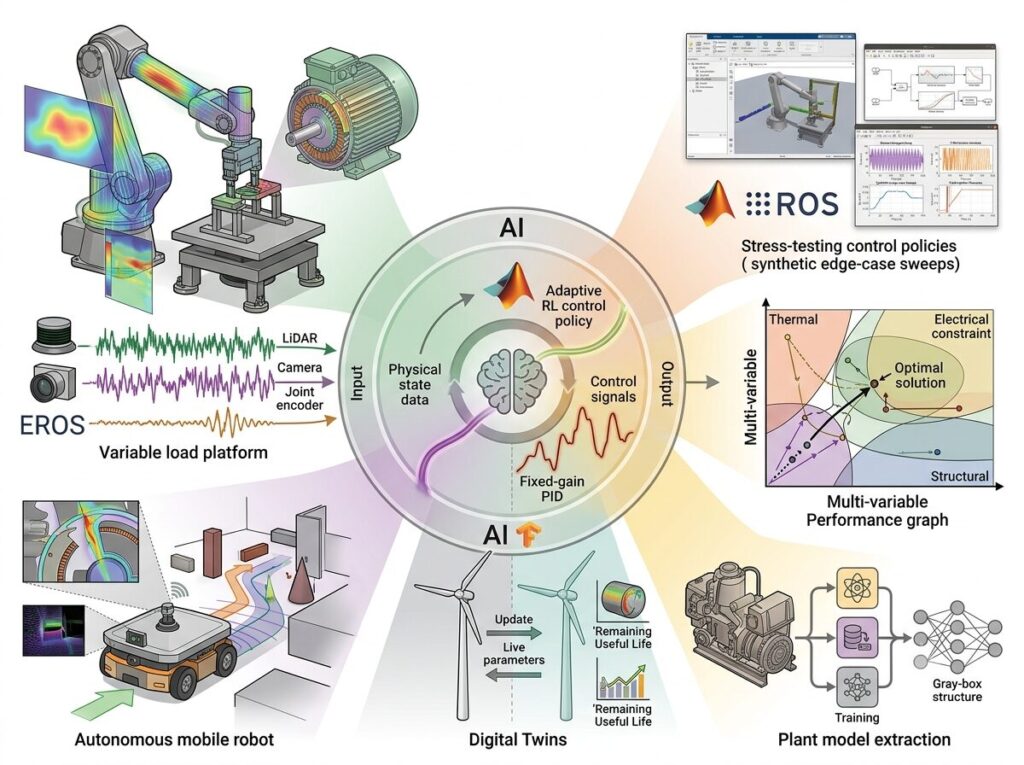
- Reinforcement Learning: Static PID controllers struggle with dynamic load shifts. We design adaptive control policies in continuous action spaces to keep multi-variable systems stable.
- AI Modeling & Simulation: Testing on hardware is expensive. We embed hybrid physics-ML models into Simulink, ROS, or PyBullet to run co-simulations before burning code onto target ICs.
- Predictive Analytics: We process vibration metrics (FFT analysis) and thermal telemetry to spot sub-surface component wear and calculate Remaining Useful Life (RUL).
- Computer Vision: Sub-millisecond defect detection, part alignment, and automated visual telemetry for high-speed assembly processes.
Artificial Intelligence for Engineering Applications
Traditional software uses fixed rules, and business AI mostly deals with text or image generation. Engineering AI works in a different domain entirely—combining classical control theory with physical hardware constraints.
Standart Business AI
- Unstructured text
- SaaS integration
- Soft Tolerances
- High Hallucination
Vs
WiredWhite Engineering AI
- High-Frequency Telemetry
- CAN Bus, Ethernet, ROS
- Physical Constraints (Temp, Bar)
- Hard Real-Time Requirements
A failed inference step in a motor drive or robotic manipulator isn’t a simple UI error. It means blown insulation, dynamic overload, or damaged hardware.
Key Frameworks We Deploy
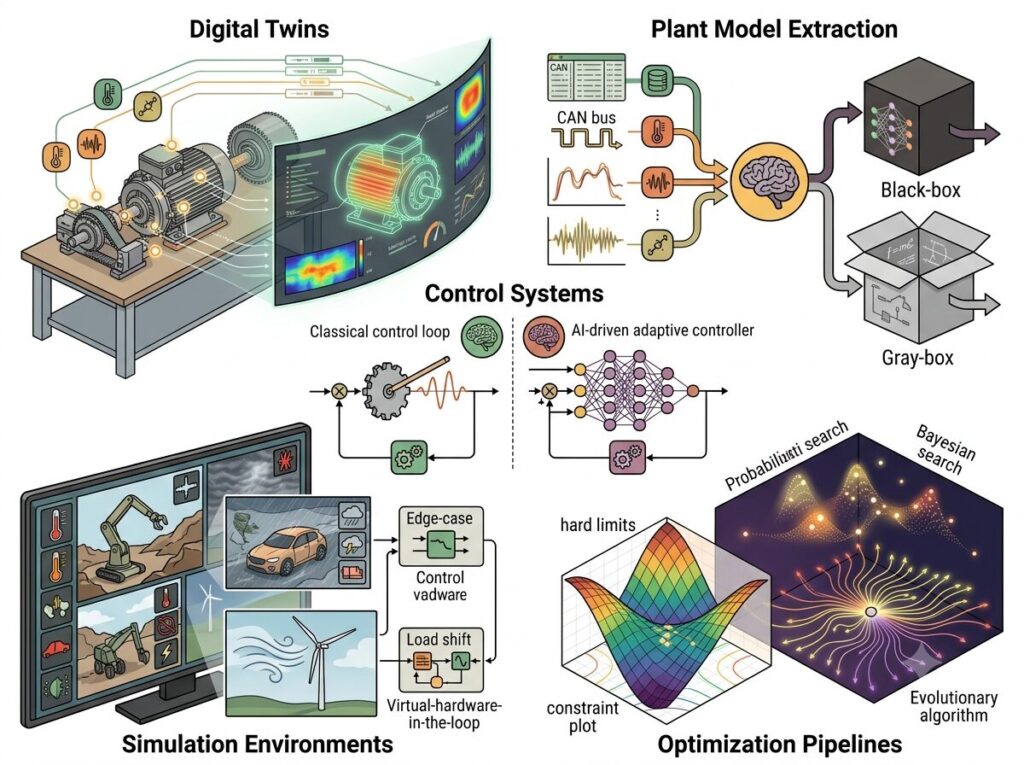
- Digital Twins: Combining live sensor feeds with hybrid physics-ML models to run real-time shadow simulations.
- Control Systems: Fixed-gain PID loops struggle when operating points shift. We build continuous RL policies that automatically compensate for non-linear load changes in real time.
- Simulation Environments: Bench testing on physical hardware is slow and expensive. Our pipeline stress-tests control policies through synthetic edge-case sweeps inside Simulink and ROS testbeds.
- Optimization Pipelines: We calibrate multi-variable plant parameters with Bayesian search and evolutionary algorithms, fitting performance curves inside hard thermal, electrical, and structural limits.
- Plant Model Extraction: We train black-box and gray-box behavioral models directly on raw operational datasets to skip hand-deriving complex system dynamics.
Machine Learning Solutions
Hardware datasets are messy. We run raw bus streams through cleanup pipelines so control algorithms receive clean, usable telemetry.
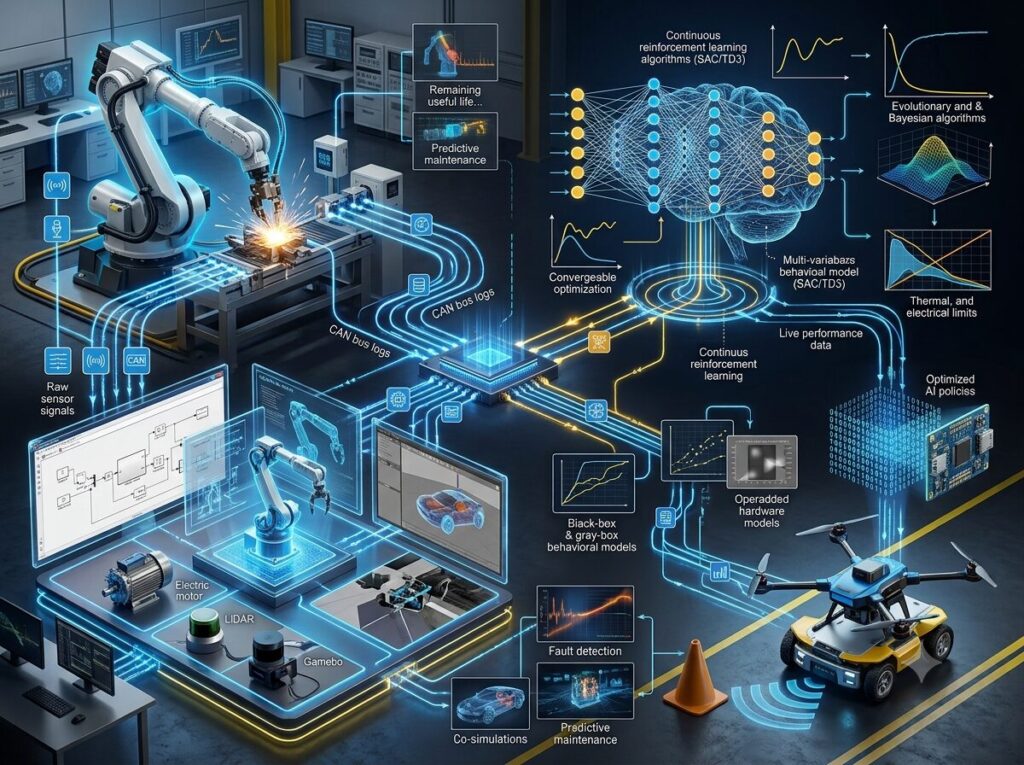
- Custom regression models that dynamically recalibrate as physical operating temperatures and loads shift.
- Edge filtering for dropped CAN bus packets, sensor drift, and invalid setpoint inputs.
- Short-horizon time-series forecasting designed for unpredictable, non-stationary duty cycles.
- Mechanical degradation tracking via vibration FFT logs, giving real-time Remaining Useful Life (RUL) numbers based on actual operating stress.
Reinforcement Learning Solutions
Reinforcement learning is our main focus. When classical control theory struggles with non-linear, multi-variable dynamics, RL solves the underlying math.
RL Implementation Pipeline
- Algorithms: SAC/TD3 (continuous torque control), PPO/DQN (discrete mode logic).
- Plant Simulation: Physics-matched simulation loops calibrated to target hardware update rates and delays.
- Observation Vector: Reduced state space filtered for primary physical observables.
- Safety: Hard-coded voltage, current, and thermal cutoffs.
- Optimization: Minimal tracking error, lower heat dissipation, reduced component wear.
- Deployment Validation: Sim-to-real domain randomization (resistance drift, inertia variance, bus jitter).
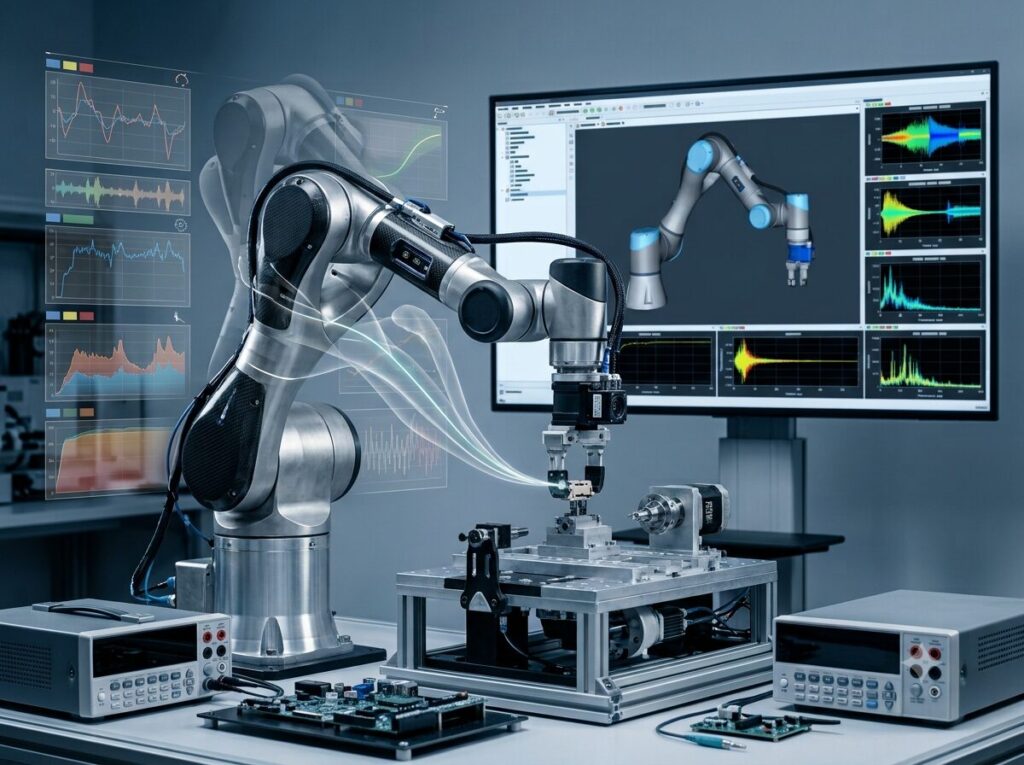
Accelerate your roadmap and avoid costly rework with proven engineering practices.
Engineering Applications
AI for Robotics
- Sim-to-real transfer for robotic manipulators and mobile platforms.
- Dynamic path planning with obstacle avoidance in tight workspaces.
- Sensor fusion across LiDAR, camera feeds, and IMU data.
AI for Electric Motors & Drives
- Electro-thermal state estimation for rotor and winding temp tracking under dynamic duty cycles.
- Suppressing torque ripple in PMSM/IPM drives via neural-assisted space vector modulation.
- Drive-train fault isolation: tracking phase imbalance, winding degradation, and bearing wear.
AI for Industrial Automation
- Real-time gain adjustment for non-linear process loops where fixed setpoints drift.
- Throughput optimization across variable-load production lines.
- Fault recovery logic for legacy manufacturing equipment.
AI for Autonomous Systems
- Reinforcement learning for Adaptive Cruise Control (ACC) and Lane Keeping Assist.
- Motion control policies tested against shifting surface friction and aerodynamic drag.
- Stress-testing controller stability under irregular operational inputs.
Energy & Storage Systems
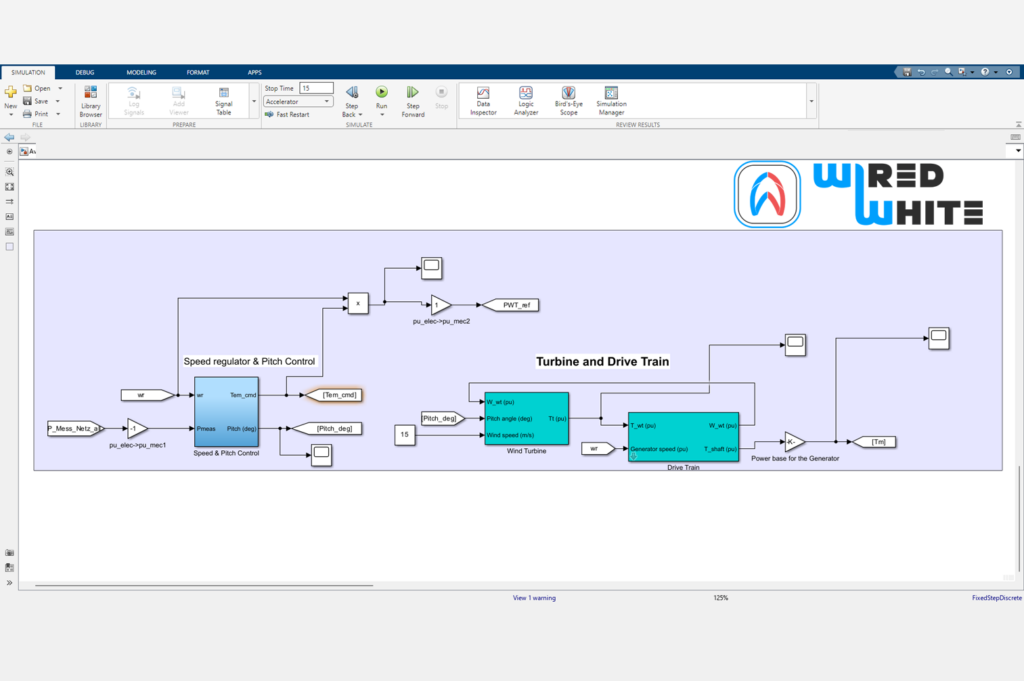
- Blade pitch control for turbulence and gust rejection.
- Grid load forecasting tied to BESS battery management.
- Multi-point cell telemetry for thermal runaway detection.
Our AI Development Process
1.
Parse raw telemetry logs to extract physical bounds, noise floors, and safety envelope limits.
2.
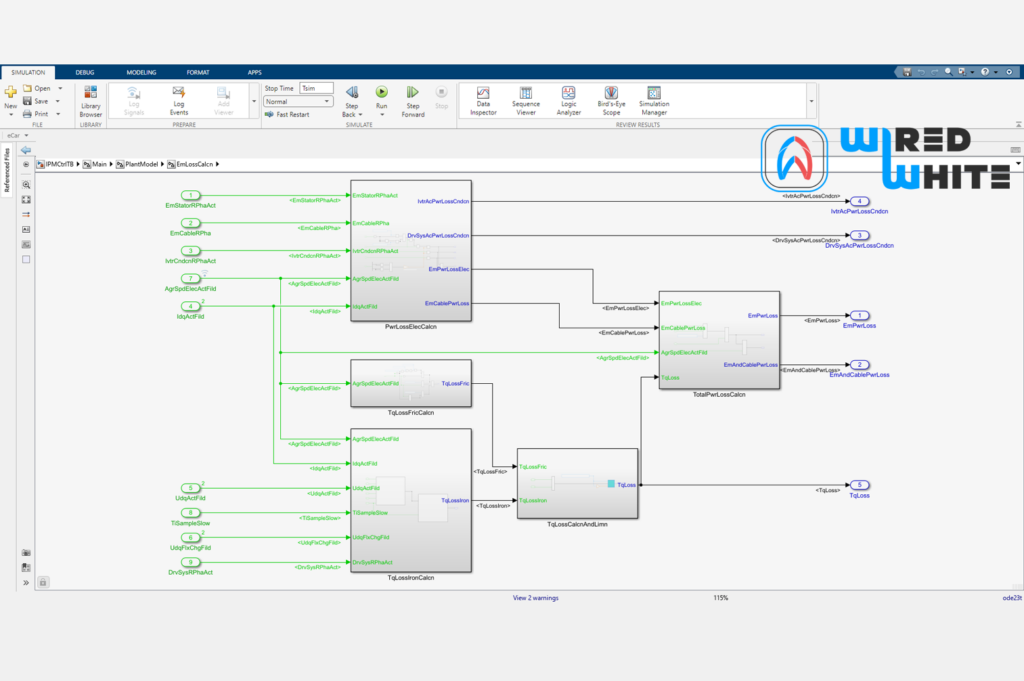
Build low-overhead physics environments in MATLAB/Simulink, ROS, or Python.
3.
Select baseline algorithms, balance multi-term reward functions, and run hyperparameter convergence sweeps.
4.
Stress-test trained policies on real HIL hardware testbeds using injected fault scenarios.
5.
Compile code directly into optimized C/C++, CUDA, or PLC binaries for Jetson, STM32, and industrial drives.
Technologies We Use
- Modeling & Control: MATLAB, Simulink, Simscape, ROS / ROS2, Gazebo.
- Core ML / RL Tools: PyTorch, RLlib, Stable-Baselines3, TensorFlow, Scikit-learn
- Vision & Edge Hardware Acceleration: TensorRT, CUDA, OpenCV, OpenVINO
- Embedded Deployment: C++, Embedded C, Micro-ROS, Python.
Why WiredWhite is the Perfect Engineering Partner for You
⏱ 15+ Years
industry experience
👨 1000+
networked engineering professionals
🔄 Integrated
project collaboration tools
✅ 100%
Proficient in advanced engineering tools
We Are Supporting Businesses, Executives, and Innovators Worldwide
Freelance Agencies
Teams of Engineers
Start-ups
Companies
Trusted by







- Free consultation call
- Contact form
Partner with Us for Your Artificial Intelligence Project
Speak directly with our experts to explore how we can help you with your AI and ML projects — with speed, precision, and full standards compliance.
Let’s move your ideas forward.
Explore All Our Business Services
We offer full-cycle engineering services ranging from small consulting projects to extensive R&D projects, where we support throughout the entire product development process.