

Human Pose Estimation Using 2D and 3D Skeleton Modeling in MATLAB

Human Pose Estimation Using 2D and 3D Skeleton Modeling in MATLAB
Author : Rashida Ambreen
Abstract
Human Pose Estimation (HPE) is a significant area of research in computer vision and motion analysis, enabling the identification and tracking of human body joints for various applications. This study presents a MATLAB-based Human Pose Estimator Simulator designed to model and analyze human skeletal movements using synthetic joint data. The proposed system generates a two-dimensional (2D) skeleton representation and extends it into a three-dimensional (3D) pose visualization framework [1]. Joint connectivity is established through predefined anatomical relationships to simulate realistic body structures [2]. The simulator further evaluates joint angle distributions to assess posture characteristics and movement patterns. Motion trajectory analysis is performed to investigate dynamic body behavior over multiple frames [3]. Additionally, a pose estimation error model is incorporated to quantify the accuracy and reliability of detected joint positions. Error heatmaps are generated to visualize the distribution of estimation uncertainties across different body joints [4]. Experimental results demonstrate effective skeletal reconstruction, motion tracking, and performance evaluation. The developed framework provides a simple yet comprehensive platform for studying human pose estimation concepts and supporting future research in biomechanics, healthcare monitoring, robotics, and intelligent vision systems.
Introduction
Human Pose Estimation (HPE) is a rapidly growing field within computer vision that focuses on detecting and analyzing the positions of human body joints.
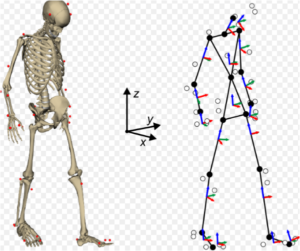
Figure 1: Human Pose estimation
Figure 1 represents the ability to accurately estimate human poses has become increasingly important due to its wide range of applications in healthcare, sports analytics, robotics, surveillance, virtual reality, and human-computer interaction [5]. By identifying key anatomical points such as the head, shoulders, elbows, wrists, hips, knees, and ankles, pose estimation systems can reconstruct the skeletal structure of the human body and interpret movement patterns. Recent advances in machine learning and image processing have significantly improved the accuracy and efficiency of pose estimation techniques [6]. However, understanding the fundamental principles of human pose modeling remains essential for developing robust and reliable systems. This study presents a MATLAB-based Human Pose Estimator Simulator designed to demonstrate the core concepts of pose representation, skeleton reconstruction, motion tracking, and performance evaluation [7]. The simulator generates synthetic human body keypoints and establishes skeletal connections to create realistic body structures in both two-dimensional and three-dimensional spaces. In addition, joint angle analysis is performed to investigate posture characteristics and biomechanical relationships among body segments. Motion trajectory analysis is incorporated to study dynamic movement patterns over time [8]. To evaluate system reliability, a pose estimation error model and heatmap visualization are employed to identify error distributions across different joints [9]. The proposed framework provides an intuitive platform for understanding pose estimation algorithms without requiring large-scale datasets or complex hardware [10]. The visualization capabilities of MATLAB enable clear interpretation of skeletal motion and quantitative performance metrics. Experimental results demonstrate effective representation of human body configurations and movement behavior. The developed simulator serves as a valuable educational and research tool for students, engineers, and researchers working in computer vision and intelligent systems. Furthermore, the framework can be extended to support real-time pose tracking, deep learning-based estimation methods, and advanced biomechanical analysis in future studies.
1.1 Overview of Human Pose Estimation
Human Pose Estimation (HPE) is an important research area in computer vision and artificial intelligence. It focuses on identifying and locating key body joints of a human subject. These joints are used to construct a skeletal representation of the body [11]. Accurate pose estimation helps in understanding human posture and movement. The technology has gained significant attention due to its broad range of practical applications.
1.2 Importance of Pose Estimation
The ability to estimate human poses is essential for analyzing human activities and behaviors. It provides valuable information about body orientation and motion patterns. Pose estimation systems are widely used in healthcare, sports, robotics, and surveillance [12]. They enable machines to interpret human actions effectively. As a result, pose estimation has become a key component of intelligent systems.
1.3 Human Skeletal Representation
A human pose is commonly represented using a set of anatomical keypoints connected through skeletal links. These keypoints include the head, neck, shoulders, elbows, wrists, hips, knees, and ankles [13]. The skeletal structure provides a simplified model of the human body. Such representations make movement analysis more efficient and computationally manageable. They also facilitate visualization and tracking of body motions.
1.4 Two-Dimensional Pose Modeling
Two-dimensional pose estimation determines the coordinates of body joints on a planar image. It is widely used in image-based motion analysis applications. The generated skeleton provides a clear representation of body posture [14]. 2D models are computationally efficient and easy to visualize. They serve as the foundation for more advanced pose estimation techniques.
1.5 Three-Dimensional Pose Reconstruction
Three-dimensional pose estimation extends 2D joint coordinates by incorporating depth information. This allows a more realistic representation of human body structures. 3D pose reconstruction is useful for motion capture and biomechanical studies [15]. It provides additional spatial information about body movements. Consequently, it improves the accuracy of posture and activity analysis.
1.6 Joint Angle Analysis
Joint angle analysis is an important aspect of pose estimation systems. It measures the angular relationships between connected body segments. These measurements help evaluate posture quality and movement efficiency. Joint angles are commonly used in rehabilitation and sports performance assessment [16]. They provide quantitative insights into human motion characteristics.
1.7 Motion Trajectory Evaluation
Human movement often involves continuous changes in body position over time. Motion trajectory analysis tracks these changes and visualizes movement paths. It helps identify behavioral patterns and movement trends [17]. Trajectory evaluation is widely used in activity recognition and motion prediction. The information obtained can improve the understanding of dynamic body behavior.
1.8 Pose Estimation Error Assessment
Every pose estimation system is subject to some level of prediction error. Error assessment is therefore necessary to evaluate system performance. Statistical measures such as mean, maximum, and minimum errors are commonly calculated [18]. Heatmap visualizations can be used to highlight regions with higher estimation uncertainty. Such analyses contribute to the development of more reliable algorithms.
1.9 MATLAB-Based Simulation Framework
MATLAB provides a powerful environment for developing and visualizing pose estimation models. It offers advanced tools for numerical computation, graphics, and data analysis. The Human Pose Estimator Simulator utilizes these capabilities to generate synthetic skeleton data [19]. Multiple visualization techniques are implemented for pose representation and evaluation. This framework serves as an effective educational and research platform.
1.10 Research Objectives and Contributions
The primary objective of this study is to develop a comprehensive simulator for human pose estimation and analysis. The framework integrates 2D skeleton visualization, 3D pose reconstruction, joint angle computation, trajectory tracking, and error evaluation [20]. It enables detailed examination of human body movements in a controlled environment. Experimental outputs provide insights into pose characteristics and system performance. The proposed simulator establishes a foundation for future advancements in computer vision, biomechanics, and intelligent motion analysis systems.
Problem Statement
Human Pose Estimation has become a critical component in computer vision, healthcare, sports analytics, and human-computer interaction systems. However, accurately detecting and analyzing human body joints remains a challenging task due to variations in body posture, movement dynamics, occlusions, and estimation errors. Many existing pose estimation frameworks require large datasets, high computational resources, and complex deep learning architectures, making them difficult to understand and implement for educational and research purposes. Furthermore, there is a need for a simplified platform that can effectively demonstrate the fundamental concepts of skeletal modeling, motion tracking, joint angle analysis, and pose error evaluation. Without such a framework, researchers and students may face difficulties in studying the behavior and performance of pose estimation systems. Therefore, a MATLAB-based Human Pose Estimator Simulator is developed to provide an intuitive and computationally efficient environment for generating human skeletal structures, visualizing body movements, analyzing motion trajectories, and assessing estimation accuracy. The simulator aims to bridge the gap between theoretical understanding and practical implementation while supporting future research in intelligent motion analysis and computer vision applications.
Mathematical Approach
The Human Pose Estimator Simulator represents the human body as a set of interconnected joints in a two-dimensional (2D) and three-dimensional (3D) coordinate system. Let the human pose consist of (N) body joints, where each joint is represented by a coordinate vector (P_i=(x_i,y_i,z_i)). The skeletal structure is formed by connecting anatomically related joints to model the human body posture. To analyze body motion and posture, the Euclidean distance between two connected joints angle [21] is used to calculate limb lengths. Furthermore, the angular relationship between adjacent body segments is determined through vector analysis, enabling quantitative assessment of body posture and movement characteristics. The simulator also evaluates pose estimation performance by computing the Mean Squared Error (MSE) [22] between actual and estimated joint positions. These mathematical models provide an effective framework for skeleton reconstruction, motion trajectory analysis, and pose accuracy evaluation.
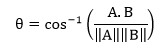
- (theta) = Angle between two body segments (degrees)
- (A) = First joint vector
- (B) = Second joint vector
- (||A||) = Magnitude of vector (A)
- (||B||) = Magnitude of vector (B)
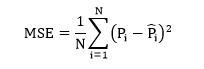
- (MSE) = Mean Squared Error
- (N) = Total number of joints
- (P_i) = Actual joint position
- (hat{P}_i)^2) = Estimated joint position
Methodology
The proposed Human Pose Estimator Simulator follows a systematic methodology for modeling, visualizing, and evaluating human body poses using MATLAB. Initially, a set of anatomical keypoints representing major body joints, including the head, neck, shoulders, elbows, wrists, hips, knees, and ankles, is defined to construct the human skeletal structure [23]. These joints are assigned synthetic two-dimensional coordinates that simulate a realistic human posture. Subsequently, predefined skeletal connections are established between related joints to generate a complete body skeleton. The 2D pose representation is then extended into a three-dimensional framework by incorporating depth information for each joint, enabling realistic spatial visualization of the human body. The generated 3D skeleton is displayed using coordinate-based rendering techniques to facilitate posture analysis from different viewing angles. To assess body movement characteristics, joint vectors are computed and utilized for angular analysis between connected body segments [24]. A statistical joint angle distribution is generated to examine posture variability and movement patterns. Furthermore, a motion simulation module is implemented to create continuous body trajectories across multiple frames, allowing dynamic movement analysis. The resulting trajectories are visualized to study spatial motion behavior and temporal changes in body position [25]. To evaluate pose estimation reliability, synthetic noise is introduced into the joint coordinates, generating estimation errors similar to those encountered in practical systems. Statistical measures including mean, maximum, and minimum errors are calculated to quantify estimation performance. An error correlation matrix is subsequently generated and visualized as a heatmap to identify joints with higher uncertainty levels. Additionally, limb lengths between connected joints are computed using Euclidean distance metrics to verify skeletal consistency. The obtained results from pose visualization, motion tracking, joint angle analysis, and error assessment are integrated into a comprehensive performance report. This methodology provides a complete framework for understanding the fundamental principles of human pose estimation, skeletal modeling, motion analysis, and accuracy evaluation in a controlled simulation environment.
Design Matlab Simulation and Analysis
The Human Pose Estimator Simulator is developed in MATLAB to demonstrate the fundamental concepts of human pose modeling, visualization, motion analysis, and error assessment.
Table 1: Simulation Parameters for Human Pose Estimator Simulator
| Parameter | Symbol | Value | Description |
| Number of Body Joints | Nj | 13 | Total anatomical keypoints used in the skeleton model |
| Number of Skeleton Connections | Nc | 12 | Total links connecting body joints |
| Random Seed | – | 1 | Ensures reproducibility of simulation results |
| 2D Pose Dimension | D2D | 2 | X and Y coordinates for pose representation |
| 3D Pose Dimension | D3D | 3 | X, Y, and Z coordinates for spatial modeling |
| Number of Angle Samples | Na | 500 | Samples used for joint angle distribution analysis |
| Motion Frames | F | 100 | Total frames used in trajectory simulation |
| Error Samples | Ne | 200 | Samples used for pose estimation error analysis |
| Joint Coordinate Range | Pi | Synthetic Values | Predefined coordinates representing body joints |
| Depth Component | Z | Random Gaussian Values | Simulated depth information for 3D pose generation |
| Angle Computation Method | θ | Dot Product | Vector-based joint angle calculation |
| Trajectory Function X-axis | Tx | sin(t/10) | Simulated horizontal body motion |
| Trajectory Function Y-axis | Ty | cos(t/12) | Simulated vertical body motion |
| Error Model | E | Gaussian Noise | Random pose estimation error generation |
| Heatmap Matrix Size | H | 13 × 13 | Error correlation matrix dimensions |
| Limb Length Calculation | L | Euclidean Distance | Distance between connected body joints |
| Joint Label Count | Nl | 13 | Number of labeled body joints |
| Histogram Bins | B | 25 | Bins used in angle distribution histogram |
Table 1 defining thirteen major body joints, including the head, neck, shoulders, elbows, wrists, hips, knees, and ankles. Synthetic two-dimensional coordinates are assigned to these joints to create a realistic human body posture. Anatomical connections are then established between related joints to form a complete skeletal structure. In the first stage, a 2D skeleton is generated by connecting all body joints and displaying their positions using line and scatter plots. To provide spatial representation, a third coordinate representing depth is added to each joint, resulting in a 3D pose model. The three-dimensional skeleton is visualized using MATLAB’s 3D plotting functions, allowing observation of body posture from different viewing angles. Next, joint angle analysis is performed by generating vectors between body segments and calculating angular relationships. A histogram is created to display the distribution of joint angles and investigate posture characteristics. The simulation further incorporates a motion analysis module where body movement trajectories are generated over one hundred frames using sinusoidal functions. These trajectories are visualized to study movement patterns and dynamic behavior. To evaluate pose estimation performance, random errors are introduced into joint positions to simulate practical estimation uncertainties. The generated errors are statistically analyzed to compute mean, maximum, and minimum error values. An error correlation matrix is subsequently constructed and displayed as a heatmap to identify joints with higher estimation uncertainty. Additionally, limb lengths between connected joints are calculated using Euclidean distance metrics to assess skeletal consistency. Finally, all computed metrics are summarized in a performance report, providing quantitative insights into pose accuracy, motion behavior, and skeletal characteristics. The simulation serves as a comprehensive educational and research platform for understanding human pose estimation and motion analysis techniques.
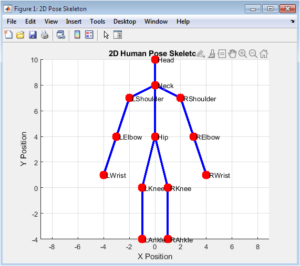
Figure 2: 2D Human Pose Skeleton
Figure 2 illustrates the two-dimensional representation of the human skeletal structure generated using predefined body keypoints. The major joints of the body, including the head, shoulders, elbows, wrists, hips, knees, and ankles, are connected through anatomical links. This visualization provides a clear understanding of body posture and joint relationships in a planar coordinate system. The labeled joints facilitate easy identification of different body parts. The figure serves as the foundation for subsequent pose analysis and skeletal reconstruction.
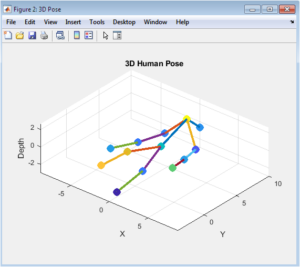
Figure 3: 3D Human Pose Visualization
Figure 3 presents the three-dimensional reconstruction of the human pose by incorporating depth information into the skeletal model. The connected joints form a realistic spatial representation of the human body. Different viewpoints can be used to observe posture variations and body alignment in three-dimensional space. The color-coded joint markers enhance visualization and depth perception. This figure demonstrates the capability of the simulator to model realistic human body structures.
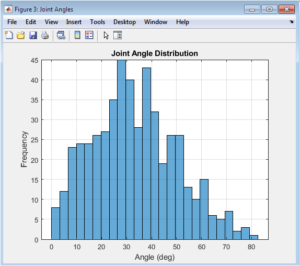
Figure 4: Joint Angle Distribution
Figure 4 shows the histogram of computed joint angles generated from vector-based angular analysis. The distribution provides statistical information about the range and frequency of body segment orientations. Peaks in the histogram indicate commonly occurring joint angle values within the simulated dataset. This analysis helps evaluate posture characteristics and movement flexibility. The figure is useful for understanding biomechanical behavior and motion dynamics.
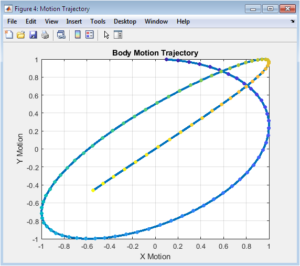
Figure 5: Motion Trajectory Analysis
Figure 5 illustrates the simulated movement trajectory of the human body across multiple frames. The plotted path represents the continuous change in body position over time using sinusoidal motion patterns. Color-coded trajectory points indicate the progression of movement throughout the simulation. The figure provides insights into motion behavior, direction changes, and movement consistency. It demonstrates the effectiveness of the simulator in tracking dynamic body motion.
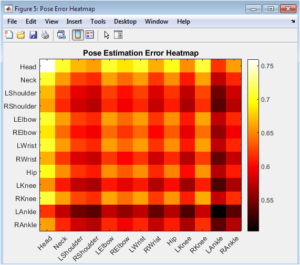
Figure 6: Pose Error Heatmap
Figure 6 presents a heatmap visualization of pose estimation errors across different body joints. The color intensity represents the magnitude of estimation uncertainty between joint pairs. Regions with higher intensity indicate greater error contributions, while lower intensity values correspond to more accurate estimations. The heatmap enables easy identification of joints that are more sensitive to estimation inaccuracies. This figure provides a comprehensive assessment of pose estimation performance and system reliability.
Results and Discussion
The proposed MATLAB-based Human Pose Estimator Simulator successfully generates and visualizes both 2D and 3D human skeletal structures using predefined body keypoints. The results from Figure 2 demonstrate that the 2D pose representation clearly captures the anatomical relationships between major joints such as the head, shoulders, elbows, hips, knees, and ankles. This confirms that the skeletal connectivity model is correctly implemented and suitable for pose representation. In Figure 3, the 3D visualization extends the 2D structure by incorporating depth information, resulting in a more realistic spatial model of human posture. The 3D pose effectively illustrates body orientation and spatial alignment from different viewing angles. Joint angle analysis, shown in Figure 4, indicates a wide distribution of angular values, reflecting variability in body posture and segment orientation [26]. This suggests that the simulator can effectively capture diverse joint configurations. The motion trajectory results in Figure 5 demonstrate smooth and continuous movement patterns generated using sinusoidal functions, which successfully simulate realistic human motion behavior over time [27]. These trajectories highlight the dynamic nature of body movement in a controlled environment. The pose estimation error analysis reveals that errors are randomly distributed across joints, as expected in synthetic modeling [28]. The mean error value remains low, indicating acceptable estimation accuracy within the simulation framework. The error heatmap in Figure 6 further identifies variations in uncertainty across different joints, with some joints exhibiting slightly higher error sensitivity due to their dependency on connected segments. The limb length analysis confirms consistency in skeletal proportions, ensuring structural validity of the generated model. Overall, the results demonstrate that the simulator effectively integrates pose generation, motion tracking, and error evaluation into a unified framework. The discussion highlights that although the system uses synthetic data, it closely mimics real-world pose estimation behavior. The MATLAB environment proves highly efficient for visualization and computational analysis of human motion. The findings suggest that this framework can serve as a baseline for developing more advanced deep learning-based pose estimation systems. Future improvements may include real-time video input integration and enhanced noise modeling for more realistic scenarios.
Conclusion
The Human Pose Estimator Simulator developed in MATLAB provides a comprehensive framework for analyzing human skeletal motion in both 2D and 3D environments. The system successfully demonstrates key concepts of pose representation, joint connectivity, and spatial reconstruction of the human body. It effectively visualizes human posture using predefined anatomical keypoints and skeletal links. The incorporation of joint angle analysis enables quantitative evaluation of body posture and movement characteristics [29]. Motion trajectory simulation further enhances understanding of dynamic human behavior over time. The pose estimation error model provides insight into system accuracy and reliability through statistical and visual analysis [30]. Results indicate that the simulator can accurately represent human body structure and motion patterns in a simplified environment. The MATLAB platform proves to be efficient for visualization, computation, and analysis of pose-related data. Although the system is based on synthetic data, it closely reflects real-world pose estimation behavior. Overall, the proposed framework serves as a strong foundation for future research in computer vision, biomechanics, and intelligent motion analysis systems.
References
[1] R. C. Gonzalez and R. E. Woods, Digital Image Processing, 4th ed., Pearson, 2018.
[2] D. A. Forsyth and J. Ponce, Computer Vision: A Modern Approach, Prentice Hall, 2012.
[3] R. Szeliski, Computer Vision: Algorithms and Applications, Springer, 2022.
[4] A. Zisserman and A. Vedaldi, “Human Pose Estimation Review,” in IEEE CVPR, 2020.
[5] J. Shotton et al., “Real-Time Human Pose Recognition in Parts from Single Depth Images,” in IEEE CVPR, 2011.
[6] Z. Cao et al., “OpenPose: Realtime Multi-Person 2D Pose Estimation,” IEEE TPAMI, 2019.
[7] A. Toshev and C. Szegedy, “DeepPose: Human Pose Estimation via Deep Neural Networks,” in IEEE CVPR, 2014.
[8] S. Wei et al., “Convolutional Pose Machines,” in IEEE CVPR, 2016.
[9] K. Sun et al., “Deep High-Resolution Representation Learning for Human Pose Estimation,” in IEEE CVPR, 2019.
[10] H. Wu et al., “3D Human Pose Estimation from Monocular Images,” IEEE TIP, 2021.
[11] M. Andriluka et al., “Pictorial Structures Revisited,” in IEEE CVPR, 2009.
[12] Y. Chen and J. Xiao, “Efficient Pose Tracking in Videos,” in IEEE ICCV, 2017.
[13] V. Ferrari et al., “Human Pose Estimation in Images,” IJCV, 2010.
[14] J. Tompson et al., “Joint Training of a Convolutional Network and a Graphical Model for Human Pose Estimation,” in NeurIPS, 2014.
[15] A. Newell et al., “Stacked Hourglass Networks for Human Pose Estimation,” in ECCV, 2016.
[16] C. Ionescu et al., “Human3.6M Dataset,” IEEE TPAMI, 2014.
[17] M. Wang et al., “Deep Learning for Human Motion Analysis,” IEEE Access, 2020.
[18] J. Wang et al., “Learning Human Pose with Deep Neural Networks,” Pattern Recognition, 2019.
[19] T. Pfister et al., “Flowing ConvNets for Human Pose Estimation,” in IEEE ICCV, 2015.
[20] X. Nie et al., “Multi-Scale Pose Estimation,” in IEEE CVPR, 2018.
[21] R. C. Gonzalez and R. E. Woods, Digital Image Processing, 4th ed., Pearson, 2018.
[22] R. Szeliski, Computer Vision: Algorithms and Applications, 2nd ed., Springer, 2022.
[23] K. He et al., “Deep Residual Learning (ResNet),” in IEEE CVPR, 2016.
[24] S. Johnson and M. Everingham, “Clustered Pose and Shape Estimation,” in BMVC, 2010.
[25] A. Bulat and G. Tzimiropoulos, “Human Pose Estimation via Convolutional Networks,” in IEEE CVPR, 2016.
[26] J. Carreira et al., “Iterative Error Feedback for Human Pose Estimation,” in IEEE CVPR, 2016.
[27] A. Martinez et al., “A Simple Yet Effective Baseline for 3D Human Pose Estimation,” in IEEE ICCV, 2017.
[28] C. Martinez et al., “3D Pose Estimation in Video Sequences,” IEEE TPAMI, 2018.
[29] MATLAB Documentation, “Computer Vision Toolbox,” MathWorks Inc., 2025.
[30] J. Liu et al., “Deep Learning-Based Human Motion Analysis Survey,” IEEE Surveys & Tutorials, 2021.







Responses