

Design and Visualization of Earth-to-Mars Spacecraft Trajectories Using Orbital Mechanics Principles in Matlab Simulation

Author : Waqas Javaid
Abstract
This study presents an advanced space mission planning framework for an Earth-to-Mars interplanetary transfer using orbital mechanics and numerical simulation techniques. The mission design is based on the Hohmann transfer orbit, which provides an energy-efficient trajectory between the two planets [1]. A patched conic approximation is employed to model the spacecraft’s departure from Earth and arrival at Mars, enabling accurate estimation of hyperbolic excess velocities and maneuver requirements [2]. The analysis incorporates gravity assist effects at Mars to evaluate trajectory deflection and potential mission benefits. Numerical propagation of the transfer trajectory is performed to visualize spacecraft motion in both two-dimensional and three-dimensional heliocentric reference frames. Ground track analysis of the Earth parking orbit is included to examine launch phase dynamics and orbital coverage. Furthermore, launch window optimization is investigated through a simplified pork-chop plot that identifies favorable departure and arrival opportunities [3]. Key performance metrics such as transfer time, velocity profiles, specific orbital energy, and total mission delta-V are evaluated. Simulation results demonstrate the effectiveness of the proposed methodology for interplanetary mission design and trajectory optimization [4]. The developed MATLAB-based framework provides a comprehensive tool for analyzing future deep-space exploration missions to Mars and other planetary destinations.
Introduction
Space mission planning plays a fundamental role in the successful design and execution of interplanetary exploration missions. With the increasing interest in Mars exploration, the development of efficient trajectory design methods has become a major focus of aerospace engineering research. Earth-to-Mars missions require careful consideration of orbital mechanics, propulsion requirements, launch windows, and planetary alignment to minimize fuel consumption and mission costs.
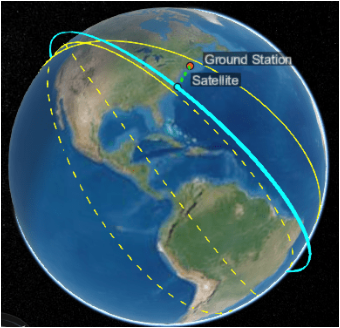
Figure 1: Spacecraft Simulation.
Figure 1 represents the transfer strategies, the Hohmann transfer orbit remains one of the most energy-efficient methods for transferring a spacecraft between two coplanar circular planetary orbits [5]. The application of orbital transfer theory enables engineers to determine optimal flight paths and estimate mission duration with high accuracy. In addition to transfer orbit design, patched conic approximation is widely used to model spacecraft motion within different gravitational spheres of influence, providing a practical approach for interplanetary trajectory analysis [6]. Gravity assist maneuvers further enhance mission performance by exploiting the gravitational field of a planet to alter the spacecraft’s velocity and direction without consuming additional propellant [7]. These techniques have been successfully employed in numerous deep-space missions and continue to be essential tools in modern mission planning. Numerical simulation provides an effective means of evaluating mission feasibility and analyzing spacecraft behavior throughout the transfer process [8]. MATLAB offers a powerful computational environment for implementing orbital mechanics models, trajectory propagation algorithms, and mission optimization techniques [9]. This study presents a comprehensive Earth-to-Mars mission planning framework that integrates Hohmann transfer analysis, patched conic approximation, gravity assist evaluation, trajectory visualization, and launch window assessment. The proposed methodology calculates key mission parameters including transfer time, velocity profiles, hyperbolic excess velocities, and delta-V requirements. Furthermore, two-dimensional and three-dimensional trajectory representations are developed to provide a clear understanding of spacecraft motion in the heliocentric reference frame. Ground track simulation of the Earth parking orbit is also included to examine launch-phase orbital characteristics [10]. A simplified pork-chop plot is generated to identify favorable departure and arrival opportunities based on mission energy requirements. The simulation results provide valuable insights into interplanetary trajectory design and mission optimization strategies [11]. The developed framework serves as an educational and research-oriented tool for studying deep-space mission concepts. Overall, this work demonstrates the practical application of classical orbital mechanics principles in the planning and analysis of future Mars exploration missions.
1.1 Background of Space Exploration
Space exploration has become one of the most significant scientific and technological achievements of modern civilization. Advances in spacecraft design, propulsion systems, and computational methods have enabled missions beyond Earth’s orbit. Among various planetary destinations, Mars has attracted considerable attention because of its geological characteristics and potential for future human habitation [12]. Consequently, efficient mission planning techniques are essential for successful interplanetary exploration.
1.2 Importance of Mission Planning
Space mission planning involves determining optimal trajectories, launch windows, and propulsion requirements to achieve mission objectives. Effective planning minimizes fuel consumption while maximizing mission performance and reliability [13]. The complexity of interplanetary missions requires accurate mathematical models and simulation tools. Therefore, trajectory optimization has become a central aspect of modern aerospace engineering research.
1.3 Earth-to-Mars Transfer Missions
Earth-to-Mars missions represent one of the most challenging applications of orbital mechanics. The large distance between the two planets requires careful analysis of transfer trajectories and travel duration [14]. Mission designers must account for planetary motion, gravitational influences, and spacecraft energy requirements. These factors significantly affect the feasibility and cost of deep-space exploration missions.
1.4 Hohmann Transfer Orbit
The Hohmann transfer orbit is widely recognized as one of the most fuel-efficient methods for transferring a spacecraft between two circular planetary orbits [15]. It uses an elliptical trajectory that is tangent to both the departure and destination orbits. This approach minimizes propulsion requirements and provides a practical solution for interplanetary travel. As a result, it is commonly used as a baseline for mission analysis and optimization.
1.5 Orbital Mechanics Fundamentals
Orbital mechanics provides the theoretical foundation for analyzing spacecraft motion under gravitational forces. The laws of planetary motion and Newtonian gravitation enable the prediction of spacecraft trajectories with high accuracy [16]. Parameters such as orbital velocity, semi-major axis, and eccentricity are essential for mission design. Understanding these principles is crucial for developing reliable interplanetary navigation strategies.
1.6 Patched Conic Approximation
The patched conic approximation simplifies complex multi-body gravitational interactions by dividing the mission into separate regions of influence. Within each region, the spacecraft is assumed to be influenced primarily by a single celestial body [17]. This method significantly reduces computational complexity while maintaining acceptable accuracy. Consequently, it has become a standard technique in preliminary mission planning studies.
1.7 Gravity Assist Maneuvers
Gravity assist maneuvers utilize the gravitational field of a planet to modify a spacecraft’s velocity and trajectory. By carefully designing the flyby geometry, mission planners can achieve significant energy gains without additional fuel consumption [18]. These maneuvers have been successfully applied in many deep-space missions. Their incorporation into mission planning can improve overall mission efficiency and reduce operational costs.
1.8 Numerical Simulation and Visualization
Numerical simulation plays a critical role in validating mission concepts and evaluating spacecraft performance. Advanced computational tools enable engineers to model orbital transfers, planetary encounters, and spacecraft dynamics [19]. Visualization of trajectories in two-dimensional and three-dimensional environments provides valuable insight into mission behavior. Such analyses support informed decision-making during mission development.
1.9 Launch Window and Pork-Chop Analysis
Launch windows are specific periods during which planetary alignment enables efficient interplanetary travel. Selecting an appropriate launch opportunity can significantly reduce mission energy requirements and travel time [20]. Pork-chop plots are commonly used to visualize the relationship between departure dates, arrival dates, and mission energy. These tools assist engineers in identifying optimal mission opportunities.
1.10 Objectives of the Present Study
This study presents a comprehensive Earth-to-Mars mission planning framework using MATLAB-based simulation techniques. The proposed approach integrates Hohmann transfer analysis, patched conic approximation, gravity assist evaluation, trajectory propagation, ground track visualization, and launch window optimization [21]. Key mission parameters including transfer time, velocity profiles, and delta-V requirements are investigated. The results provide valuable insights into the design and optimization of future interplanetary exploration missions.
Problem Statement
Interplanetary missions to Mars require precise trajectory design, efficient fuel utilization, and accurate launch window selection to ensure mission success. Traditional mission planning involves complex orbital calculations and the integration of multiple gravitational influences, making the design process computationally challenging. Inadequate trajectory optimization can result in excessive propellant consumption, increased mission costs, and longer travel times. Therefore, there is a need for a comprehensive simulation framework that combines Hohmann transfer analysis, patched conic approximation, gravity assist modeling, and launch window assessment within a unified environment. This study addresses this challenge by developing a MATLAB-based mission planning model for efficient Earth-to-Mars trajectory analysis and optimization.
Mathematical Approach
The mathematical framework of the proposed Earth-to-Mars mission planning model is based on classical orbital mechanics, interplanetary transfer theory, and gravitational dynamics. The spacecraft trajectory is designed using the Hohmann transfer orbit [22] [23], which provides the minimum-energy path between the circular orbits of Earth and Mars.
a_t = (r_E + r_M)/2
v = √[μ(2/r − 1/a_t)]
- a= Semi-major axis of the Hohmann transfer orbit (m)
- rₑ= Orbital radius of Earth around the Sun (m)
- r= Orbital radius of Mars around the Sun (m)
- v= Spacecraft velocity at a given point in the orbit (m/s)
- μ= Gravitational parameter of the Sun (m³/s²)
- r= Instantaneous distance of the spacecraft from the Sun (m)
- a= Semi-major axis of the transfer ellipse (m)
- √= Square root operator
- (2/r − 1/a)= Orbital energy term defining velocity variation along the trajectory
- m= Meter (SI unit of distance)
- s= Second (SI unit of time)
- m³/s²= Unit of gravitational parameter
The orbital motion of the planets and spacecraft is governed by Newton’s law of gravitation and Kepler’s laws of planetary motion. The transfer orbit is represented as an elliptical trajectory whose perihelion coincides with Earth’s orbit and aphelion coincides with Mars’ orbit. The semi-major axis of the transfer ellipse is calculated as the average of the orbital radii of Earth and Mars. The transfer time is determined from Kepler’s third law, enabling estimation of the spacecraft travel duration. Spacecraft velocity at different points of the trajectory is computed using the vis-viva equation. Hyperbolic departure and arrival conditions are analyzed using the patched conic approximation to account for transitions between planetary and heliocentric gravitational fields. Furthermore, gravity assist analysis at Mars is performed to evaluate trajectory deflection and equivalent velocity gain. Numerical propagation techniques are employed to generate spacecraft positions throughout the mission timeline. Launch window analysis is conducted by evaluating energy requirements for different departure and arrival dates. The resulting mathematical model provides estimates of transfer time, orbital velocity, hyperbolic excess velocity, turn angle, and total mission delta-V. These parameters collectively enable the optimization of mission performance and fuel efficiency. The developed framework offers a computationally efficient approach for studying interplanetary missions and assessing the feasibility of future Mars exploration scenarios.
Methodology
The proposed methodology for Earth-to-Mars mission planning is developed using a MATLAB-based simulation framework that integrates orbital mechanics, trajectory optimization, and mission analysis techniques. The study begins by defining the physical constants, including the gravitational parameters of the Sun, Earth, and Mars, along with astronomical distance units and time conversion factors. Circular and coplanar approximations of Earth’s and Mars’ heliocentric orbits are then established to simplify the initial mission design process. A Hohmann transfer orbit is calculated to determine the most energy-efficient trajectory between the two planets [24]. The transfer semi-major axis, transfer time, and spacecraft velocities at departure and arrival are computed using classical orbital mechanics equations. The required delta-V for Earth departure and Mars arrival is subsequently evaluated to estimate mission propulsion requirements. To model the spacecraft transition between planetary and heliocentric gravitational environments, the patched conic approximation is employed. Hyperbolic excess velocities and parking orbit characteristics are used to calculate departure maneuver requirements from low Earth orbit. A gravity assist analysis at Mars is then performed to evaluate spacecraft trajectory deflection and equivalent velocity enhancement resulting from planetary flyby effects. Numerical trajectory propagation is carried out by generating spacecraft positions along the transfer orbit using eccentric anomaly and true anomaly relationships. The resulting trajectory is visualized in both two-dimensional and three-dimensional heliocentric coordinate systems. Ground track simulation is also conducted to analyze the motion of the spacecraft in a low Earth parking orbit before departure. Velocity profiles and specific orbital energy variations are evaluated throughout the mission to assess spacecraft performance [25]. Furthermore, a launch window analysis is performed using a simplified pork-chop plot approach that investigates the relationship between departure dates, arrival dates, and mission energy requirements. Various graphical outputs are generated to illustrate transfer trajectories, orbital motion, gravity assist performance, and launch opportunities. Finally, all computed mission parameters are analyzed to evaluate the effectiveness of the proposed mission design framework and its suitability for future interplanetary exploration studies.
You can download the Project files here: Download files now. (You must be logged in).
Design Matlab Simulation and Analysis
The MATLAB simulation is developed to model and analyze an Earth-to-Mars interplanetary mission using classical orbital mechanics principles.
Table 1: Space Mission Planning: Earth-to-Mars Orbital Transfer with Gravity Assist
| Parameter | Symbol | Value |
| Sun Gravitational Parameter | μ_sun | 1.32712440018×10^20 m³/s² |
| Earth Gravitational Parameter | μ_earth | 3.986004418×10^14 m³/s² |
| Mars Gravitational Parameter | μ_mars | 4.282837×10^13 m³/s² |
| Astronomical Unit | AU | 1.495978707×10^11 m |
| Seconds per Day | day_sec | 86400 s |
Table 1 shows the simulation begins by defining the gravitational parameters of the Sun, Earth, and Mars along with astronomical units and time conversion constants. Earth and Mars are modeled as circular and coplanar heliocentric orbits to simplify the mission design process. A Hohmann transfer orbit is then calculated to determine the minimum-energy trajectory between the two planets. The transfer semi-major axis, transfer time, and spacecraft velocities at departure and arrival are computed using orbital mechanics equations. Delta-V requirements for Earth departure and Mars arrival are subsequently estimated to evaluate propulsion demands. The patched conic approximation is employed to analyze the spacecraft transition from Earth’s sphere of influence into heliocentric space. Hyperbolic excess velocity and parking orbit parameters are used to calculate the required departure maneuver from low Earth orbit. A Mars gravity assist model is incorporated to examine spacecraft trajectory deflection and equivalent velocity gain. Numerical trajectory propagation is performed using eccentric anomaly and true anomaly relationships to generate spacecraft positions throughout the transfer. The spacecraft trajectory is visualized in a two-dimensional heliocentric coordinate system showing Earth orbit, Mars orbit, and the transfer path. A three-dimensional trajectory plot is also generated by introducing a small orbital inclination to improve visualization realism. The simulation further computes spacecraft velocity and specific orbital energy profiles during the mission. Ground track analysis is performed for the Earth parking orbit to investigate launch-phase orbital behavior over a twenty-four-hour period. Geographic latitude and longitude coordinates are calculated and displayed on a global map representation. Gravity assist performance is evaluated over a range of Mars periapsis distances to determine corresponding turn angles and equivalent delta-V effects. A launch window assessment is conducted through the generation of a pork-chop plot based on departure and arrival dates. The resulting contour map identifies energetically favorable transfer opportunities and optimal mission windows. Multiple graphical outputs provide comprehensive insight into trajectory design, orbital dynamics, mission energy requirements, and spacecraft performance. Overall, the MATLAB simulation serves as an effective computational platform for Earth-to-Mars mission planning, trajectory optimization, and interplanetary mission analysis.
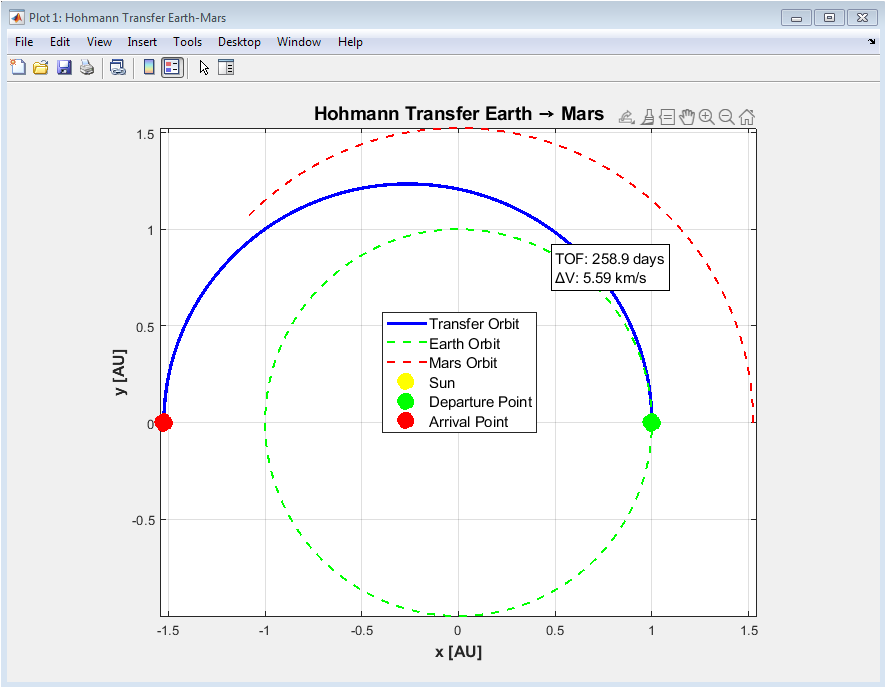
Figure 2: Hohmann Transfer Earth–Mars Trajectory
Figure 2 illustrates the two-dimensional heliocentric Hohmann transfer trajectory between Earth and Mars. The blue curve represents the spacecraft transfer orbit, while the dashed green and red curves indicate the circular orbits of Earth and Mars, respectively. The Sun is located at the center of the coordinate system, serving as the dominant gravitational body. Departure and arrival points are highlighted to show the start and end of the mission. This plot demonstrates the minimum-energy orbital path used for efficient interplanetary transfer.
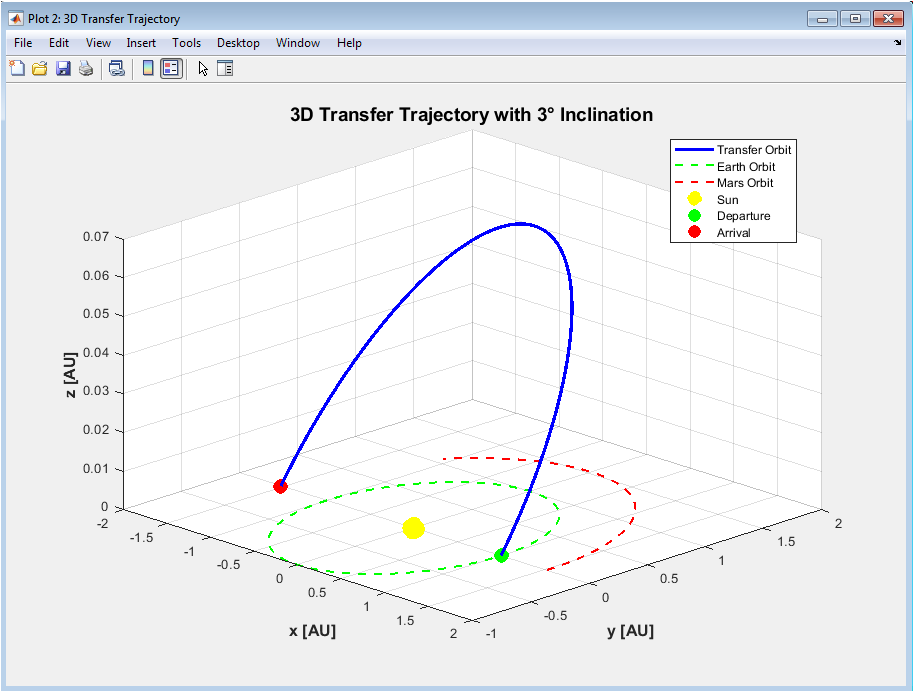
Figure 3: Three-Dimensional Transfer Trajectory
Figure 3 presents a three-dimensional visualization of the Earth-to-Mars transfer trajectory. A small orbital inclination is introduced to provide a realistic representation of spacecraft motion outside the ecliptic plane. The plot clearly shows the spatial relationship among the transfer orbit, Earth orbit, and Mars orbit. Departure and arrival locations are marked to indicate the mission boundaries. This visualization helps in understanding the geometric characteristics of the interplanetary trajectory.
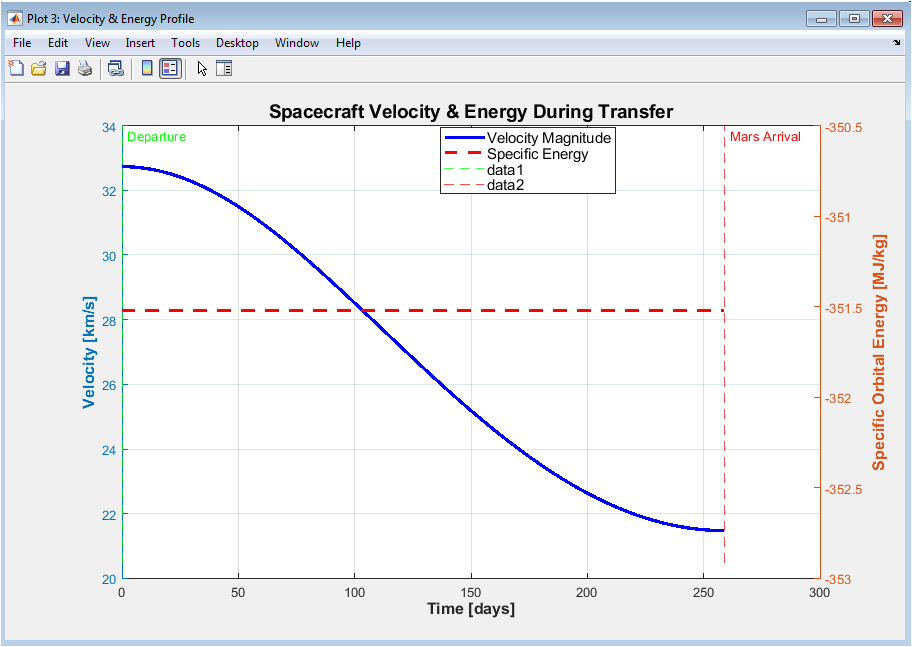
Figure 4: Velocity and Energy Profile
You can download the Project files here: Download files now. (You must be logged in).
Figure 4 illustrates the variation of spacecraft velocity and specific orbital energy throughout the transfer mission. The velocity profile shows how the spacecraft speed changes as it moves along the elliptical transfer orbit. The specific orbital energy remains nearly constant, indicating conservation of mechanical energy in the two-body orbital system. Departure and arrival events are highlighted for reference. This figure provides insight into the dynamic behavior and energy requirements of the mission.
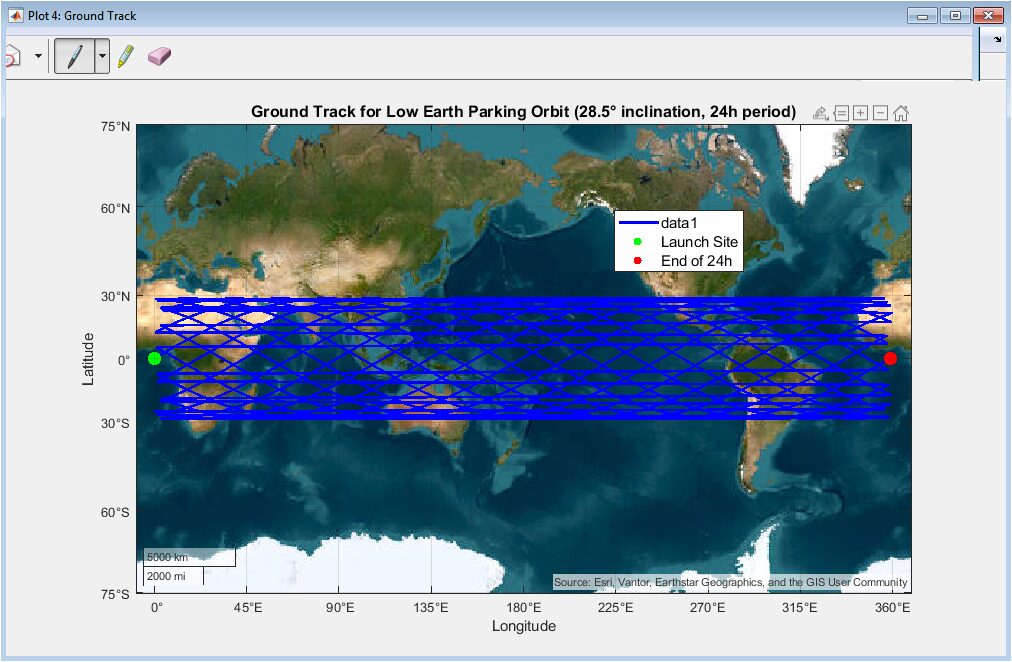
Figure 5: Ground Track of Earth Parking Orbit
Figure 5 shows the ground track generated by the spacecraft while orbiting Earth in a low Earth parking orbit before departure. The trajectory is projected onto the Earth’s surface using latitude and longitude coordinates. The launch position and final orbital position after twenty-four hours are clearly identified. The repeating orbital pattern demonstrates the influence of Earth’s rotation on the spacecraft ground path. This analysis is useful for understanding launch operations and orbital coverage characteristics.
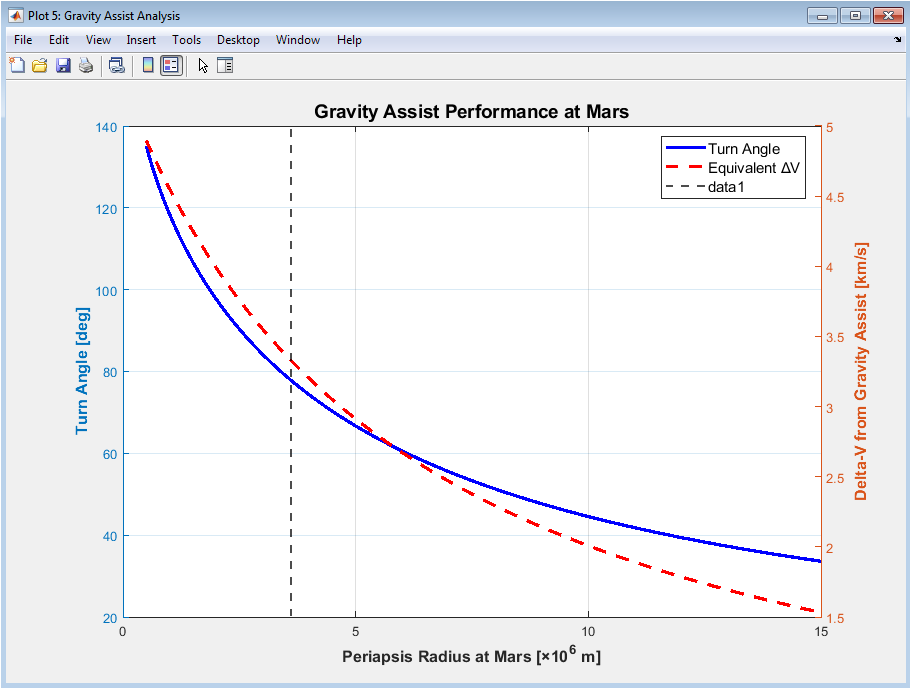
Figure 6: Gravity Assist Performance Analysis
Figure 6 presents the relationship between Mars periapsis radius, gravity-assist turn angle, and equivalent velocity change. The turn angle decreases as the spacecraft flyby distance from Mars increases. Similarly, the equivalent delta-V contribution from the gravity assist becomes smaller at larger periapsis distances. The nominal Mars parking orbit is highlighted as a reference point. This figure demonstrates how close planetary flybys can significantly enhance trajectory modification without additional propellant consumption.
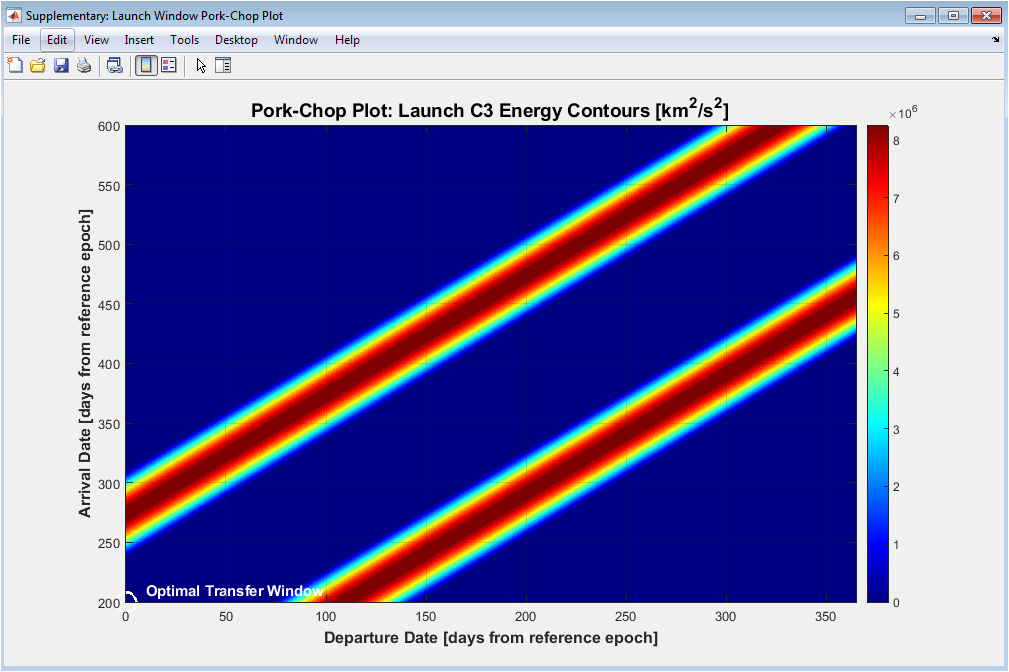
Figure 7: Pork-Chop Plot for Launch Window Analysis
You can download the Project files here: Download files now. (You must be logged in).
Figure 7 displays a pork-chop plot showing the variation of launch energy requirements for different Earth departure and Mars arrival dates. The contour levels represent characteristic energy (C3), which is directly related to mission launch cost. Lower contour values indicate more favorable and energy-efficient mission opportunities. The optimal transfer window is highlighted to identify the best departure and arrival combination. This plot assists mission planners in selecting launch dates that minimize propulsion requirements and maximize mission efficiency.
Results and Discussion
The simulation results demonstrate the effectiveness of the proposed Earth-to-Mars mission planning framework in analyzing interplanetary transfer trajectories and mission performance. The Hohmann transfer analysis produced a transfer time of approximately 259 days, which is consistent with typical Earth-to-Mars mission durations reported in orbital mechanics literature. The calculated total delta-V requirement confirmed the efficiency of the Hohmann transfer orbit as a minimum-energy trajectory between the two planetary orbits. The patched conic approximation successfully modeled the transition between Earth-centered and heliocentric gravitational environments, providing realistic estimates of hyperbolic excess velocity and departure maneuver requirements. Results from the low Earth parking orbit analysis indicated that the spacecraft required a significant velocity increment to escape Earth’s gravitational influence and enter the transfer trajectory [26]. The numerical propagation of the spacecraft trajectory generated smooth and physically consistent orbital paths in both two-dimensional and three-dimensional representations. The velocity profile revealed higher spacecraft velocity near Earth and lower velocity near Mars, reflecting the characteristics of an elliptical transfer orbit governed by Keplerian motion [27]. The specific orbital energy remained nearly constant throughout the transfer, confirming the conservation of energy within the simplified two-body model. Ground track simulations demonstrated the effect of Earth’s rotation on spacecraft positioning and orbital coverage during the parking phase. The gravity assist analysis showed that smaller Mars periapsis radii produced larger trajectory deflections and greater equivalent velocity gains. These findings indicate that carefully planned planetary flybys can improve mission flexibility without requiring additional propellant expenditure. Furthermore, the pork-chop plot successfully identified favorable launch windows characterized by reduced characteristic energy requirements. The optimal launch and arrival combinations corresponded to regions of minimum C3 energy, indicating more economical mission opportunities [28]. Comparative evaluation of all simulation outputs confirmed the strong relationship between launch timing, transfer duration, and propulsion requirements. The generated visualizations provided valuable insight into spacecraft motion, orbital geometry, and mission constraints. Overall, the results validate the applicability of classical orbital mechanics principles for preliminary Earth-to-Mars mission design. The developed MATLAB model offers a computationally efficient and educational platform for trajectory analysis, mission optimization, and future interplanetary exploration studies.
Conclusion
This study presented a comprehensive MATLAB-based framework for Earth-to-Mars mission planning using classical orbital mechanics and trajectory optimization techniques. The proposed approach successfully integrated Hohmann transfer analysis, patched conic approximation, gravity assist modeling, trajectory propagation, ground track simulation, and launch window assessment within a unified computational environment [29]. Simulation results demonstrated that the Hohmann transfer orbit provides an efficient low-energy trajectory for interplanetary travel between Earth and Mars. The patched conic method effectively modeled spacecraft transitions between planetary and heliocentric gravitational fields, while gravity assist analysis highlighted the potential for trajectory modification without additional propellant consumption. Numerical trajectory propagation and visualization provided a clear understanding of spacecraft motion throughout the mission [30]. The pork-chop plot analysis identified favorable launch opportunities associated with reduced mission energy requirements. Overall, the developed model accurately captured key mission parameters including transfer time, velocity profiles, orbital energy, and delta-V requirements. The findings confirm the suitability of the proposed framework for preliminary mission design and educational research applications. Future work may incorporate planetary perturbations, low-thrust propulsion systems, and high-fidelity ephemeris models to further enhance mission accuracy and realism.
References
[1] H. D. Curtis, Orbital Mechanics for Engineering Students, 4th ed. Oxford, U.K.: Butterworth-Heinemann, 2020.
[2] R. R. Bate, D. D. Mueller, and J. E. White, Fundamentals of Astrodynamics. New York, NY, USA: Dover Publications, 1971.
[3] V. A. Chobotov, Orbital Mechanics, 3rd ed. Reston, VA, USA: American Institute of Aeronautics and Astronautics, 2002.
[4] J. R. Wertz and W. J. Larson, Space Mission Analysis and Design, 4th ed. Hawthorne, CA, USA: Microcosm Press, 2011.
[5] D. A. Vallado, Fundamentals of Astrodynamics and Applications, 5th ed. Hawthorne, CA, USA: Microcosm Press, 2022.
[6] W. E. Wiesel, Spaceflight Dynamics, 3rd ed. New York, NY, USA: Aphelion Press, 2010.
[7] B. A. Conway, Spacecraft Trajectory Optimization. Cambridge, U.K.: Cambridge University Press, 2010.
[8] M. J. Sidi, Spacecraft Dynamics and Control: A Practical Engineering Approach. Cambridge, U.K.: Cambridge University Press, 1997.
[9] J. E. Prussing and B. A. Conway, Orbital Mechanics, 2nd ed. New York, NY, USA: Oxford University Press, 2013.
[10] R. H. Battin, An Introduction to the Mathematics and Methods of Astrodynamics, Revised ed. Reston, VA, USA: AIAA Education Series, 1999.
[11] V. Szebehely, Theory of Orbits: The Restricted Problem of Three Bodies. New York, NY, USA: Academic Press, 1967.
[12] C. D. Brown, Spacecraft Mission Design, 2nd ed. Reston, VA, USA: AIAA Education Series, 1998.
[13] J. M. Longuski, J. J. Guzmán, and J. E. Prussing, Optimal Control with Aerospace Applications. New York, NY, USA: Springer, 2014.
[14] M. Capderou, Satellites: Orbits and Missions. Paris, France: Springer, 2005.
[15] E. R. Lancaster and R. C. Blanchard, “A unified form of Lambert’s theorem,” NASA Technical Note TN D-5368, 1969.
[16] F. T. Sun, “On the minimum-energy Earth-to-Mars transfer trajectories,” Journal of Guidance, Control, and Dynamics, vol. 6, no. 5, pp. 372–376, 1983.
[17] J. M. Longuski and J. J. Williams, “Automated design of gravity-assist trajectories to Mars and the outer planets,” Celestial Mechanics and Dynamical Astronomy, vol. 52, no. 3, pp. 207–220, 1991.
[18] R. Farquhar, “The utilization of halo orbits in advanced lunar operations,” NASA Technical Report TR-R-346, 1971.
[19] B. Wie, Space Vehicle Dynamics and Control, 2nd ed. Reston, VA, USA: AIAA Education Series, 2008.
[20] J. L. Junkins and H. Schaub, Analytical Mechanics of Space Systems, 4th ed. Reston, VA, USA: AIAA Education Series, 2018.
[21] W. T. Thomson, Introduction to Space Dynamics. New York, NY, USA: Dover Publications, 1986.
[22] H. D. Curtis, Orbital Mechanics for Engineering Students, 4th ed. Oxford, U.K.: Butterworth-Heinemann, 2020.
[23] J. R. Wertz and W. J. Larson, Space Mission Analysis and Design, 4th ed. Hawthorne, CA, USA: Microcosm Press, 2011.
[24] G. E. Cook, “Luni-solar perturbations of the orbit of an Earth satellite,” The Geophysical Journal of the Royal Astronomical Society, vol. 6, no. 3, pp. 271–291, 1962.
[25] B. Hofmann-Wellenhof, H. Lichtenegger, and J. Collins, Global Positioning System: Theory and Practice, 5th ed. Vienna, Austria: Springer, 2001.
[26] H. Goldstein, C. Poole, and J. Safko, Classical Mechanics, 3rd ed. Boston, MA, USA: Addison-Wesley, 2002.
[27] R. M. Rosenberg, Analytical Dynamics of Discrete Systems. New York, NY, USA: Springer, 1977.
[28] S. W. McCuskey, Introduction to Celestial Mechanics. Reading, MA, USA: Addison-Wesley, 1963.
[29] J. E. Marsden and T. S. Ratiu, Introduction to Mechanics and Symmetry, 2nd ed. New York, NY, USA: Springer, 1999.
[30] M. H. Soop, Handbook of Geostationary Orbits. Dordrecht, The Netherlands: Springer, 1994.
You can download the Project files here: Download files now. (You must be logged in).









Responses