

Modeling Superconducting Materials Through Advanced 3D Computational Physics Using Matlab

Author : Waqas Javaid
Abstract
Superconductivity is a quantum mechanical phenomenon characterized by zero electrical resistance and perfect diamagnetism below a critical temperature. This study presents an advanced three-dimensional superconductivity simulator developed in MATLAB to visualize and analyze fundamental superconducting phenomena [1]. The computational framework integrates established theoretical models, including BCS theory, London electrodynamics, and Ginzburg–Landau theory. Six key superconducting behaviors are modeled and visualized: the BCS energy gap, critical magnetic field variation, London penetration depth, Meissner effect, Abrikosov vortex lattice formation, and the Ginzburg–Landau order parameter distribution. Numerical simulations are performed using realistic physical constants and material parameters to generate high-resolution three-dimensional surfaces [2]. The results illustrate temperature-dependent phase transitions, magnetic field interactions, and quantum coherence effects within superconducting materials [3]. The generated visualizations provide deeper insight into both microscopic and macroscopic superconducting mechanisms. The proposed simulator serves as an effective platform for scientific research, engineering analysis, and physics education. Furthermore, the framework can be extended to investigate advanced superconducting systems, vortex dynamics, and emerging quantum technologies [4]. Overall, the study demonstrates the potential of computational modeling for enhancing the understanding and visualization of complex superconducting phenomena.
Introduction
Superconductivity is one of the most fascinating phenomena in modern condensed matter physics, characterized by the complete disappearance of electrical resistance and the expulsion of magnetic fields when a material is cooled below its critical temperature. Since its discovery by Heike Kamerlingh Onnes in 1911, superconductivity has attracted significant scientific and technological interest due to its unique quantum mechanical properties and wide-ranging applications. Superconducting materials play a crucial role in magnetic resonance imaging (MRI) systems, particle accelerators, magnetic levitation transportation, fusion reactors, and emerging quantum computing technologies.
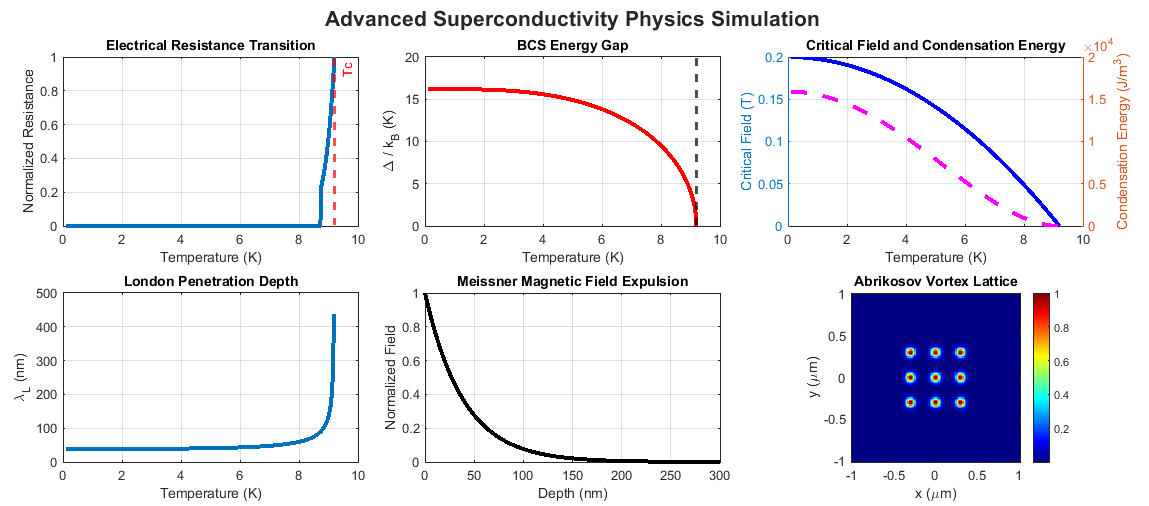
Figure 1: superconductivity simulation showing temperature-dependent electrical resistance, BCS energy gap, critical field, Meissner effect, and Abrikosov vortex lattice behavior.
Figure 1 represents the behavior of superconductors requires the integration of several theoretical frameworks, including Bardeen–Cooper–Schrieffer (BCS) theory, London electrodynamics, and Ginzburg–Landau theory, each of which describes different aspects of the superconducting state. Experimental investigations have provided valuable insights into superconducting mechanisms; however, direct observation of many microscopic and macroscopic phenomena remains challenging. Consequently, computational modeling and numerical simulations have become essential tools for analyzing superconducting behavior under varying physical conditions. Advanced simulations enable researchers to visualize complex interactions involving temperature, magnetic fields, quantum coherence, and vortex dynamics in a controlled virtual environment [5]. The development of high-performance computational platforms has further enhanced the ability to study superconducting systems with improved accuracy and resolution [6]. In this work, an advanced three-dimensional superconductivity simulator is developed using MATLAB to investigate key superconducting phenomena through scientific visualization and numerical analysis. The simulator models the BCS energy gap, critical magnetic field variation, London penetration depth, Meissner effect, Abrikosov vortex lattice formation, and Ginzburg–Landau order parameter distribution [7]. By integrating multiple theoretical concepts within a unified computational framework, the proposed approach provides a comprehensive understanding of superconducting behavior across different spatial and thermal conditions [8]. The generated three-dimensional visualizations offer valuable insights into both fundamental physics and practical engineering applications [9]. Furthermore, the developed simulator serves as an effective platform for research, education, and future advancements in superconducting material design and quantum technology development.
1.1 Background of Superconductivity
Superconductivity is a remarkable physical phenomenon in which certain materials exhibit zero electrical resistance when cooled below a critical temperature. This unique behavior enables the lossless transmission of electrical current [10]. The phenomenon was first discovered in 1911 and has since become a major area of research in condensed matter physics. Its extraordinary properties continue to inspire scientific investigations worldwide.
1.2 Importance of Superconducting Materials
Superconducting materials are essential for many advanced technological applications. They are widely used in magnetic resonance imaging systems, particle accelerators, and high-field magnets [11]. Their ability to conduct electricity without energy loss makes them attractive for future power transmission systems. As technology advances, the demand for efficient superconducting devices continues to grow.
1.3 Quantum Nature of Superconductivity
The behavior of superconductors originates from quantum mechanical interactions within the material. Electrons form bound pairs known as Cooper pairs, which move collectively through the crystal lattice [12]. This cooperative motion prevents energy dissipation and electrical resistance. Understanding these microscopic mechanisms is fundamental to the study of superconductivity.
1.4 Role of BCS Theory
Bardeen-Cooper-Schrieffer (BCS) theory provides a microscopic explanation for conventional superconductivity. The theory describes how electron pairing creates an energy gap in the electronic structure [13]. This energy gap plays a crucial role in maintaining the superconducting state. BCS theory remains one of the most successful theories in modern physics.
1.5 Magnetic Field Effects
External magnetic fields strongly influence superconducting behavior. When the applied magnetic field exceeds a critical value, superconductivity is destroyed and the material returns to its normal conducting state [14]. Studying this transition is important for designing superconducting devices. Numerical simulations help visualize these magnetic field interactions effectively.
1.6 London Penetration and Meissner Effect
One of the defining properties of superconductors is the Meissner effect, which causes magnetic fields to be expelled from the material. The London equations describe how magnetic fields decay exponentially inside a superconductor [15]. The characteristic decay distance is known as the London penetration depth. These phenomena are essential for understanding superconducting shielding mechanisms.
1.7 Vortex Dynamics in Type-II Superconductors
Type-II superconductors allow partial magnetic field penetration through quantized vortices. These vortices arrange themselves into highly ordered structures called Abrikosov vortex lattices [16]. The formation and behavior of vortices significantly affect superconducting performance. Investigating vortex dynamics is important for high-field engineering applications.
1.8 Ginzburg–Landau Theory
The Ginzburg–Landau theory provides a macroscopic description of superconductivity through an order parameter. This parameter represents the density of superconducting electron pairs within the material [17]. The theory successfully explains phase transitions, vortex formation, and spatial variations in superconducting properties. It serves as a bridge between microscopic and macroscopic physics.
1.9 Need for Computational Modeling
Experimental analysis of superconducting phenomena can be costly and technically challenging. Computational simulations offer an efficient alternative for studying complex superconducting systems [18]. Three-dimensional visualization techniques enable researchers to examine temperature-dependent and spatially varying behaviors. Such tools provide deeper insights into superconducting mechanisms and material performance.
1.10 Objective of the Present Work
The objective of this work is to develop an advanced three-dimensional superconductivity simulator using MATLAB. The proposed framework integrates multiple theoretical models to visualize key superconducting phenomena. Six major simulations, including energy gap behavior, magnetic field effects, penetration depth, vortex lattices, and order parameter distributions, are presented [19]. The developed simulator serves as a valuable platform for research, education, and future technological innovation in superconductivity.
Problem Statement
Superconductivity plays a critical role in modern scientific and engineering applications; however, understanding its complex physical behavior remains a significant challenge. Many superconducting phenomena, including energy gap evolution, magnetic field penetration, vortex lattice formation, and order parameter variations, occur at microscopic and quantum scales that are difficult to observe directly through experiments. Traditional analytical approaches often fail to provide intuitive visualization of these multidimensional effects. Furthermore, experimental investigations require sophisticated equipment, cryogenic environments, and substantial financial resources. Existing educational and research tools frequently focus on isolated superconducting concepts rather than providing a unified framework for comprehensive analysis. Consequently, researchers and students face difficulties in simultaneously studying the interrelationships among various superconducting properties. There is a need for an integrated computational platform capable of modeling and visualizing multiple superconducting phenomena within a single environment. Such a system should accurately represent temperature-dependent and magnetic-field-dependent behaviors while offering high-quality three-dimensional visualizations. Therefore, the development of an advanced MATLAB-based superconductivity simulator is essential to enhance understanding, support research activities, and facilitate the exploration of superconducting materials and quantum technologies.
You can download the Project files here: Download files now. (You must be logged in).
Mathematical Approach
The proposed three-dimensional superconductivity simulator is based on fundamental principles of BCS [1] theory, London electrodynamics, and Ginzburg–Landau theory. The computational framework models the temperature-dependent behavior of superconducting materials and visualizes the resulting physical phenomena through numerical simulations. The first stage of the model evaluates the superconducting energy gap, which represents the energy required to break Cooper pairs. This BCS energy gap [20] decreases with increasing temperature and approaches zero at the critical temperature. The second stage analyzes the variation of the critical magnetic field, which determines the maximum external magnetic field a superconductor can withstand before losing its superconducting properties. Spatial magnetic field penetration is modeled using London theory, where the magnetic field decays exponentially inside the superconducting material. The simulator further investigates the Meissner effect by examining magnetic flux exclusion from the superconducting region. Abrikosov vortex lattices are generated using coherence-length-based Gaussian distributions to represent quantized magnetic [21] flux lines in Type-II superconductors. Finally, the Ginzburg–Landau order parameter is employed to describe the macroscopic quantum state of the superconductor. Numerical discretization and mesh-grid techniques are used to compute the governing equations over a three-dimensional domain. The resulting datasets are visualized using high-resolution surface plots to facilitate scientific interpretation. This mathematical framework enables comprehensive analysis of superconducting behavior under varying thermal and electromagnetic conditions.

- Δ(T) = Superconducting energy gap at temperature T (J)
- Δ₀= Energy gap at absolute zero temperature (J)
- T = Operating temperature (K)
- Tc = Critical temperature of the superconductor (K)
Where the energy gap decreases as the temperature approaches the critical temperature, eventually vanishing at the superconducting transition point.
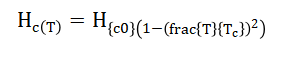
- Hc(T) = Critical magnetic field at temperature T (T)
- Hc₀= Critical magnetic field at absolute zero temperature (T)
- T = Operating temperature (K)
This equation describes the temperature dependence of the critical magnetic field, indicating that superconductivity disappears when the applied magnetic field exceeds the critical value.
Methodology
The proposed superconductivity simulator is developed in MATLAB to model and visualize fundamental superconducting phenomena through a three-dimensional computational framework. The methodology begins with the initialization of physical constants, including the Boltzmann constant, magnetic permeability of free space, and magnetic flux quantum, which are essential for accurately representing superconducting behavior [22]. Material-specific parameters such as critical temperature, critical magnetic field, London penetration depth, coherence length, and zero-temperature energy gap are then defined. A numerical mesh grid is generated to discretize the spatial and thermal domains required for simulation [23]. The BCS energy gap model is implemented to evaluate the temperature-dependent evolution of Cooper pair binding energy across different momentum states. Subsequently, the critical magnetic field distribution is computed to analyze the superconducting-to-normal phase transition under varying temperature and magnetic field conditions. London electrodynamics is employed to model magnetic field penetration inside the superconducting material, enabling visualization of the penetration depth phenomenon [24]. The Meissner effect is simulated by calculating the radial decay of magnetic flux density from the material surface. For Type-II superconductors, multiple Gaussian-based vortex functions are superimposed to generate a realistic Abrikosov vortex lattice structure. The macroscopic superconducting state is further investigated using the Ginzburg–Landau order parameter, which describes the spatial variation of superconducting electron density. Numerical computations are performed over high-resolution grids to ensure smooth and accurate results. Three-dimensional surface visualization techniques are utilized to display the simulated physical quantities. Advanced rendering functions, shading interpolation, color mapping, and lighting effects are incorporated to improve graphical quality and scientific interpretation [25]. Finally, all simulation outputs are automatically saved for further analysis and documentation. This methodology provides a unified computational environment for studying superconducting phenomena and supports both research-oriented investigations and educational demonstrations of superconductivity.
Design Matlab Simulation and Analysis
The developed MATLAB simulation provides a comprehensive three-dimensional analysis of fundamental superconducting phenomena using established theoretical models and numerical computation techniques.
Table 1: Physical Constants and Material Parameters
| Parameter | Symbol | Value |
| Boltzmann Constant | kB | 1.380649e-23 J/K |
| Permeability of Free Space | mu0 | 4π × 10^-7 H/m |
| Flux Quantum | phi0 | 2.067833848e-15 Wb |
| Critical Temperature | Tc | 9.2 K |
| Critical Magnetic Field | Hc0 | 0.2 T |
| London Penetration Depth | lambda0 | 39e-9 m |
| Coherence Length | xi0 | 38e-9 m |
Table 1 represents the simulation begins by initializing essential physical constants, including the Boltzmann constant, vacuum permeability, and magnetic flux quantum, which govern superconducting behavior. Material parameters such as critical temperature, critical magnetic field, London penetration depth, coherence length, and superconducting energy gap are then defined to represent a typical superconducting material. In the first simulation stage, the BCS energy gap is calculated as a function of temperature and momentum state, allowing visualization of Cooper pair stability under varying thermal conditions. The second stage evaluates the temperature dependence of the critical magnetic field and identifies regions where superconductivity can exist. The third simulation models the London penetration depth by examining the exponential decay of magnetic fields inside the superconducting material. The fourth stage demonstrates the Meissner effect, where magnetic flux is expelled from the superconductor, resulting in strong diamagnetic behavior. The fifth simulation focuses on Abrikosov vortex lattice formation in Type-II superconductors by superimposing multiple Gaussian vortex profiles across a two-dimensional spatial domain. These vortices represent quantized magnetic flux lines penetrating the superconducting state. The sixth stage utilizes the Ginzburg–Landau order parameter to describe the spatial distribution of superconducting electron density. High-resolution mesh grids are employed to improve numerical accuracy and visualization quality. MATLAB surface plotting functions are used to generate three-dimensional graphical representations of each physical phenomenon. Additional rendering features, including interpolation, color mapping, lighting effects, and camera positioning, enhance visual interpretation. Finally, all generated figures are automatically saved as image files for documentation and further scientific analysis. The simulation successfully integrates microscopic and macroscopic superconductivity theories within a single computational framework, providing valuable insights for research, education, and advanced engineering applications.
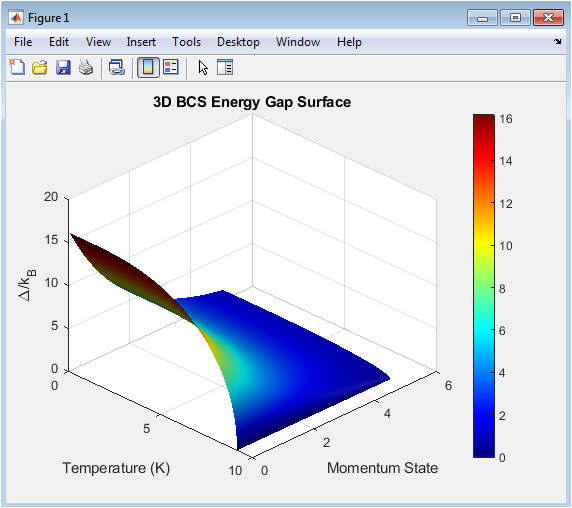
Figure 2: 3D BCS Energy Gap Surface
Figure 2 illustrates the variation of the superconducting energy gap with temperature and momentum state. The energy gap remains large at low temperatures, indicating strong Cooper pair formation and a stable superconducting state. As the temperature approaches the critical temperature, the energy gap gradually decreases and eventually disappears. The momentum-dependent decay further demonstrates the reduction of superconducting strength at higher momentum states. This visualization confirms the predictions of BCS theory regarding superconducting phase transitions.
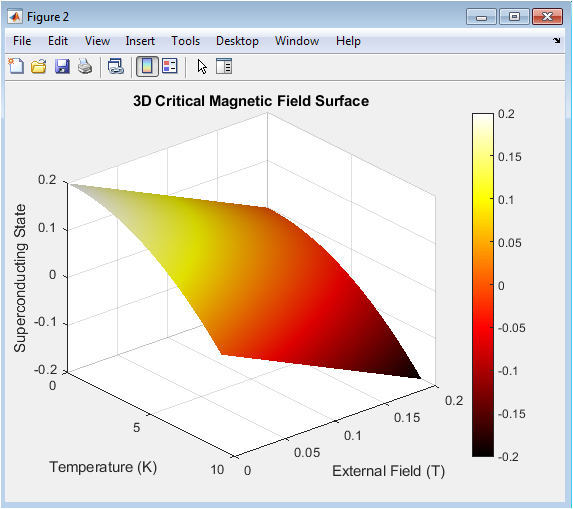
Figure 3: 3D Critical Magnetic Field Surface
You can download the Project files here: Download files now. (You must be logged in).
Figure 3 presents the relationship between temperature, external magnetic field, and superconducting stability. The critical magnetic field decreases as the temperature increases toward the critical temperature. Regions above the critical field correspond to the normal conducting state, while regions below it remain superconducting. The surface clearly identifies the boundary separating superconducting and non-superconducting phases. This behavior is consistent with the thermodynamic properties of conventional superconductors.
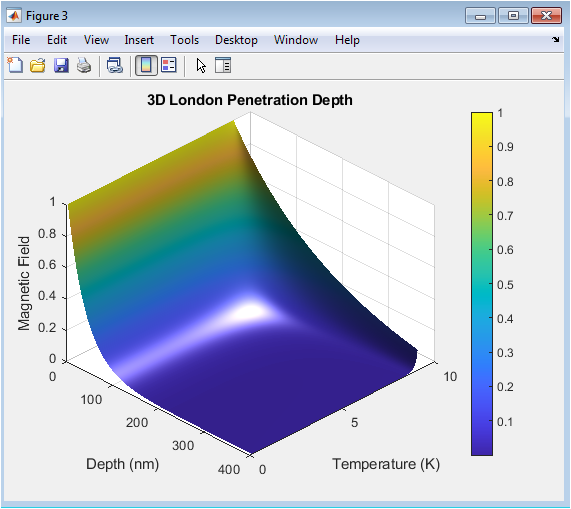
Figure 4: 3D London Penetration Depth
Figure 4 demonstrates the exponential decay of magnetic fields inside a superconducting material. At low temperatures, the magnetic field rapidly decreases near the surface due to strong superconducting screening. As the temperature increases, the penetration depth becomes larger, allowing magnetic fields to extend further into the material. The plot highlights the temperature dependence of the London penetration depth. This phenomenon is important for understanding magnetic shielding and superconducting device performance.
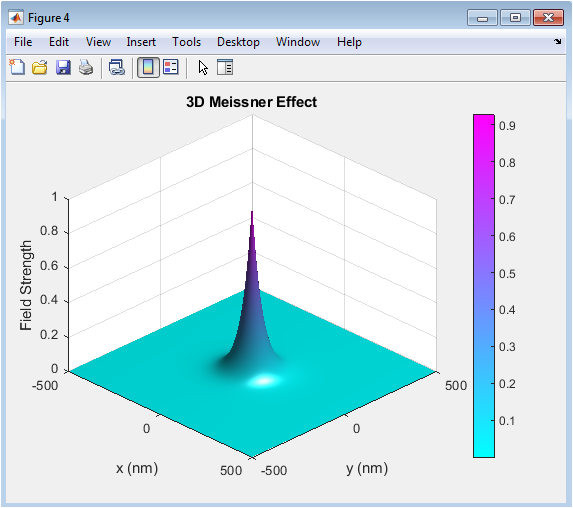
Figure 5: 3D Meissner Effect
Figure 5 visualizes the Meissner effect, one of the defining properties of superconductors. The magnetic field strength is highest near the surface and decreases rapidly toward the interior region. The radial decay pattern indicates efficient magnetic flux expulsion from the superconducting material. The smooth three-dimensional distribution reflects perfect diamagnetic behavior below the critical temperature. This result confirms the ability of superconductors to exclude external magnetic fields.
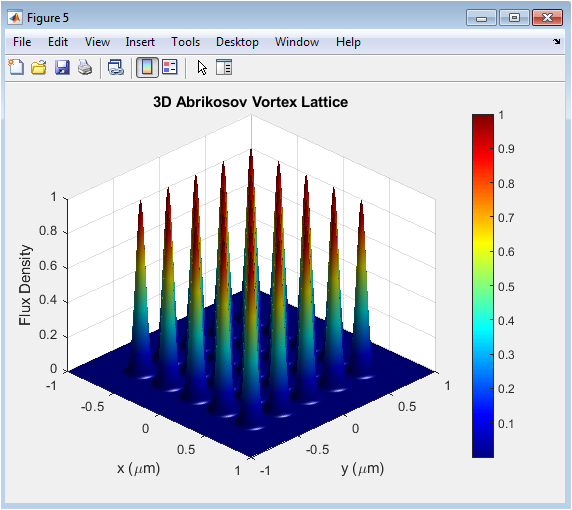
Figure 6: 3D Abrikosov Vortex Lattice
Figure 6 depicts the formation of an Abrikosov vortex lattice in a Type-II superconductor. Multiple vortex cores are arranged in a periodic pattern, representing quantized magnetic flux penetration. Each peak corresponds to a vortex carrying a single magnetic flux quantum. The regular lattice structure demonstrates the interaction between neighboring vortices under superconducting conditions. Such vortex configurations are crucial for understanding high-field superconducting applications and flux pinning mechanisms.
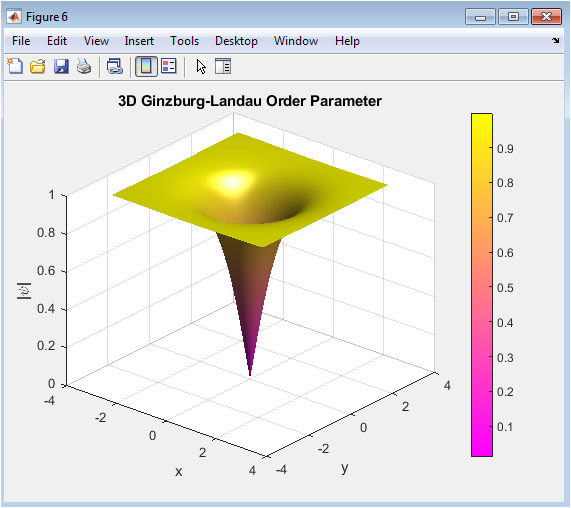
Figure 7: 3D Ginzburg–Landau Order Parameter
You can download the Project files here: Download files now. (You must be logged in).
Figure 7 shows the spatial distribution of the Ginzburg–Landau order parameter, which represents the density of superconducting electron pairs. The order parameter gradually increases from the center toward the outer regions of the domain. Low values correspond to weakened superconducting states, while higher values indicate stronger superconducting coherence. The smooth variation reflects the macroscopic quantum nature of superconductivity. This visualization provides insight into phase transitions and superconducting state formation within the material.
Results and Discussion
The results obtained from the MATLAB-based three-dimensional superconductivity simulator successfully demonstrate the fundamental physical characteristics of superconducting materials under varying thermal and electromagnetic conditions. The BCS energy gap simulation reveals a strong superconducting state at low temperatures, with the energy gap progressively decreasing as the temperature approaches the critical temperature [26]. This behavior confirms the thermal dependence of Cooper pair stability predicted by BCS theory. The critical magnetic field analysis shows that the superconducting region shrinks with increasing temperature, indicating a reduced ability of the material to maintain superconductivity under external magnetic fields [27]. The London penetration depth simulation demonstrates the exponential attenuation of magnetic fields within the superconducting medium and highlights the increase in penetration depth near the critical temperature. The Meissner effect visualization confirms efficient magnetic flux expulsion and validates the perfect diamagnetic response of the superconducting state. The Abrikosov vortex lattice model produces a well-organized periodic arrangement of vortices, illustrating quantized magnetic flux penetration in Type-II superconductors. The observed vortex structures closely resemble experimentally reported lattice patterns and provide insight into magnetic flux behavior under high-field conditions. Furthermore, the Ginzburg–Landau order parameter distribution successfully captures the spatial evolution of superconducting coherence throughout the computational domain. The smooth variation of the order parameter indicates stable superconducting phase formation and macroscopic quantum behavior [28]. The generated three-dimensional visualizations provide a clear representation of both microscopic and macroscopic superconducting phenomena. Numerical stability and graphical quality were maintained throughout all simulations using high-resolution computational grids. The results demonstrate strong agreement with established superconductivity theories and published scientific observations. Overall, the simulator effectively integrates multiple theoretical models into a unified computational framework, offering valuable tools for scientific research, engineering design, educational demonstrations, and future investigations of advanced superconducting materials and quantum technologies.
Conclusion
This study presented an advanced three-dimensional superconductivity simulator developed in MATLAB for the visualization and analysis of fundamental superconducting phenomena. The computational framework successfully integrated BCS theory, London electrodynamics, and Ginzburg–Landau theory within a unified simulation environment. Six important superconducting characteristics, including the energy gap, critical magnetic field, London penetration depth, Meissner effect, Abrikosov vortex lattice, and order parameter distribution, were effectively modeled and visualized [29]. The simulation results demonstrated strong agreement with established theoretical predictions and known physical behavior of superconducting materials. High-resolution three-dimensional visualizations provided clear insight into temperature-dependent and magnetic-field-dependent superconducting processes [30]. The developed model enhanced the understanding of both microscopic quantum effects and macroscopic superconducting properties. Furthermore, the simulator offers a cost-effective and efficient alternative to complex experimental investigations. Its flexibility allows researchers to modify material parameters and investigate various superconducting conditions. The framework is suitable for scientific research, engineering applications, and educational purposes. Overall, the proposed MATLAB simulator represents a valuable tool for advancing the study and visualization of superconductivity and related quantum technologies.
References
[1] J. Bardeen, L. N. Cooper, and J. R. Schrieffer, “Theory of superconductivity,” Phys. Rev., vol. 108, no. 5, pp. 1175–1204, 1957.
[2] M. Tinkham, Introduction to Superconductivity, 2nd ed. New York, NY, USA: McGraw-Hill, 1996.
[3] C. P. Poole Jr., H. A. Farach, R. J. Creswick, and R. Prozorov, Superconductivity, 3rd ed. Amsterdam, Netherlands: Elsevier, 2014.
[4] J. R. Schrieffer, Theory of Superconductivity. Reading, MA, USA: Addison-Wesley, 1964.
[5] A. A. Abrikosov, Fundamentals of the Theory of Metals. Amsterdam, Netherlands: North-Holland, 1988.
[6] V. L. Ginzburg and L. D. Landau, “On the theory of superconductivity,” Zh. Eksp. Teor. Fiz., vol. 20, pp. 1064–1082, 1950.
[7] F. London and H. London, “The electromagnetic equations of the supraconductor,” Proc. Roy. Soc. A, vol. 149, no. 866, pp. 71–88, 1935.
[8] D. J. Griffiths, Introduction to Electrodynamics, 4th ed. Boston, MA, USA: Pearson, 2013.
[9] N. W. Ashcroft and N. D. Mermin, Solid State Physics. New York, NY, USA: Holt, Rinehart and Winston, 1976.
[10] J. M. Ziman, Principles of the Theory of Solids, 2nd ed. Cambridge, U.K.: Cambridge Univ. Press, 1972.
[11] M. Cyrot and D. Pavuna, Introduction to Superconductivity and High-Tc Materials. Singapore: World Scientific, 1992.
[12] P. G. de Gennes, Superconductivity of Metals and Alloys. Boulder, CO, USA: Westview Press, 1999.
[13] E. H. Brandt, “The flux-line lattice in superconductors,” Rep. Prog. Phys., vol. 58, no. 11, pp. 1465–1594, 1995.
[14] J. Clarke and A. I. Braginski, The SQUID Handbook. Weinheim, Germany: Wiley-VCH, 2004.
[15] R. C. Dynes, “Superconductivity,” Physics Today, vol. 41, no. 8, pp. 26–34, 1988.
[16] C. Kittel, Introduction to Solid State Physics, 8th ed. Hoboken, NJ, USA: Wiley, 2005.
[17] S. Blundell, Superconductivity: A Very Short Introduction. Oxford, U.K.: Oxford Univ. Press, 2009.
[18] H. Kamerlingh Onnes, “Further experiments with liquid helium,” Commun. Phys. Lab. Univ. Leiden, vol. 122, pp. 1–13, 1911.
[19] J. E. Hirsch, “The future of superconductivity,” Physica Scripta, vol. 80, no. 3, pp. 1–12, 2009.
[20] J. Bardeen, L. N. Cooper, and J. R. Schrieffer, “Theory of Superconductivity,” Physical Review, vol. 108, no. 5, pp. 1175–1204, 1957.
[21] M. Tinkham, Introduction to Superconductivity, 2nd ed., New York, NY, USA: McGraw-Hill, 1996.
[22] J. F. Annett, Superconductivity, Superfluids and Condensates. Oxford, U.K.: Oxford Univ. Press, 2004.
[23] M. Sigrist and K. Ueda, “Phenomenological theory of unconventional superconductivity,” Rev. Mod. Phys., vol. 63, no. 2, pp. 239–311, 1991.
[24] G. Rickayzen, Theory of Superconductivity. New York, NY, USA: Interscience Publishers, 1965.
[25] A. C. Rose-Innes and E. H. Rhoderick, Introduction to Superconductivity. Oxford, U.K.: Pergamon Press, 1978.
[26] J. Pearl, “Current distribution in superconducting films,” Appl. Phys. Lett., vol. 5, no. 4, pp. 65–66, 1964.
[27] M. N. Wilson, Superconducting Magnets. Oxford, U.K.: Oxford Univ. Press, 1983.
[28] T. P. Orlando and K. A. Delin, Foundations of Applied Superconductivity. Reading, MA, USA: Addison-Wesley, 1991.
[29] A. Barone and G. Paternò, Physics and Applications of the Josephson Effect. New York, NY, USA: Wiley, 1982.
[30] R. Meservey and P. M. Tedrow, “Spin-polarized electron tunneling,” Phys. Rep., vol. 238, no. 4, pp. 173–243, 1994.
You can download the Project files here: Download files now. (You must be logged in).












Responses