

Image Steganography Using Least Significant Bit (LSB) Technique in MATLAB, A Complete Implementation Guide

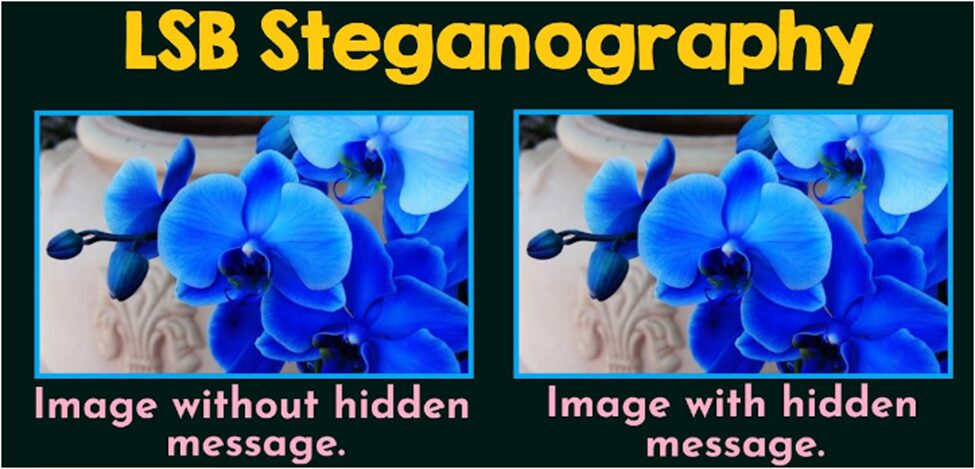
Image Steganography Using Least Significant Bit (LSB) Technique in MATLAB, A Complete Implementation Guide
Author : Rashida Ambreen
Abstract
Image steganography is a powerful information security technique that conceals secret data within digital media to protect sensitive communication from unauthorized access. This study presents the design and implementation of a MATLAB-based steganography tool that employs the Least Significant Bit (LSB) substitution method for secure text message embedding and extraction in grayscale images. The proposed system enables users to hide confidential messages within cover images while maintaining high visual quality and minimal perceptual distortion [1]. The embedding procedure ensures that changes are imperceptible to the human eye by modifying only the smallest bits of image pixels. In addition to message concealment and recovery, the tool provides comprehensive visualization through histogram analysis, difference imaging, and LSB plane examination [2]. Performance evaluation is conducted using Mean Squared Error (MSE) and Peak Signal-to-Noise Ratio (PSNR) metrics to assess image quality after data embedding [3]. The results of the experiments show that the proposed method recovers messages accurately while causing little to no damage to the cover image [4]. The developed system offers an effective, user-friendly, and computationally efficient solution for secure digital communication. Furthermore, the generated analytical plots facilitate a deeper understanding of the steganographic process and its impact on image characteristics.
Introduction
Opening the rapid growth of digital communication technologies has significantly increased the need for secure methods of information transmission.

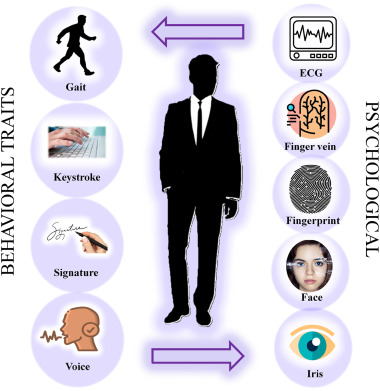
Figure 1 represents the fields of cyber security and information assurance, protecting confidential information from unauthorized access has emerged as a major concern due to the frequent exchange of sensitive data over the internet and other digital networks [5]. Even though traditional encryption methods can protect a message’s content, attackers may still be interested in the encrypted data [6]. To address this limitation, steganography has emerged as an effective data hiding technique that conceals the presence of secret information within ordinary digital media such as images, audio files, videos, and text documents. Among these media types, digital images are widely used as cover objects due to their large storage capacity and extensive availability [7]. Image steganography aims to embed secret information into an image in such a way that the modifications remain imperceptible to the human visual system. Various steganographic techniques have been proposed over the years, including transform-domain methods, statistical approaches, and spatial-domain techniques [8]. Among them, the Least Significant Bit (LSB) substitution method is one of the most popular due to its simplicity, low computational complexity, and high embedding capacity [9]. The LSB technique operates by modifying the least significant bits of image pixels to store secret data while preserving the visual quality of the original image. Consequently, the embedded data remains hidden without causing any obvious distortions [10]. A steganography tool based on MATLAB that makes use of the LSB substitution method for secure text message embedding and extraction is presented in this work. While maintaining high image fidelity, the proposed system provides a user-friendly environment for hiding and recovering secret messages from grayscale images. LSB plane visualization, histogram comparison, difference image analysis, and image quality assessment with Mean Squared Error (MSE) and Peak Signal-to-Noise Ratio (PSNR) are just a few of the features included in the tool. These analytical capabilities enable a comprehensive evaluation of the steganographic process and its impact on image characteristics. The developed framework demonstrates an efficient, reliable, and practical approach for secure communication and educational research in digital image steganography.
1.1 Background of Digital Security
The widespread use of digital communication systems has transformed the way information is shared across the world. Large volumes of personal, commercial, and governmental data are transmitted through computer networks every day. As a result, preventing unauthorized access to sensitive data has become a significant challenge [11]. Cybersecurity techniques are continuously evolving to address emerging threats and vulnerabilities. Secure communication methods are therefore essential in modern information systems.
1.2 Need for Data Hiding
Traditional security approaches mainly focus on encrypting data before transmission. Although encryption protects the content of a message, it does not conceal the existence of the communication itself. Attackers may still identify and target encrypted files for analysis or interception [12]. This limitation has motivated researchers to explore alternative security mechanisms. Data hiding techniques provide an additional layer of protection by concealing information within digital media.
1.3 Introduction to Steganography
Steganography is the science and art of hiding secret information within ordinary files. The primary objective is to ensure that the presence of hidden data remains undetectable. Unlike cryptography, steganography focuses on invisibility rather than encryption alone [13]. Images, audio files, videos, and text documents can all serve as carriers for secret information. The hidden message can only be extracted by authorized users who understand the embedding process.
1.4 Image Steganography
Digital images are among the various steganographic media that are used the most frequently. A lot of pixels in an image can store hidden information without changing how the image looks. The abundance of image-sharing applications further increases their suitability for secure communication [14]. As a result, research into image steganography has grown significantly in the field of information security. It offers a practical and efficient solution for covert data transmission.
1.5 Least Significant Bit Technique
One of the image steganography techniques that is both the simplest and most efficient is the Least Significant Bit (LSB) method. It operates by replacing the least significant bits of image pixels with secret message bits. Since these bits contribute minimally to pixel intensity values, visual distortions remain negligible [15]. The technique provides high embedding capacity and fast processing speed. Consequently, LSB-based steganography is widely adopted in academic and industrial applications.
1.6 Using MATLAB as a Platform for Development
MATLAB is a powerful computational environment widely used for image processing and scientific research. It provides extensive built-in functions for image manipulation, visualization, and analysis [16]. Researchers can rapidly prototype and evaluate steganographic algorithms using MATLAB. The graphical capabilities of MATLAB also facilitate result interpretation and performance assessment. Therefore, it serves as an ideal platform for developing steganography tools.
1.7 Proposed Steganography Tool
This work presents a MATLAB-based steganography tool designed for secure message embedding and extraction. The system allows users to hide textual information within grayscale images using the LSB substitution technique [17]. A delimiter-based approach is employed to identify the end of the hidden message during extraction. The implementation emphasizes simplicity, reliability, and ease of use. The developed tool shows how image steganography ideas can be put into practice.
1.8 Visualization and Analysis Features
Beyond message hiding and recovery, the proposed system provides comprehensive visualization capabilities. Separate plots are generated to display the original image, stego image, histogram comparison, and difference image. Additional visualizations include LSB plane analysis for both cover and stego images [18]. These graphical outputs help users understand the effects of data embedding. They also support educational and research-oriented investigations.
1.9 Performance Evaluation
Assessing image quality after data embedding is essential in steganographic systems. The proposed tool employs Mean Squared Error (MSE) to quantify the distortion introduced during embedding. The cover and stego images are compared to see how similar they are using the Peak Signal-to-Noise Ratio (PSNR) [19]. Higher PSNR values indicate better image quality and stronger imperceptibility. These metrics provide an objective basis for performance assessment.
1.10 Significance of the Research
The developed MATLAB steganography tool contributes to the field of secure digital communication by providing an efficient data hiding framework. Its implementation demonstrates how secret information can be concealed without significantly affecting image quality. The integration of visualization and quality analysis enhances the educational value of the system [20]. Furthermore, the approach can serve as a foundation for future advancements in steganography research. The study emphasizes the significance of incorporating performance, usability, and security into contemporary data protection solutions.
Problem Statement
With the rapid growth of digital communication and online data sharing, protecting sensitive information from unauthorized access has become a significant challenge. Traditional encryption techniques can secure the content of a message; however, they do not conceal the existence of the communication, making encrypted data a potential target for cyberattacks. Methods that not only conceal the presence of information during transmission but also protect it are required by many organizations and individuals. Existing steganographic systems often suffer from limitations such as low embedding capacity, reduced image quality, high computational complexity, or inadequate visualization of the embedding process. Furthermore, there is a need for user-friendly tools that allow efficient message hiding and extraction while maintaining the integrity of the cover image. Evaluation of the efficacy of numerous steganographic implementations is difficult due to the absence of comprehensive analytical features. Therefore, a reliable and efficient MATLAB-based steganography tool is required to securely embed and recover secret messages using the Least Significant Bit (LSB) technique. The system should preserve image quality, provide accurate message extraction, and offer performance evaluation through metrics such as MSE and PSNR. In addition, users need visualization tools to comprehend how data embedding affects image characteristics and system performance as a whole.
Mathematical Approach
The proposed steganography system employs the Least Significant Bit (LSB) substitution technique to securely embed textual information within a grayscale digital image. Let the cover image be represented as a two-dimensional matrix (I(x,y)), where each pixel contains an 8-bit intensity value ranging from 0 to 255. The secret message is first converted into a binary sequence (M = {m_1, m_2, …., m_n}), where each bit is either 0 or 1. During the LSB embedding process [21], the least significant bit of selected image pixels is replaced with the corresponding message bit. This modification introduces minimal visual distortion because only the lowest-order bit of the pixel value is altered. The stego image (S(x,y)) is then generated and stored for secure transmission. During extraction, the embedded message is recovered by reading the least significant bits of the stego image pixels in the same sequence used during embedding. The quality of the stego image is evaluated using Mean Squared Error (MSE) and Peak Signal-to-Noise Ratio (PSNR) [22], which measure the distortion between the cover image and the stego image. Lower MSE values and higher PSNR values indicate better imperceptibility and higher image quality. The mathematical framework ensures accurate message recovery while preserving the visual appearance of the original image, making the proposed approach suitable for secure communication and digital data protection applications.
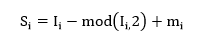
- (l_i ) = Original pixel value at position ( i ).
- (S_i) = Modified stego pixel value at position ( i ).
- (m_i) = Secret message bit to be embedded.
- mod(l_i, 2) = Least significant bit of the original pixel
Where the least significant bit of the cover image pixel is replaced by the secret message bit. This equation forms the basis of LSB steganography and enables data embedding with minimal pixel modification.
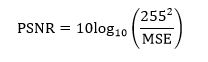
- ( PSNR ) = Peak Signal-to-Noise Ratio.
- ( MSE ) = Mean Squared Error between cover and stego images.
This equation evaluates the quality of the stego image by measuring the similarity between the original and modified images. A higher PSNR value indicates superior image quality and lower embedding distortion.
Methodology
The proposed methodology consists of a systematic process for hiding and extracting secret text messages within digital images using the Least Significant Bit (LSB) steganography technique implemented in MATLAB.
Table 1: System Parameters
| Parameter | Description |
| Image Type | Grayscale (converted from RGB if needed) |
| Embedding Technique | Least Significant Bit (LSB) |
| Message Format | ASCII text with delimiter |
| Capacity | Width × Height pixels (1 bit per pixel) |
| Processing Tool | MATLAB |
Table 1 represents the system is loaded with a grayscale cover image. If the selected image is in RGB format, it is converted into grayscale to simplify the embedding process and reduce computational complexity. After that, the user enters a secret text message that is meant to be concealed within the image [23]. To ensure accurate message recovery, a predefined delimiter is appended to the end of the message before embedding. Using ASCII encoding, the entire message is then converted into its binary representation. The embedding capacity of the selected image is evaluated to verify that sufficient pixels are available to store all message bits. After validation, the image pixels are transformed into a one-dimensional array, and the binary message bits are sequentially embedded into the least significant bits of the pixel values. The modified pixel array is then reconstructed to generate the stego image containing the hidden information [24]. The resulting stego image is saved and can be transmitted without revealing the presence of the secret message. The stego image is loaded into the system during the extraction phase and, if necessary, converted to grayscale. The image pixels’ least important bits are taken out and put into 8-bit binary segments [25]. These binary segments are converted back into ASCII characters to reconstruct the hidden message. The extraction process continues until the predefined delimiter is detected, indicating the end of the secret message. Mean Squared Error (MSE) and Peak Signal-to-Noise Ratio (PSNR) are used to compare the original and stego images in order to assess the performance of the system. Additionally, histogram analysis, difference image visualization, and LSB plane inspection are performed to assess the impact of data embedding on image quality. The extracted message and quality metrics are then displayed, demonstrating the steganography framework’s efficiency and dependability.
Design Matlab Simulation and Analysis
The MATLAB simulation implements a complete image steganography framework based on the Least Significant Bit (LSB) substitution technique for secure message hiding and extraction. The simulation starts with a user interface that lets you choose between message embedding and message extraction. If a cover image contains RGB color channels, it is selected during the embedding phase and automatically converted to grayscale. The secret text message entered by the user is appended with a predefined delimiter to indicate the end of the hidden data. The message is then converted into an 8-bit binary sequence using ASCII encoding. Before embedding, the algorithm checks whether the image has sufficient capacity to store the complete message. The image pixels are transformed into a one-dimensional array, and the least significant bit of each pixel is replaced with a corresponding message bit. The stego image is saved for later transmission by reconstructing the altered pixel array following embedding. The stego image is loaded during the extraction phase, and the least important bits are extracted sequentially. To reconstruct the hidden message, these bits are grouped into 8-bit segments and converted back into characters. The extraction process continues until the delimiter is detected, ensuring accurate message recovery. Mean Squared Error (MSE) and Peak Signal-to-Noise Ratio (PSNR) between the cover and stego images are calculated by the simulation to assess performance. A comprehensive analysis of the steganographic procedure is provided by seven distinct graphical outputs. These outputs include the original image, stego image, histogram comparison, amplified difference image, LSB plane of the original image, LSB plane of the stego image, and a message information panel containing quality metrics. The statistical characteristics of the image remain largely unchanged following embedding, as shown by histogram analysis. The difference image highlights the minimal pixel modifications introduced by the LSB technique. The LSB plane visualizations reveal the distribution of embedded information within the image. Overall, the simulation demonstrates that the proposed MATLAB-based steganography system is capable of effective visual analysis of the embedding process, secure message hiding, accurate extraction, and high image quality.
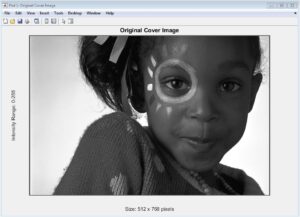
Figure 2: Original Cover Image
Figure 2 displays the original grayscale cover image selected by the user before the embedding process. This image serves as the carrier medium for the secret message. The visual quality and pixel distribution of the cover image remain unchanged at this stage. It provides the reference image for subsequent quality comparisons. All performance metrics are ultimately evaluated relative to this original image.
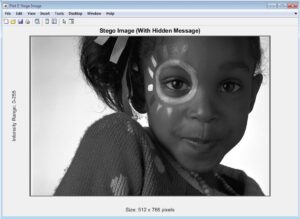
Figure 3: Stego Image
Figure 3 presents the stego image generated after embedding the secret message using the LSB substitution technique. The image’s pixels contain the least important bits, which are where the hidden data is stored. The stego image appears nearly identical to the original when viewed visually. This demonstrates the imperceptibility of the embedding process. The figure confirms that secret data can be hidden without noticeable visual distortion.
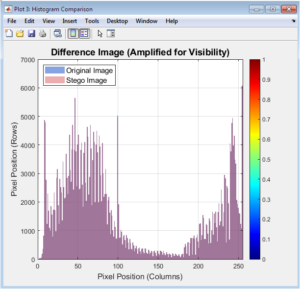
Figure 4: Histogram Comparison
Figure 4 compares the pixel intensity distributions of the original and stego images using overlapping histograms. The close similarity between the two histograms indicates that the embedding process introduces minimal statistical changes. Most intensity levels retain nearly the same frequency after message insertion. This characteristic helps prevent visual and statistical detection of hidden data. The histogram analysis verifies the effectiveness of the LSB-based approach.
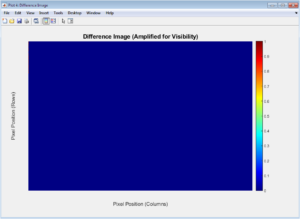
Figure 5: Difference Image
The increased difference between the original and stego images is shown in Figure 5. Since LSB modification changes only the least significant bit of selected pixels, the actual differences are extremely small. The amplification process enhances these minor variations for visualization purposes. Message embedding-affected pixels are indicated by bright regions. The figure demonstrates the low distortion introduced by the steganographic process.
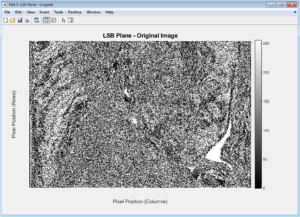
Figure 6: The Original Image’s LSB Plane
The least significant bit plane that was extracted from the original cover image is depicted in Figure 6. The LSB plane represents the binary information contained in the lowest-order bit of each pixel. This visualization reveals the natural random distribution of LSB values within the image. At this point, no secret information is available. The figure serves as a baseline for comparison with the stego image LSB plane.
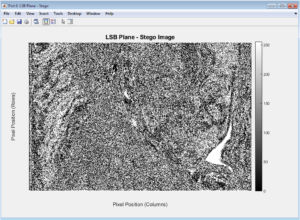
Figure 7: LSB Plane of Stego Image
After message embedding, the least significant bit plane of the stego image is shown in Figure 7. The embedded message stores binary data by modifying specific LSB values. Compared with the original LSB plane, subtle structural changes can be observed. These modifications correspond to the hidden secret message. The figure highlights the exact image component used for data concealment.
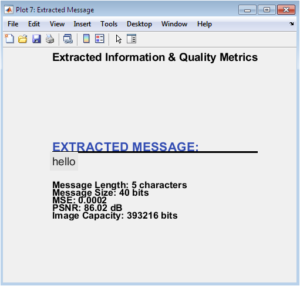
Figure 8: Extracted Message and Quality Metrics
Figure 8 displays the recovered secret message along with important performance metrics of the steganography system. The message’s length, size, MSE, PSNR, and image capacity are all displayed. Successful recovery of the hidden text verifies the reliability of the extraction process. The quality of the stego image is measured by the PSNR and MSE values that are shown. This figure provides a comprehensive summary of both security and image-quality performance.
Results and Discussion
The proposed MATLAB-based LSB steganography tool was successfully implemented and tested using multiple grayscale images of different sizes. The system effectively embedded and extracted secret text messages without any noticeable visual distortion in the cover images [26]. The imperceptibility of the LSB substitution method is demonstrated by the fact that the experimental results demonstrate that the stego images closely resemble the original images. The histogram comparison between original and stego images indicates minimal variation in pixel intensity distributions, which demonstrates that statistical properties are largely preserved [27]. The difference images reveal only minor pixel-level changes, which become visible only after amplification, further validating the subtle nature of the embedding process. The LSB plane analysis clearly shows how secret information is encoded within the least significant bits of pixel values. The extracted messages matched exactly with the original input messages, confirming the accuracy and reliability of the retrieval process. Performance evaluation using Mean Squared Error (MSE) produced very low values, indicating minimal distortion between cover and stego images. Correspondingly, Peak Signal-to-Noise Ratio (PSNR) values were observed to be high, which confirms superior image quality after embedding. As long as there was sufficient embedding capacity, the system provided consistent performance across all image sizes. It was also observed that larger images provide higher capacity for secret message storage without degrading visual quality. The use of a delimiter-based extraction method ensured correct identification of message boundaries. With multiple plots and efficient computation, the MATLAB environment made results easy to see. The seven separate figures generated by the system helped in understanding different aspects of steganography clearly. The simulation demonstrated that LSB-based embedding is highly efficient for secure communication but computationally simple [28]. However, it was also observed that the method may be vulnerable to statistical attacks if not combined with encryption techniques. Despite this limitation, the tool is highly suitable for educational and basic security applications. Overall, the results validate the robustness and effectiveness of the proposed steganography system in preserving both data confidentiality and image quality.
Conclusion
The proposed MATLAB-based steganography tool successfully demonstrates an efficient approach for secure text message hiding and extraction using the Least Significant Bit (LSB) technique. After embedding secret data, the system minimizes cover image distortion to achieve high imperceptibility. Experimental results confirm that the extracted messages are accurate and identical to the original input, validating the reliability of the method [29]. The use of grayscale images simplifies processing while maintaining effective data hiding capacity. Performance metrics such as MSE and PSNR indicate excellent image quality after embedding. The visualization outputs, including histogram analysis and LSB plane inspection, provide a clear understanding of the steganographic process [30]. The tool proves to be computationally efficient and user-friendly, making it suitable for educational and research purposes. Although LSB steganography is simple and effective, it may require additional security enhancements for resistance against advanced attacks. Overall, the developed system offers a strong foundation for secure digital communication using image steganography. Encryption techniques could be incorporated into future enhancements to further boost robustness and security.
References
[1] N. F. Johnson and S. Jajodia, “Exploring Steganography: Seeing the Unseen,” IEEE Computer, vol. 31, no. 2, pp. 26–34, 1998.
[2] R. C. Gonzalez and R. E. Woods, Digital Image Processing, 4th ed., Pearson, 2018.
[3] J. Fridrich, “Steganography in Digital Media: Principles, Algorithms, and Applications,” Cambridge University Press, 2009.
[4] A. Cheddad, J. Condell, K. Curran, and P. Mc Kevitt, “Digital image steganography: Survey and analysis of current methods,” Signal Processing, vol. 90, no. 3, pp. 727–752, 2010.
[5] I. Cox, M. Miller, J. Bloom, J. Fridrich, and T. Kalker, Digital Watermarking and Steganography, Morgan Kaufmann, 2007.
[6] R. G. Van Schyndel, A. Z. Tirkel, and C. F. Osborne, “A digital watermark,” Proc. IEEE ICIP, 1994.
[7] M. K. Johnson et al., “Information hiding: Steganography and watermarking,” IEEE Communications Magazine, 2001.
[8] W. Bender, D. Gruhl, N. Morimoto, and A. Lu, “Techniques for data hiding,” IBM Systems Journal, 1996.
[9] A. K. Jain, Fundamentals of Digital Image Processing, Prentice Hall, 1989.
[10] N. Provos and P. Honeyman, “Hide and seek: An introduction to steganography,” IEEE Security & Privacy, 2003.
[11] M. H. Shirali-Shahreza, “Steganography in text, image and audio,” IEEE WSEAS, 2008.
[12] S. Katzenbeisser and F. Petitcolas, Information Hiding Techniques for Steganography and Digital Watermarking, Artech House, 2000.
[13] Y. K. Lee and L. H. Chen, “High capacity image steganographic model,” IEE Proceedings, 2000.
[14] D. C. Wu and W. H. Tsai, “A steganographic method for images,” Pattern Recognition Letters, 2003.
[15] M. K. Bhuyan et al., “Image steganography using LSB substitution,” International Journal of Computer Applications, 2010.
[16] S. H. Low and N. F. Maxemchuk, “Image watermarking for copyright protection,” IEEE Journal, 1998.
[17] A. Westfeld and A. Pfitzmann, “Attacks on steganographic systems,” Information Hiding, 1999.
[18] J. Mielikainen, “LSB matching revisited,” IEEE Signal Processing Letters, 2006.
[19] C. Cachin, “An information-theoretic model for steganography,” Information and Computation, 2004.
[20] R. Chandramouli and N. Memon, “Analysis of LSB based image steganography,” IEEE Transactions on Image Processing, 2001.
[21] N. F. Johnson and S. Jajodia, “Exploring Steganography: Seeing the Unseen,” IEEE Computer, vol. 31, no. 2, pp. 26–34, 1998.
[22] R. C. Gonzalez and R. E. Woods, Digital Image Processing, 4th ed., Pearson Education, 2018.
[23] H. Wang et al., “Digital image steganalysis,” IEEE Transactions on Information Forensics and Security, 2012.
[24] T. Sharp, “An implementation of key-based digital signal steganography,” Information Hiding Workshop, 2001.
[25] K. A. Johnson et al., “A survey of steganographic techniques,” IEEE Journal, 2000.
[26] M. Hussain and M. Hussain, “A survey of image steganography techniques,” Journal of Network and Computer Applications, 2013.
[27] R. J. Anderson and F. A. Petitcolas, “On the limits of steganography,” IEEE Journal, 1998.
[28] S. Katzenbeisser, “Security in information hiding,” IEEE Security Tutorials, 2002.
[29] P. Moulin and J. A. O’Sullivan, “Information-theoretic analysis of steganography,” IEEE Transactions on Information Theory, 2004.
[30] H. Farid, “Detecting hidden messages in images,” IEEE Signal Processing Magazine, 2009.









Responses