Case Study: FEM-Based Co-Simulation & Design of a Six-Phase Claw-Pole Alternator
Enhancing multi-phase generator efficiency, between-claw magnet flux, and rectifier co-simulation through 3D finite element analysis.
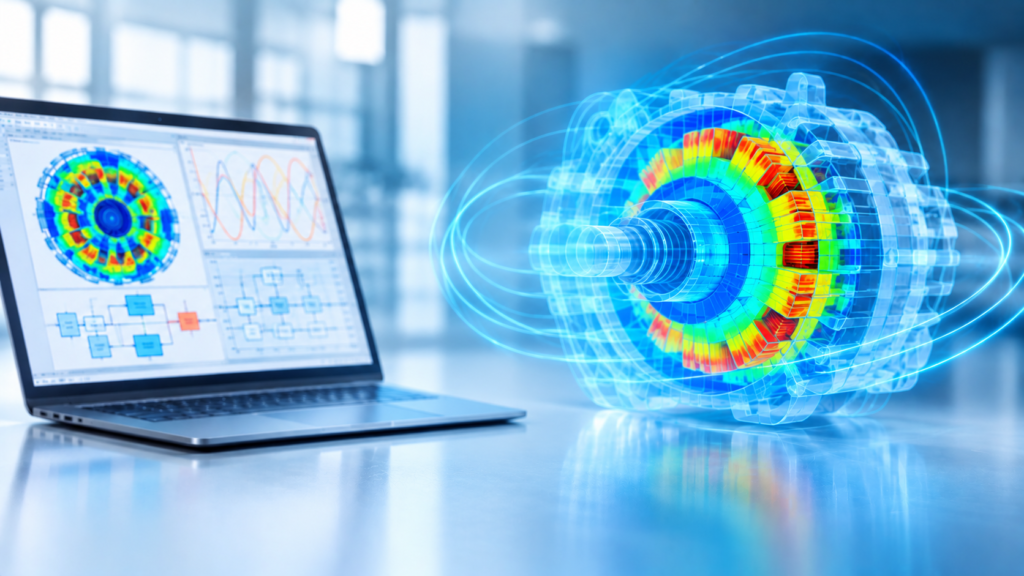
WiredWhite’s engineering expertise in electrical machine modeling and simulation is demonstrated by a project focused on the development of a finite-element-based model of a six-phase automotive claw-pole alternator and its rectifier.
The project combined detailed electromagnetic modeling with power-electronics simulation to investigate the behavior of an automotive electrical generator under realistic operating conditions. The model was developed using measurements from a real alternator, providing a foundation for analyzing the interaction between the electrical machine and its rectification system.
Industry
Automotive
Product
Hybrid Electric Vehicles, Electric Vehicles, BAS
Service
Electric Machine Design
Technical Stack
FEM Software
Duration
6 months
Client
Confidential
Project Overview & Objectives
The Product:
A 3D Finite Element Method (FEM) simulation model of a six-phase automotive claw-pole alternator co-simulated directly with power electronics rectifiers.
Why It Was Necessary:
Improving the efficiency of automotive power networks is essential for modern vehicle development. Independent modeling of the alternator and rectifier is insufficient because of strong electromagnetic interdependence between the machine and passive diode bridges.
Where It Was Used:
Applied in automotive engineering research to evaluate electrical machines, power electronics, and electrical grid topologies for conventional and electric vehicles.
Task Solved:
Solved the challenge of modeling high-speed skin and proximity effects in stator windings, optimizing claw leakage flux, and establishing an accurate co-simulation pipeline validated against physical test bench measurements.
Project objectives:
- Electromagnetic machine modeling: Develop a finite-element-based model of a six-phase claw-pole alternator.
- Power-electronics integration: Develop a rectifier model and integrate it with the alternator model.
- Co-simulation: Simulate the coupled behavior of the electrical machine and its power-electronics system.
- Measurement-based development: Use a real alternator as the reference for determining machine geometry, dimensions, and relevant electrical characteristics.
- System-level analysis: Investigate the interaction between the alternator and rectifier to support the development and analysis of automotive electrical generation systems.
The Challenge
Designing and analyzing a high-output 6-phase automotive claw-pole generator presents complex physical and computational hurdles:
01
Alternator-Rectifier Interdependence:
Strong interaction between the multi-phase machine and diode rectifiers prevents separate component analysis and demands coupled co-simulation.
02
Skin and Proximity Effects at High Speeds:
High operational rotational speeds introduce high-frequency skin and proximity effects within the stator windings that must be accurately captured.
03
3D Claw Leakage & Geometry Complexity:
Complex claw-pole geometry exhibits significant 3D magnetic leakage flux between rotor claw poles, requiring specialized flux-compensation techniques.
04
High Computational Demand:
Simulating a full 3D machine geometry with individual conductors incurs high computational times, requiring model sectoring without loss of physical detail.
Our Solution
To overcome these technical obstacles, WiredWhite established a multi-layered 3D FEM co-simulation workflow:
Step 1: Empirical Machine Parameterization
Measured and disassembled a physical automotive claw-pole alternator to extract precise 3D CAD geometries, stator resistance, and inductance characteristics.
Step 2: 3D FEM & Circuit Co-Simulation
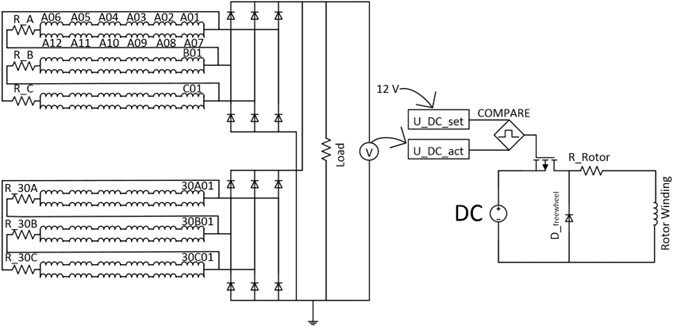
Built a 3D electromagnetic FEM machine model coupled to an external circuit representing the six-phase delta-connected stator, excitation control loop, twin passive diode rectifiers, and DC load.
Step 3: Between-Claw Permanent Magnets
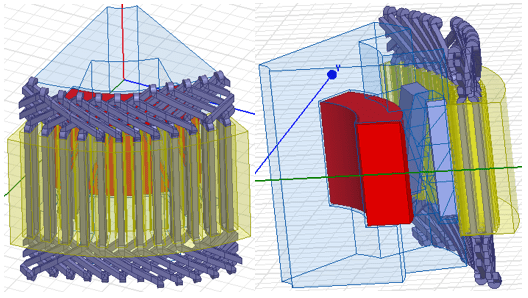
Integrated permanent magnets between neighboring rotor claws to counteract claw leakage flux and reinforce main stator flux.
Step 4: Optimized Sector Model
Transformed the full 3D geometry into a reduced sector model with combined stranded conductors (configuring 2 parallel branches and 6 turns per phase in model settings) to accelerate computation.
Step 5: Closed-Loop Excitation in Generator Mode
Operated the model strictly in generator mode, utilizing a closed-loop controller to regulate excitation current and maintain grid voltage under high current draw.
Elevate Your Automotive Machine Design! Contact WiredWhite to discuss your engineering requirements.
Technical Stack
3D FEM Software
Electromagnetic 3D machine modeling, sector geometry design, flux calculation, and between-claw magnet integration.
Co-Simulation Circuit Solver
Modeling the 6-phase delta stator winding connections, twin passive diode rectifiers, excitation current control loop, and DC load.
Specialized Test Bench Hardware
Custom automotive power network test bench used for electrical/mechanical parameter measurements and empirical validation.
MATLAB & Simulink
System-level macro-modeling of electrical machine, power electronics, and power network components based on FEM results.
Results & Empirical Validation
To validate the 3D FEM co-simulation framework, simulation results were benchmarked against empirical measurements from a specialized automotive alternator test bench under closed-loop excitation control.
1️⃣ High-Current DC Output
Delivered a steady DC load current of 123 A to the vehicle network load.
2️⃣ Precise Excitation Control
The closed-loop controller established a rotor excitation current of 5.34 A to sustain full output, closely matching test bench measurements.
3️⃣Stable DC-Link Voltage
Maintained stable grid voltage regulation at approximately 12 V DC after full-wave rectification
4️⃣Stator Machine Architecture
Successfully operated a six-phase delta connection configured with two parallel branches and six turns per phase.
5️⃣ Smooth Torque & Low Ripple
Demonstrated stable torque development after transient settling, achieving favorable torque ripple behavior even prior to structural optimization.
6️⃣ High Waveform Fidelity
Confirmed strong qualitative agreement between simulated induced phase voltages, phase sequences, DC-link voltage curves, and physical test bench data.
Accelerate your electric drive and generator development with validated 3D FEM co-simulation models.
Why WiredWhite is the Perfect Engineering Partner for You
⏱ 15+ Years
industry experience
👨 1000+
networked engineering professionals
🔄 Integrated
project collaboration tools
✅ 100%
Proficient in advanced engineering tools
- Free consultation call
- Contact form
Contact us now.
Speak directly with our experts to explore how we can help you model, simulate, and validate your engineering projects.