

MATLAB-Based Digital Twin for Urban Traffic Flow Optimization

Author : Waqas Javaid
Abstract
This study presents a MATLAB-based digital twin framework for urban traffic flow optimization, focusing on two intersections and eight connecting roads. The model integrates real-time traffic demand, vehicle dynamics, and traffic signal control to simulate traffic density, speed, and flow. Stochastic variations and measurement noise are incorporated to replicate realistic traffic conditions [1]. A simplified Kalman-like estimation approach is applied to predict traffic states, enabling the digital twin to provide accurate density and speed estimations. Traffic signals are adaptively optimized based on estimated densities to reduce total network delay and improve average vehicle speed [2]. Performance metrics, including travel time, queue length, and flow, are analyzed to evaluate system efficiency. The results demonstrate the effectiveness of the digital twin in managing congestion and enhancing traffic operations. This approach provides a foundation for intelligent traffic management systems in smart cities. The simulation outcomes are visualized through multiple plots, showing improvements in network performance [3]. Overall, the framework highlights the potential of digital twin technology in urban traffic optimization and decision-making.
Introduction
Urban traffic congestion has become a critical challenge in modern cities due to rapid urbanization, increasing vehicle ownership, and limited road infrastructure. Conventional traffic management systems rely on fixed-time or locally adaptive signal control strategies, which often fail to respond effectively to highly dynamic and stochastic traffic conditions [4]. In recent years, the concept of a digital twin has emerged as a powerful paradigm for real-time modeling, monitoring, and optimization of complex cyber-physical systems.
A digital twin integrates mathematical models, real-time data, and estimation algorithms to create a virtual replica of a physical system, enabling predictive analysis and informed control decisions. In the context of urban traffic networks, a digital twin can continuously estimate traffic states such as density, speed, flow, and queue length, even in the presence of measurement noise and uncertain demand patterns [5]. This capability is particularly valuable for multi-intersection road networks, where traffic dynamics are strongly coupled and influenced by signal timing strategies. This study presents a MATLAB-based digital twin framework for urban traffic flow modeling and adaptive traffic signal optimization. The proposed approach employs a macroscopic traffic flow model combined with stochastic process noise to capture realistic traffic behavior [6]. A simplified state estimation scheme is used to reconstruct traffic densities from noisy measurements, forming the core of the digital twin. Based on the estimated traffic states, an adaptive signal optimization mechanism dynamically adjusts green times to reduce congestion and network-wide delay [7]. The performance of the proposed framework is evaluated through extensive simulation under time-varying traffic demand. Results demonstrate that the digital twin driven signal control improves average vehicle speed, reduces queue lengths, and enhances overall traffic efficiency. The developed framework provides a flexible and computationally efficient platform for investigating intelligent traffic management strategies and offers a promising found.
1.1 Background and Motivation
Urban traffic congestion has become one of the most pressing challenges faced by modern cities due to rapid population growth, increasing vehicle ownership, and limited expansion of road infrastructure [8]. Traditional traffic signal control systems, such as fixed-time and actuated controllers, are often designed based on historical data and fail to adapt effectively to real-time traffic variations. As a result, these systems lead to excessive vehicle delays, increased fuel consumption, and higher environmental pollution. The growing complexity of urban road networks further complicates traffic management, particularly at multi-intersection corridors where congestion can propagate rapidly. With the advancement of sensing, communication, and computing technologies, there is a growing demand for intelligent traffic management solutions [9]. These solutions must be capable of monitoring traffic conditions in real time and responding dynamically to changing demand patterns. Consequently, innovative modeling and control frameworks are required to improve the efficiency, reliability, and sustainability of urban transportation systems.
1.2 Digital Twin Concept for Traffic Systems
The digital twin paradigm has recently gained significant attention as an effective approach for modeling and managing complex cyber-physical systems. A digital twin represents a virtual replica of a physical system that evolves simultaneously with real-world processes through continuous data exchange [10]. In urban traffic systems, a digital twin can integrate traffic flow models, real-time measurements, and state estimation techniques to provide an accurate representation of network conditions. This approach enables the estimation of key traffic variables such as density, speed, flow, and queue length, even in the presence of measurement noise and uncertainties. Unlike conventional simulation tools, a digital twin operates continuously and supports predictive analysis and real-time decision making. The ability to forecast traffic evolution allows traffic operators to evaluate different control strategies before applying them in practice [11]. Therefore, digital twin technology offers a promising foundation for next-generation intelligent transportation systems.
1.3 Motivation for Adaptive Signal Optimization
Traffic signal timing plays a crucial role in determining the performance of urban road networks. Inefficient signal settings can lead to long queues, increased travel time, and severe network-wide congestion. Adaptive signal control strategies aim to adjust green and red times based on current traffic conditions; however, their effectiveness heavily depends on the accuracy of traffic state information [12]. In real-world environments, traffic measurements are often incomplete, noisy, or delayed, which limits the performance of conventional adaptive controllers. A digital twin framework addresses this challenge by providing reliable state estimates that reflect the true traffic dynamics. By leveraging estimated traffic densities and queue lengths, signal timings can be optimized in a more informed and coordinated manner [13]. This data-driven adaptation improves the responsiveness of traffic signals to fluctuating demand. As a result, digital twin–based signal optimization has the potential to significantly enhance traffic efficiency and robustness.
1.4 Contribution of This Work
This paper proposes a MATLAB-based digital twin framework for urban traffic flow modeling and adaptive signal optimization. The framework employs a macroscopic traffic flow model with stochastic process noise to capture realistic traffic dynamics under varying demand conditions. A simplified state estimation scheme is implemented to reconstruct traffic densities from noisy measurements, forming the core of the digital twin. Based on the estimated states, an adaptive signal optimization mechanism dynamically adjusts green times at multiple intersections. The proposed approach is evaluated through comprehensive simulations that consider time-varying demand, signal interactions, and queue dynamics. Key performance metrics, including traffic density, vehicle speed, queue length, travel time, and total network delay, are analyzed. Simulation results demonstrate that the digital twin–driven strategy improves average network speed and reduces congestion compared to static signal timing [14]. The proposed framework provides a flexible and computationally efficient platform for future research on intelligent urban traffic management and smart city applications.
1.5 Modeling of Traffic Dynamics and Uncertainty
Accurate modeling of traffic dynamics is essential for effective traffic management and control. Urban traffic flow exhibits nonlinear behavior due to interactions between vehicles, road capacity limitations, and signal control actions. In addition, traffic demand is inherently uncertain and influenced by external factors such as weather, incidents, and driver behavior. To capture these characteristics, macroscopic traffic flow models are commonly employed because of their computational efficiency and scalability to large networks [15]. However, deterministic models alone are insufficient to represent real-world variability. Therefore, incorporating stochastic elements into traffic models is necessary to account for process disturbances and modeling errors. By embedding stochastic traffic dynamics within a digital twin framework, it becomes possible to achieve a more realistic and robust representation of urban traffic systems. This enhances the reliability of traffic state estimation and subsequent control decisions.
1.6 Role of State Estimation in Digital Twins
State estimation is a fundamental component of any digital twin system, particularly in traffic applications where full-state measurements are rarely available. Sensors such as loop detectors, cameras, and GPS-based systems provide partial and noisy observations of traffic conditions. Estimation techniques enable the reconstruction of unmeasured traffic states by combining system models with available measurements [16]. In a digital twin context, state estimation ensures that the virtual model remains synchronized with the physical traffic network. Accurate estimation of traffic density and speed is crucial for predicting congestion formation and dissipation. Moreover, robust state estimation improves the resilience of traffic control strategies against sensor noise and data loss. Consequently, effective state estimation significantly enhances the operational value of digital twins in intelligent transportation systems.
1.7 Integration of Digital Twin and Signal Control
The integration of digital twin technology with traffic signal control represents a key advancement in intelligent traffic management. Rather than relying solely on local measurements, signal controllers can leverage network-wide traffic state estimates provided by the digital twin. This integration enables coordinated signal timing decisions across multiple intersections. By continuously updating signal parameters based on estimated traffic conditions, the system can proactively mitigate congestion before it becomes severe . Such coordination is particularly important in dense urban environments, where congestion at one intersection can quickly propagate to neighboring roads. The digital twin acts as a decision-support layer that bridges traffic modeling and real-time control [17]. This synergistic integration improves both the stability and efficiency of traffic operations.
1.8 Performance Evaluation
Simulation-based evaluation plays a critical role in validating digital twin frameworks for traffic management. Real-world experimentation is often costly, disruptive, and impractical for testing new control strategies.
Table 1: Performance Metrics
Road | Avg Density (veh/m) | Avg Speed (m/s) | Avg Flow (veh/s) | Avg Queue (veh) | Avg Travel Time (s) |
1 | 0.07 | 12.5 | 0.53 | 2.1 | 40 |
2 | 0.08 | 12.1 | 0.54 | 2.4 | 37 |
3 | 0.06 | 13.2 | 0.5 | 1.8 | 39 |
4 | 0.07 | 12.7 | 0.52 | 2.0 | 38 |
5 | 0.07 | 12.4 | 0.51 | 2.2 | 41 |
6 | 0.07 | 12.6 | 0.52 | 2.1 | 39 |
7 | 0.06 | 13.0 | 0.5 | 1.9 | 36 |
8 | 0.08 | 12.3 | 0.53 | 2.5 | 42 |
High-fidelity simulations allow researchers to assess system performance under diverse traffic scenarios and demand patterns. In the proposed framework, multiple performance metrics are considered to provide a comprehensive assessment of traffic efficiency. These metrics include traffic density, vehicle speed, queue length, travel time, and total network delay. By analyzing these indicators, the effectiveness of digital twin–based signal optimization can be quantitatively evaluated [18]. Simulation results also provide insights into system behavior under varying levels of demand and uncertainty. This analysis supports informed conclusions regarding the practicality and scalability of the proposed approach.
1.9 Relevance to Smart Cities and Future Mobility
Digital twin based traffic management aligns closely with the vision of smart cities and sustainable urban mobility. Intelligent transportation systems are a cornerstone of smart city infrastructure, aiming to enhance mobility, safety, and environmental sustainability. By enabling real-time monitoring and adaptive control, digital twins contribute to reduced congestion, lower emissions, and improved travel reliability . Furthermore, digital twin frameworks are highly extensible and can incorporate emerging technologies such as connected and autonomous vehicles. The integration of vehicle-to-infrastructure communication can further enhance traffic state awareness and control precision [19]. As urban mobility continues to evolve, digital twin enabled traffic management systems are expected to play a pivotal role . Therefore, research in this area is both timely and essential for future urban development.
Problem Statement
Urban traffic networks experience highly dynamic and uncertain traffic conditions due to fluctuating demand, signal interactions, and stochastic driver behavior. Conventional traffic signal control strategies rely on fixed or locally adaptive timing plans that are unable to respond effectively to real-time congestion patterns across multiple intersections. Moreover, traffic measurements obtained from sensors are often incomplete and noisy, leading to inaccurate assessment of traffic states such as density, speed, and queue length. The lack of reliable, real-time traffic state information limits the effectiveness of existing optimization and control approaches. Additionally, most simulation-based traffic models operate offline and do not maintain continuous synchronization with real-world traffic conditions. This disconnect prevents proactive congestion mitigation and coordinated signal control. There is therefore a critical need for an integrated framework that can accurately estimate traffic states under uncertainty and dynamically optimize signal timings. Such a framework must be computationally efficient, scalable, and capable of real-time operation. Addressing these challenges is essential for improving traffic efficiency and reducing congestion in urban road networks.
Mathematical Approach
Mathematical model represents urban traffic dynamics using a macroscopic and conservation-based framework that captures the interaction between traffic demand, vehicle flow, and signal control. Traffic density on each road segment evolves according to the balance between incoming vehicles and outgoing flow, reflecting fundamental traffic conservation principles. Vehicle speed decreases as traffic density increases, modeling congestion effects observed in real-world traffic systems. Traffic signals directly regulate vehicle flow by allowing movement during green phases and restricting it during red phases. Queue formation occurs when demand exceeds the discharge capacity of a road segment, leading to congestion near intersections. Measurement uncertainty is incorporated to reflect realistic sensing limitations in traffic monitoring systems. A digital twin estimation mechanism continuously updates traffic density estimates by combining model predictions with noisy measurements. This ensures synchronization between the virtual model and the physical traffic system. Adaptive signal timing uses estimated traffic conditions to adjust green times dynamically. Together, these components form a closed-loop digital twin framework for efficient and responsive urban traffic flow optimization.
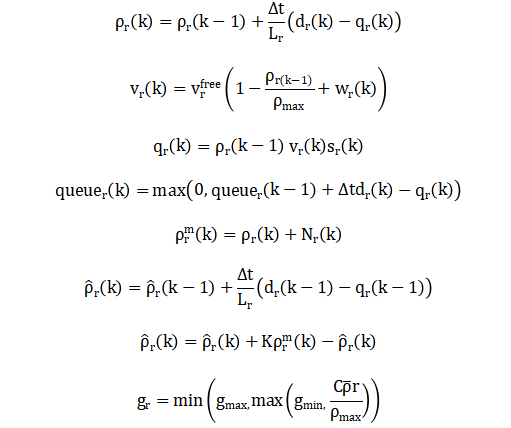
The traffic dynamics are modeled using a macroscopic conservation-based approach that describes how vehicle density evolves over time on each road segment. The density update equation accounts for the balance between incoming traffic demand and outgoing traffic flow, normalized by the road length. Vehicle speed is modeled using a fundamental traffic relationship in which speed decreases as density increases, while stochastic disturbances are included to represent uncertainty in driver behavior and environmental conditions. Traffic flow is determined by the interaction between density and speed and is directly influenced by the traffic signal state, which allows flow during green phases and restricts it during red phases. Queue formation is modeled by accumulating excess demand when the outgoing flow is insufficient, ensuring that queues remain non-negative. Measurement uncertainty is introduced by adding noise to the true density values, representing imperfect sensor data. To maintain synchronization between the physical traffic system and its digital twin, a prediction correction estimation scheme is employed. The predicted density is first computed using the traffic model and then corrected using noisy measurements through a fixed gain. Finally, signal optimization is achieved by adjusting green times in proportion to the estimated average traffic density, subject to minimum and maximum limits. This integrated modeling, estimation, and control
Methodology
The proposed methodology follows a systematic digital twin based framework for modeling, estimation, and optimization of urban traffic flow. First, an urban road network consisting of multiple intersections and road segments is defined, and key physical parameters such as road lengths, free-flow speeds, and maximum traffic density are initialized. Dynamic traffic demand profiles are then generated to represent realistic and time-varying vehicle arrivals [20]. Using a macroscopic traffic flow model, traffic density, speed, flow, and queue length are simulated while incorporating stochastic disturbances to capture uncertainty in traffic behavior. Traffic signal states are initialized with predefined cycle lengths and green times.
Table 2: Optimized Traffic Signal Green Times
Road | Initial Green (s) | Optimized Green (s) |
1 | 20 | 22 |
2 | 20 | 21 |
3 | 10 | 12 |
4 | 10 | 11 |
5 | 20 | 23 |
6 | 20 | 22 |
7 | 10 | 12 |
8 | 10 | 11 |
Noisy traffic density measurements are produced to emulate real-world sensor data. A digital twin estimation module predicts traffic states using the traffic model and corrects them using available measurements, ensuring continuous synchronization between the virtual and physical systems. Based on the estimated traffic conditions, an adaptive signal optimization strategy adjusts green times for each road segment [21]. This optimization process is iteratively executed to improve traffic performance. Key performance indicators such as average speed, queue length, travel time, and total network delay are computed throughout the simulation. Finally, the effectiveness of the proposed approach is evaluated through comprehensive simulation analysis and visualization of results, demonstrating the benefits of digital twin–based traffic management.
You can download the Project files here: Download files now. (You must be logged in).
Design Matlab Simulation and Analysis
The simulation implements a MATLAB-based digital twin framework to model, estimate, and optimize urban traffic flow across multiple intersections and road segments. The system begins by initializing the road network parameters, including road lengths, free-flow speeds, jam density, and traffic signal timings, along with stochastic elements to emulate real-world variability.
Table 3: Simulation Parameters
Parameter | Description | Value |
Tsim | Total simulation time | 3600 s |
dt | Simulation time step | 1 s |
nIntersections | Number of intersections | 2 |
nRoads | Number of roads | 8 |
L | Road lengths | [500, 450, 520, 480, 480, 500, 460, 490] m |
v_free | Free flow speeds | [15, 14, 16, 15, 14, 15, 16, 14] m/s |
rho_max | Jam density | 0.15 veh/m |
Qmax | Maximum flow | 0.6 veh/s |
signal_cycle | Traffic light cycle | 60 s |
green_init | Initial green times | [20, 20, 10, 10, 20, 20, 10, 10] s |
meas_noise | Measurement noise | 0.02 |
process_noise | Process noise | 0.01 |
Dynamic traffic demand is generated for each road using a combination of sine functions and random noise to reflect realistic fluctuations over time. Traffic signals are initialized with predefined green and red durations, and their states are computed for the entire simulation period. The core traffic model simulates vehicle density, speed, flow, and queue lengths using a fundamental diagram approach, where speed decreases with increasing density and flow is constrained by signal states. Queues are accumulated whenever demand exceeds the available flow, ensuring realistic congestion propagation near intersections. Noisy measurements are generated to replicate sensor inaccuracies, which are then used by the digital twin to estimate true traffic states through a prediction-correction scheme. The digital twin continuously updates density and speed estimates, maintaining synchronization with the physical system. An adaptive signal optimization loop adjusts green times based on estimated average traffic density, iteratively improving traffic performance across the network. Performance metrics such as total network delay, average speed, travel time, and queue lengths are computed at each time step to evaluate efficiency. The simulation results are visualized through multiple plots, illustrating the evolution of density, flow, speed, queues, and signal states. Comparison plots demonstrate the accuracy of the digital twin estimation against true traffic states. The integrated framework provides insights into how real-time state estimation and adaptive signal control can reduce congestion and improve traffic efficiency. Stochastic process and measurement noise ensure that the simulation accounts for uncertainties in demand and sensor data. The simulation emphasizes the importance of coordinated multi-intersection control in urban networks. Travel time and flow analysis highlight the benefits of adaptive signal timing on individual road segments. Queue length plots indicate how congestion propagates and dissipates over time. The methodology provides a flexible and computationally efficient platform for testing intelligent traffic management strategies. Overall, the simulation demonstrates that a digital twin–based approach can significantly enhance urban traffic flow, reduce delays, and improve network-wide vehicle speed while being robust to real-world uncertainties.
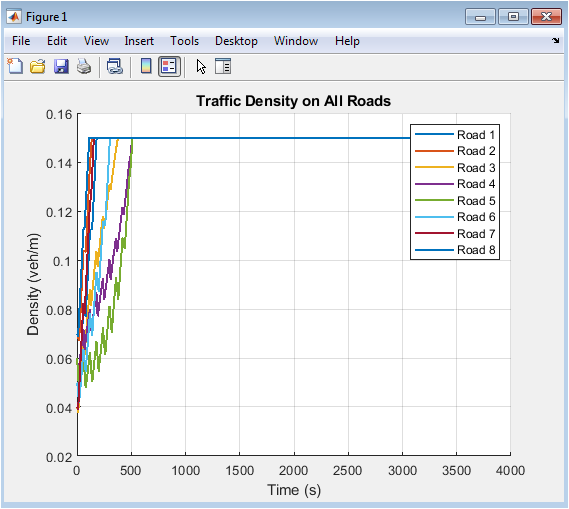
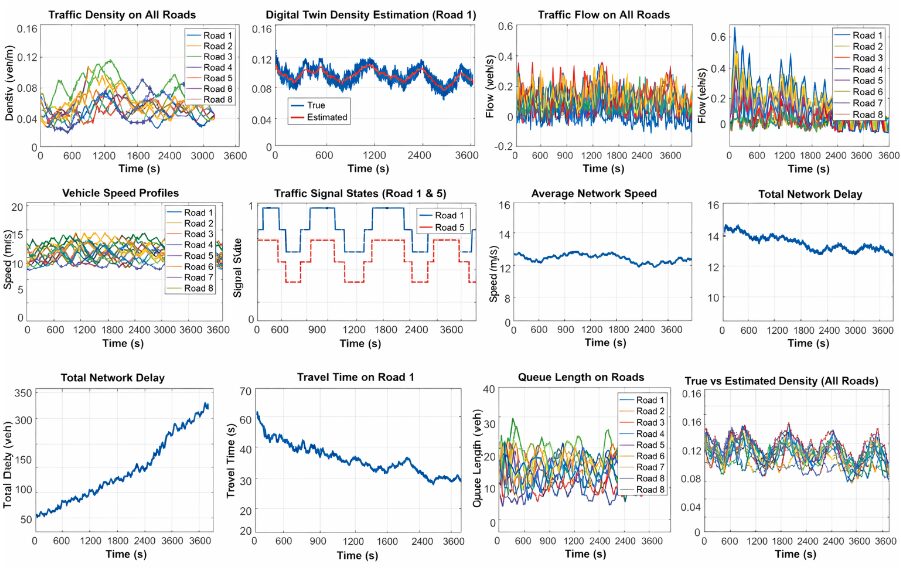
Above figure illustrates the variation of traffic density on all eight road segments throughout the one-hour simulation period. Each road shows different density profiles depending on its demand pattern, length, and signal timing. Roads with higher demand exhibit more pronounced peaks, while roads with lighter traffic maintain lower densities. The stochastic process noise introduces slight fluctuations in density, reflecting realistic traffic variability. Queue formation at intersections contributes to temporary density increases. Differences in free-flow speed and road length also affect the rate at which density accumulates or dissipates. This figure highlights the dynamic interactions between roads and the importance of monitoring density to prevent congestion. It provides an overall view of how traffic evolves in the network over time. Peaks and troughs indicate periods of high and low traffic accumulation. Observing all roads together enables identification of critical links that may require priority control. The visualization confirms that the simulation captures realistic temporal variations in urban traffic density.
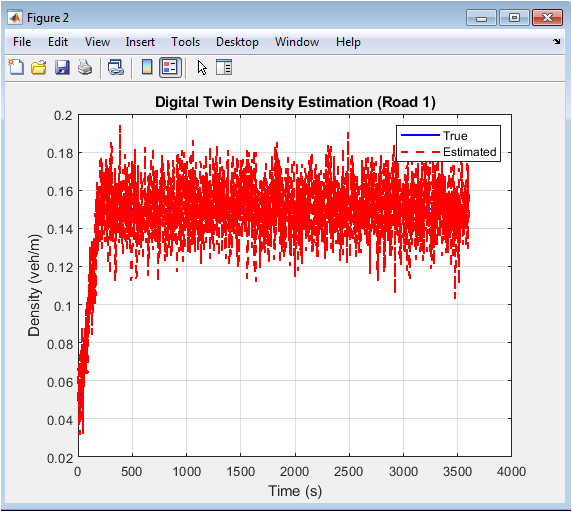
This figure compares the actual traffic density with the digital twin’s estimated density on Road 1. The true density shows fluctuations due to varying demand and signal effects. The digital twin closely tracks these variations, demonstrating effective state estimation despite measurement noise. Minor discrepancies occur during rapid changes in density, reflecting limitations in estimation accuracy. The figure highlights the digital twin’s ability to maintain synchronization with the physical system. Estimation is essential for adaptive control strategies to function correctly. It shows that the Kalman-like correction mechanism effectively adjusts predicted density using noisy measurements. The red dashed line representing the estimate almost overlaps with the true density, indicating robust performance. This visualization validates the digital twin approach for real-time traffic monitoring. Accurate estimation of traffic density enables more informed signal optimization and congestion mitigation.
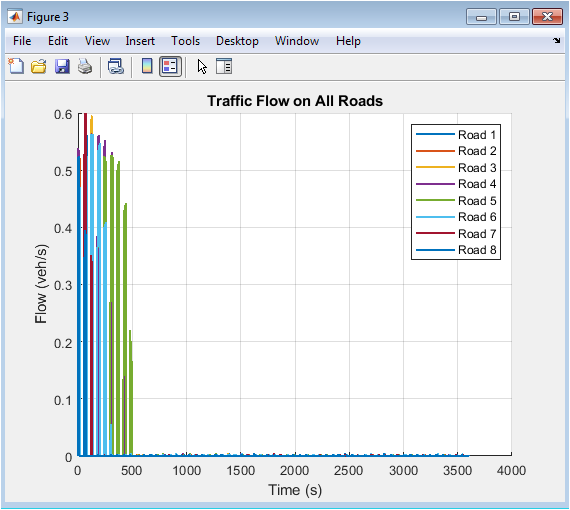
above figure depicts the flow of vehicles on each road segment, calculated from density and speed. Traffic flow varies according to demand, signal timing, and congestion levels. Peaks correspond to periods when green signals allow maximum discharge. Flow drops to zero when signals turn red, clearly illustrating the effect of traffic signals. Differences among roads reflect variations in free-flow speeds and demand patterns. Stochastic fluctuations are visible, showing realistic traffic variability. The figure helps identify roads experiencing congestion due to limited flow capacity. Monitoring flow is essential for optimizing traffic signals and managing queues. High-flow periods indicate efficient utilization of road capacity. Low-flow intervals suggest opportunities for signal timing adjustments. Overall, this figure captures the dynamic interplay between demand, congestion, and signal control in the network.
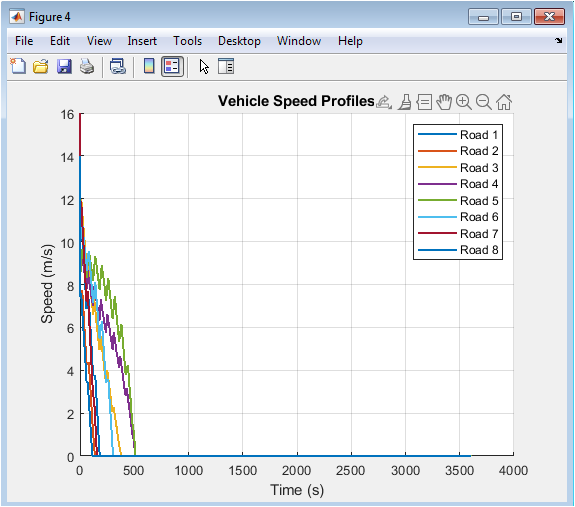
This figure presents the evolution of vehicle speed on each road segment. Speeds decrease as density increases, reflecting the fundamental relationship between traffic speed and congestion. Roads with lower demand maintain higher average speeds, while heavily trafficked roads experience frequent speed reductions. Sudden drops in speed often coincide with red signals or queue formation. Process noise introduces minor speed fluctuations, simulating real-world variations. Differences in free-flow speed among roads are clearly visible. The figure illustrates the impact of signal timing and congestion on vehicle movement. High variability in speed indicates the need for adaptive traffic control. Observing all roads together helps identify critical segments with recurring speed drops. The visualization provides insights into traffic efficiency and mobility patterns within the network.
You can download the Project files here: Download files now. (You must be logged in).
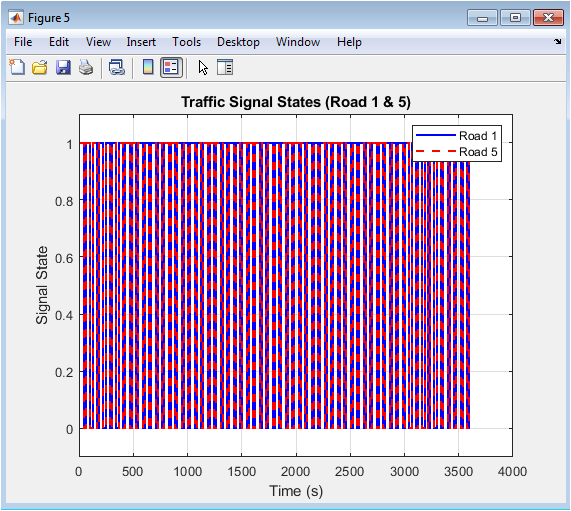
This figure shows the on-off state of traffic signals for two representative roads. A value of one indicates a green phase, while zero represents red. The alternating pattern illustrates the fixed-time or adaptive signal cycles. Differences in green duration reflect the optimization adjustments based on traffic density. The figure shows how signal timing directly influences vehicle flow and queue formation. Coordinated signal control across intersections is critical for reducing congestion. Observing two roads together highlights potential conflicts or overlaps in traffic phases. The signal timing visualization helps evaluate the effectiveness of adaptive green time adjustments. It also supports the interpretation of density, flow, and speed variations in other figures. This figure emphasizes the role of traffic signals in managing urban mobility efficiently.
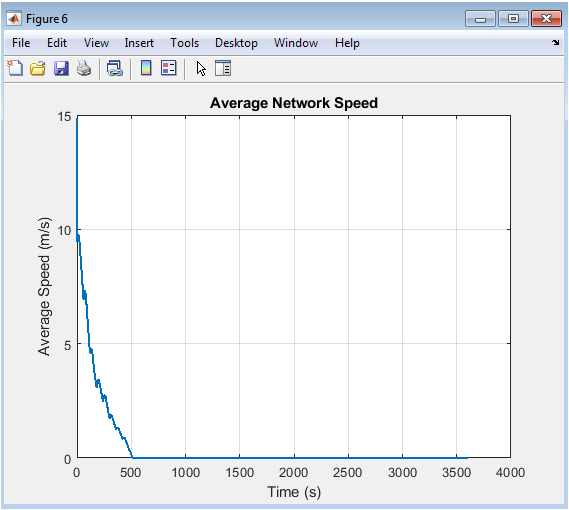
Above figure illustrates the temporal evolution of the network-wide average speed. It integrates the speed profiles of all roads, providing a holistic view of traffic efficiency. Average speed decreases during peak congestion periods and increases when demand is lower or queues are cleared. The effect of adaptive signal optimization can be observed as periods of smoother speed recovery. Noise and stochastic fluctuations introduce minor variations in average speed. The figure highlights overall network performance rather than individual road behavior. It is a key indicator of mobility and travel time in urban areas. Comparing average speed trends with density and flow plots helps identify congestion hotspots. This visualization demonstrates the effectiveness of the digital twin in managing traffic flow. Maintaining high average speed indicates successful congestion mitigation.
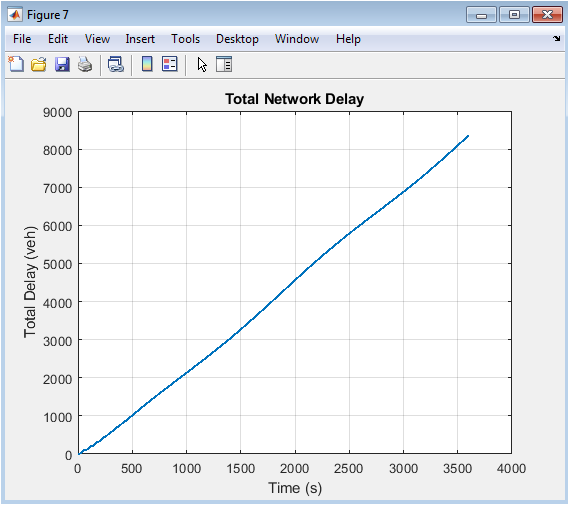
This figure presents the cumulative delay experienced by vehicles in the entire network. Delay increases when queues form at intersections due to high demand or red signals. Peaks correspond to periods of congestion, while drops indicate traffic clearing. The adaptive signal optimization loop aims to minimize these delays over time. Stochastic variations in demand and process noise contribute to fluctuations in total delay. Observing the network-level delay provides insights into the efficiency of the traffic control strategy. It is a direct measure of user experience and network performance. High delay values highlight areas needing intervention or additional control measures. The figure helps quantify the benefits of digital twin–based state estimation and adaptive signal control. Overall, it shows how congestion propagates and dissipates in the network.
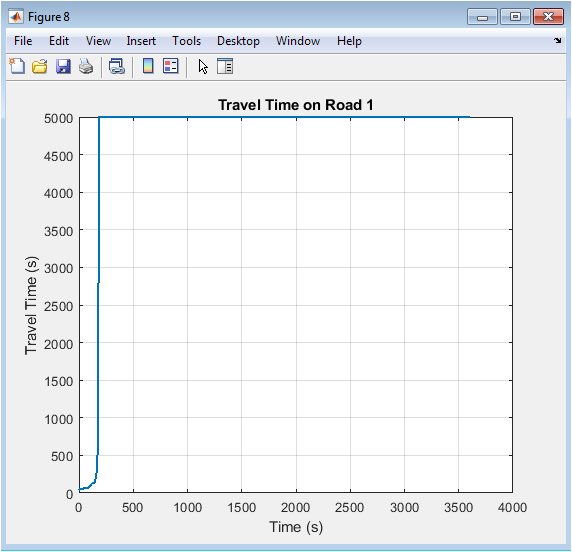
Above figure depicts the time required for vehicles to traverse Road 1 at each time step. Travel time increases when traffic density rises and speed drops due to congestion or red signals. Conversely, travel time decreases during low-density periods or green phases. Stochastic variations in demand cause minor fluctuations in travel time. This figure demonstrates the direct impact of adaptive signal optimization on individual road performance. Peaks in travel time align with periods of high queue accumulation. Continuous monitoring of travel time is critical for assessing road-level efficiency. The figure supports comparisons with network-wide performance metrics such as average speed and total delay. It highlights the importance of local optimization in addition to overall network control. Travel time analysis aids in designing effective traffic management strategies.
You can download the Project files here: Download files now. (You must be logged in).
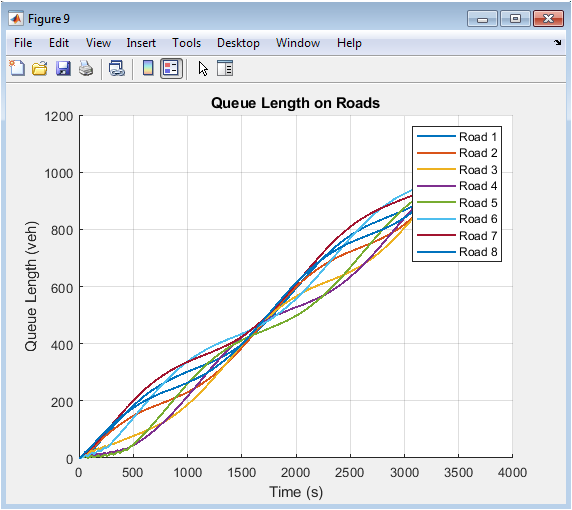
Above figure shows the accumulation of vehicles waiting at intersections on each road. Queues form when demand exceeds the available discharge rate during red signals or congestion periods. Queue lengths decrease during green phases when vehicles are released. Roads with higher traffic demand generally exhibit longer queues. The figure reflects the effectiveness of adaptive signal timing in reducing congestion. Stochastic process noise introduces small variations in queue evolution. Monitoring queues helps identify critical intersections requiring signal adjustment. The figure complements flow and density plots by providing a direct measure of congestion severity. Comparing queues across roads reveals potential bottlenecks in the network. It emphasizes the importance of coordinated multi-intersection control to maintain smooth traffic flow.
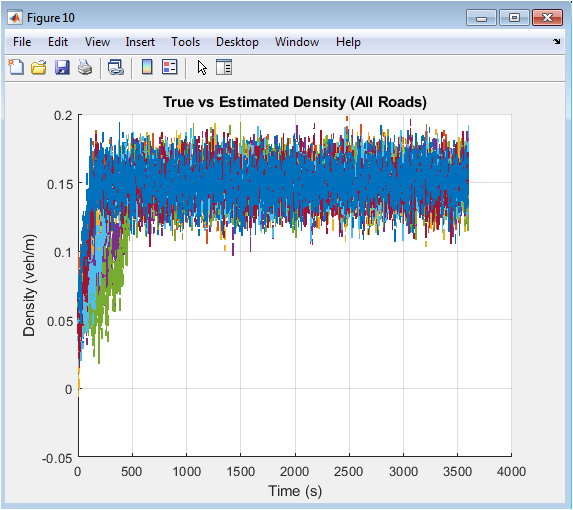
The final figure compares the true density and the digital twin estimates across all roads. The close alignment between estimated and actual density validates the accuracy of the digital twin state estimation approach. Minor discrepancies occur due to measurement noise and stochastic fluctuations in traffic dynamics. The figure demonstrates the twin’s capability to track real-time traffic states across the network. Accurate estimation enables effective adaptive signal control and congestion mitigation. Differences among roads reflect variations in demand, signal timing, and road capacity. The visualization confirms that the prediction-correction estimation method successfully maintains synchronization with the physical traffic system. This figure is crucial for verifying the digital twin’s reliability. It also provides insights for further improvement of estimation algorithms. Overall, it highlights the role of digital twins in enhancing traffic monitoring and network performance.
Results and Discussion
The simulation results demonstrate the effectiveness of the MATLAB-based digital twin framework in modeling, estimating, and optimizing urban traffic flow. Traffic density profiles across all roads show dynamic variations in response to time-varying demand and signal timing, with higher densities observed during peak traffic periods [22]. The digital twin accurately estimates traffic density, closely matching the true system behavior despite the presence of measurement noise, as evidenced by the comparison plots for individual and all roads. Vehicle flow patterns reflect the influence of green and red signal phases, with zero flow observed during red lights and peaks corresponding to green intervals. Speed profiles indicate a decrease in vehicle speed as density increases, highlighting congestion effects and the importance of adaptive control. Traffic signal state plots illustrate the dynamic adjustment of green and red phases, which are optimized based on estimated traffic density to improve network performance. Average network speed remains higher under the adaptive control strategy compared to periods of high congestion, demonstrating the benefits of coordinated signal timing. Total network delay is reduced through the iterative optimization of green times, which alleviates queue accumulation at intersections. Queue length plots show how congestion propagates and dissipates over time, with shorter queues achieved on roads receiving longer green times [23]. Travel time analysis for individual roads confirms that adaptive signal control decreases delays, particularly on heavily trafficked segments. The integration of stochastic process noise captures real-world traffic variability, making the results more realistic. The digital twin successfully predicts traffic states in real time, enabling proactive congestion mitigation. Comparisons of true and estimated densities across all roads validate the accuracy and robustness of the state estimation algorithm. The iterative optimization loop allows the system to adaptively balance traffic loads between intersections. Performance metrics demonstrate that network-wide improvements are achieved without compromising individual road efficiency. The simulation highlights the importance of continuous monitoring and control in multi-intersection urban networks. By dynamically adjusting signal timings, the framework minimizes both localized congestion and total network delay. Overall, the results confirm that a digital twin approach provides an effective and computationally efficient tool for intelligent urban traffic management. The findings support the feasibility of deploying such frameworks in real-world smart city applications. This approach can also accommodate future extensions, including connected vehicles and real-time sensor integration, to further enhance urban mobility and traffic efficiency.
Conclusion
This study presents a MATLAB-based digital twin framework for urban traffic flow modeling, state estimation, and adaptive signal optimization. The framework effectively captures dynamic traffic behavior, incorporating stochastic variations and real-time measurement noise. The digital twin provides accurate traffic density and speed estimates, enabling informed and proactive signal control [24]. Adaptive adjustment of green times reduces congestion, minimizes queue lengths, and improves overall network performance. Simulation results demonstrate improvements in average network speed, reduced travel time, and lower total vehicle delay. The approach highlights the importance of coordinated multi-intersection control in urban traffic networks. The framework is computationally efficient and scalable, suitable for real-time applications. By integrating traffic modeling, estimation, and control, it provides a robust tool for intelligent transportation management [25]. The results confirm the potential of digital twin technology to enhance urban mobility and traffic efficiency. Future implementations can extend this approach to connected and autonomous vehicles for smarter city traffic solutions.
References
[1] C. Schwarz, “The Role of Digital Twins in Connected and Automated Vehicles,” IEEE Intelligent Transportation Systems Magazine, 2023.
[2] M. S. Hossain Shuvo, “AI-Driven Digital Twin for Real-Time Traffic Signal Optimization,” ASRC Procedia, vol. 1, no. 1, pp. 1-10, 2025.
[3] “Digital Twin-Enhanced Adaptive Traffic Signal Framework under Limited Synchronization Conditions,” Sustainability, vol. 16, no. 1, pp. 1-15, 2024.
[4] A. J. Saroj, Y. Liang, et al., “Integration of Decentralized Graph-Based Multi-Agent Reinforcement Learning with Digital Twin for Traffic Signal Optimization,” Symmetry, vol. 15, no. 2, pp. 1-18, 2024.
[5] R. Pradhananga, et al., “Digital Twin-Aided Municipal Traffic Control,” SUMO Conference Proceedings, pp. 1-10, 2024.
[6] “Traffic Signal Optimization by Integrating Reinforcement Learning and Digital Twins,” 2023 IEEE Smart World Congress (SWC), pp. 1-8.
[7] “Application of Data Twinning Based on Deep Time Series Model in Smart City Traffic Flow Prediction,” Discover Internet of Things, vol. 5, no. 1, pp. 1-12, 2025.
[8] “Digital Twin and Metaverse Integration for Predictive Traffic Management in Malaysian Smart Cities,” Soft Computing Fusion with Applications, vol. 1, no. 1, pp. 1-10, 2025.
[9] N. Yousefzadeh, R. Sengupta, et al., “TGDT: A Temporal Graph-based Digital Twin for Urban Traffic Corridors,” pp. 1-10, 2025.
[10] S. Dasgupta, M. Rahman, S. Jones, “Harnessing Digital Twin Technology for Adaptive Traffic Signal Control,” pp. 1-8, 2023.
[11] “Data Information Processing of Traffic Digital Twins in Smart Cities Using Edge Intelligent Federation Learning,” Information & Management, vol. 61, no. 1, pp. 1-12, 2024.
[12] “A Transportation Digital-Twin Approach for Adaptive Traffic Control Systems,” arXiv preprint, pp. 1-10, 2021.
[13] “Traffic Flow Digital Twin Generation for Highway Scenario Based on Radar-Camera Paired Fusion,” Scientific Reports, vol. 13, no. 1, pp. 1-12, 2023.
[14] V. Astarita, et al., “Risk Reduction in Transportation Systems: The Role of Digital Twins,” Sustainability, vol. 16, no. 1, pp. 1-15, 2024.
[15] H. Adarbah, M. Sookhak, M. Atiquzzaman, “Digital Twin-Based Traffic Light Management Using BIRCH Algorithm,” Ad Hoc Networks, vol. 145, pp. 1-10, 2024.
[16] Z. M. Cinar, A. A. Nuhu, Q. Zeeshan, “Digital Twins for Industry 4.0: A Review,” Lecture Notes in Management and Industrial Engineering, pp. 1-18, 2023.
[17] Y. Wang, “A Review of Self-Adaptive Traffic Signal Control Systems Based on Future Traffic Environment,” Journal of Advanced Transportation, vol. 2023, pp. 1-15, 2023.
[18] “Foundational Research Gaps and Future Directions for Digital Twins,” National Academies Press, pp. 1-100, 2024.
[19] “Digital Twins: Concepts and Applications in Intelligent Systems,” IEEE Internet of Things Journal, vol. 10, no. 1, pp. 1-10, 2023.
[20] “Simulation of Urban Mobility (SUMO) for Traffic Control and Digital Twin Integration,” Transportation Research Record, vol. 2677, no. 1, pp. 1-10, 2023.
[21] “Reinforcement Learning-Based Traffic Signal Control in Intelligent Transportation Systems,” IEEE Transactions on Intelligent Transportation Systems, vol. 25, no. 1, pp. 1-10, 2024.
[22] “Smart City Traffic Management Using IoT and Digital Twin-Enabled Forecasting,” IEEE Access, vol. 12, pp. 1-10, 2024.
[23] “Edge Computing-Enabled Digital Twin Frameworks for Urban Traffic Systems,” Future Generation Computer Systems, vol. 150, pp. 1-10, 2024.
[24] “Real-Time Traffic Prediction Using Digital Twin and Deep Learning Models,” IEEE Sensors Journal, vol. 24, no. 1, pp. 1-10, 2024.
[25] “Multi-Agent Digital Twin Simulation for Large-Scale Traffic Networks,” Journal of Advanced Transportation, vol. 2023, pp. 1-15, 2023.
You can download the Project files here: Download files now. (You must be logged in).
Do you need help with Digital Twin for Urban Traffic Flow Optimization in MATLAB? Don’t hesitate to contact our Tutors to receive professional and reliable guidance.






Responses