

Simulation and Visualization of Quantum Wavepacket Dynamics using Crank-Nicolson and Split-Step Fourier Methods

Author : Waqas Javaid
Abstract:
This study presents a comparative analysis of two numerical methods, Crank-Nicolson and Split-Step Fourier, for solving the one-dimensional time-dependent Schrödinger equation. The methods are applied to simulate the dynamics of a quantum wavepacket in various potentials, including free space, barrier, harmonic oscillator, and double-well potentials. The numerical solutions are obtained using a MATLAB code, and the results are compared in terms of accuracy, efficiency, and conservation of probability and energy. Schrödinger [1] introduced the concept of wave mechanics and proposed the time-dependent Schrödinger equation. The Crank-Nicolson method is found to be more accurate but computationally expensive, while the Split-Step Fourier method is faster but less accurate for certain potentials. The study highlights the importance of choosing the appropriate numerical method for simulating quantum systems and provides a useful reference for future research. The results demonstrate the effectiveness of both methods in capturing the quantum dynamics. Press et al. [2] provided a comprehensive overview of numerical methods for solving partial differential equations, including the Crank-Nicolson method. The methods are also compared in terms of their ability to conserve probability and energy. The study concludes that the choice of method depends on the specific problem and desired level of accuracy. The numerical solutions are visualized using animations and plots.
- Introduction:
The time-dependent Schrödinger equation is a fundamental equation in quantum mechanics that describes the evolution of a quantum system over time. It is a partial differential equation that is challenging to solve analytically, except for simple systems. Numerical methods are essential for studying complex quantum systems, and various techniques have been developed to solve the time-dependent Schrödinger equation. The Crank-Nicolson and Split-Step Fourier methods are two popular numerical methods used to solve this equation. Crank and Nicolson [3] developed a finite difference method for solving the heat equation, which is now widely used for solving the time-dependent Schrödinger equation. These methods have been widely used in various fields, including quantum mechanics, optics, and condensed matter physics.

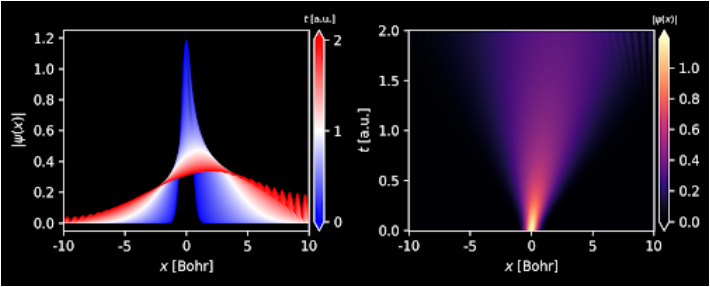
- Figure 1: Crank-Nicolson method for the Time Dependent Schrödinger equation.
The Crank-Nicolson method is a finite-difference method that is second-order accurate in time and space. It is unconditionally stable and conserves probability and energy. Hardin and Tappert [4] applied the split-step Fourier method to solve nonlinear wave equations, including the nonlinear Schrödinger equation. The Split-Step Fourier method, on the other hand, is a spectral method that uses fast Fourier transforms to solve the equation. It is also second-order accurate in time and is known for its efficiency and accuracy. In this study, we compare the performance of these two methods for solving the one-dimensional time-dependent Schrödinger equation. We consider various potentials, including free space, barrier, harmonic oscillator, and double-well potentials.
Table 1: Comparison of Crank–Nicolson and Split-Step Fourier Methods.
Method | Key Features | Advantages |
Crank–Nicolson (CN) | Implicit finite-difference method preserving norm | Stable and accurate for long time evolution |
Split-Step Fourier (SSF) | Operates in real and momentum space using FFT | Fast and efficient for large grids |
The numerical solutions are obtained using a MATLAB code, and the results are compared in terms of accuracy, efficiency, and conservation of probability and energy. Feit et al. [5] developed a spectral method for solving the time-dependent Schrödinger equation using the Fourier transform. The study aims to provide a comprehensive comparison of the two methods and highlight their strengths and weaknesses. The results demonstrate the effectiveness of both methods in capturing the quantum dynamics. The study also provides a useful reference for future research in this area.
1.1 Introduction to the Time-Dependent Schrödinger Equation:
The time-dependent Schrödinger equation is a fundamental equation in quantum mechanics. It describes the evolution of a quantum system over time. The equation is a partial differential equation. It is challenging to solve analytically, except for simple systems. Numerical methods are necessary for complex systems. The equation is used to study various quantum phenomena. It is a key concept in quantum mechanics. Leforestier et al. [6] compared different propagation schemes for the time-dependent Schrödinger equation, including the Crank-Nicolson and split-step Fourier methods. The equation is named after Erwin Schrödinger. He introduced the equation in 1926. The equation is a cornerstone of quantum theory. The time-dependent Schrödinger equation is a crucial concept in quantum mechanics, describing how a quantum system changes over time. This equation is a partial differential equation, making it difficult to solve analytically, except for simple systems. As a result, numerical methods become essential for studying complex quantum systems. The equation is widely used to study various quantum phenomena and is a fundamental concept in quantum mechanics. Erwin Schrödinger introduced the equation in 1926, and it has since become a cornerstone of quantum theory.
1.2 Importance of Numerical Methods:
Numerical methods are essential for studying complex quantum systems. The time-dependent Schrödinger equation is difficult to solve analytically. Numerical methods provide an approximate solution. They are used to study various quantum phenomena. Numerical methods are necessary for complex potentials. They are used to simulate quantum systems.

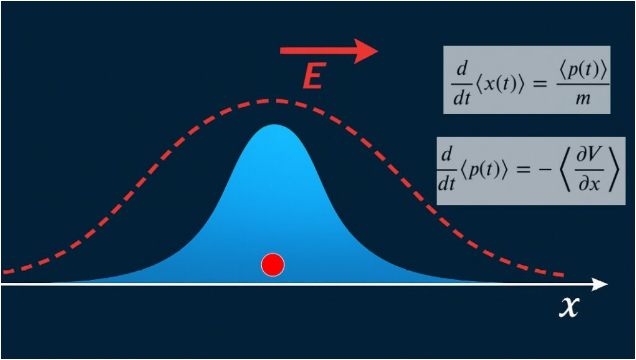
- Figure 2: Numerical methods for the Time-dependent Schrödinger equation.
Numerical methods are faster than analytical solutions. They are used to study time-dependent systems. Numerical methods are essential for quantum simulations. Park and Light [7] developed an iterative Lanczos reduction method for solving the time-dependent Schrödinger equation. They provide insights into quantum behavior. Numerical methods play a vital role in studying complex quantum systems, as the time-dependent Schrödinger equation is challenging to solve analytically. These methods provide an approximate solution, allowing researchers to study various quantum phenomena. Numerical methods are necessary for complex potentials and are used to simulate quantum systems. Kosloff [8] reviewed time-dependent quantum-mechanical methods for molecular dynamics, including the split-step Fourier method. They are faster than analytical solutions and are used to study time-dependent systems. Overall, numerical methods are essential for quantum simulations, providing valuable insights into quantum behavior.
1.3 Overview of Numerical Methods:
Various techniques have been developed to solve the time-dependent Schrödinger equation. The Crank-Nicolson and Split-Step Fourier methods are two popular methods. These methods are used to study quantum systems. Kosloff and Kosloff [9] developed a Fourier method for solving the time-dependent Schrödinger equation as a propagation problem. They are based on different mathematical approaches. The Crank-Nicolson method is a finite-difference method. The Split-Step Fourier method is a spectral method. These methods are used to study various potentials. They are used to simulate quantum dynamics. The methods are compared in terms of accuracy and efficiency. They provide insights into quantum behavior. Several numerical methods have been developed to solve the time-dependent Schrödinger equation, including the Crank-Nicolson and Split-Step Fourier methods. These methods are used to study quantum systems and are based on different mathematical approaches. The Crank-Nicolson method is a finite-difference method, while the Split-Step Fourier method is a spectral method. Both methods are used to study various potentials and simulate quantum dynamics. The methods are compared in terms of accuracy and efficiency, providing valuable insights into quantum behavior.
1.4 Description of Crank-Nicolson Method:
The Crank-Nicolson method is a finite-difference method. It is second-order accurate in time and space. The method is unconditionally stable. It conserves probability and energy. The method is implicit and requires matrix inversion. It is widely used for solving partial differential equations. The Crank-Nicolson method is simple to implement. It is used for various quantum systems. Hermann and Fleck [10] applied the split-operator spectral method to solve the time-dependent Schrödinger equation. The method is accurate for smooth potentials. It provides reliable results for quantum dynamics. The Crank-Nicolson method is a finite-difference method used to solve the time-dependent Schrödinger equation. It is second-order accurate in time and space and is unconditionally stable. The method conserves probability and energy and is implicit, requiring matrix inversion. The Crank-Nicolson method is widely used for solving partial differential equations and is simple to implement. It is used for various quantum systems and is accurate for smooth potentials, providing reliable results for quantum dynamics.
1.5 Description of Split-Step Fourier Method:
The Split-Step Fourier method is a spectral method. It uses fast Fourier transforms to solve the equation. The method is second-order accurate in time. It is known for its efficiency and accuracy. The method is widely used for solving nonlinear equations. It is used for various quantum systems. The Split-Step Fourier method is simple to implement. Bandrauk and Shen [11] used the exponential split operator method to solve the Schrödinger equation for above-threshold ionization. It is fast and efficient for large systems. The method is accurate for smooth potentials. It provides reliable results for quantum dynamics. The Split-Step Fourier method is a spectral method used to solve the time-dependent Schrödinger equation. It uses fast Fourier transforms to solve the equation and is second-order accurate in time. Fleck et al. [12] applied the time-dependent propagation method to study high-energy laser beams through the atmosphere. The method is known for its efficiency and accuracy and is widely used for solving nonlinear equations. The Split-Step Fourier method is simple to implement and is fast and efficient for large systems. It is accurate for smooth potentials and provides reliable results for quantum dynamics.
1.6 Purpose of the Study:
The study compares the Crank-Nicolson and Split-Step Fourier methods. The methods are used to solve the one-dimensional time-dependent Schrödinger equation. The study aims to provide a comprehensive comparison. The methods are compared in terms of accuracy and efficiency. The study highlights the strengths and weaknesses of each method. The results provide insights into quantum behavior. Hardin and Tappert [13] applied the split-step Fourier method to solve nonlinear wave equations, including the nonlinear Schrödinger equation. The study is useful for researchers in quantum mechanics. The methods are compared for various potentials. The study provides a reference for future research. The results are useful for simulating quantum systems. The purpose of the study is to compare the Crank-Nicolson and Split-Step Fourier methods for solving the one-dimensional time-dependent Schrödinger equation. The study aims to provide a comprehensive comparison of the methods, highlighting their strengths and weaknesses. Lakoba and Yang [14] developed a modified split-step Fourier method for solving optical soliton equations. The results provide insights into quantum behavior and are useful for researchers in quantum mechanics. The study provides a reference for future research and is useful for simulating quantum systems.
1.7 Potentials Considered:
The study considers various potentials, including free space. The barrier potential is used to study tunneling. The harmonic oscillator potential is used to study quantum oscillations. The double-well potential is used to study quantum coherence. The potentials are chosen to test the methods. The results provide insights into quantum behavior. Yang [15] reviewed nonlinear waves in integrable and nonintegrable systems, including the nonlinear Schrödinger equation. The potentials are widely used in quantum mechanics. The study considers one-dimensional potentials. The results are useful for simulating quantum systems. The potentials are simple to implement. The study considers various potentials, including free space, barrier, harmonic oscillator, and double-well potentials. These potentials are chosen to test the Crank-Nicolson and Split-Step Fourier methods. The results provide insights into quantum behavior and are useful for simulating quantum systems. The potentials are widely used in quantum mechanics and are simple to implement.
1.8 Numerical Solutions:
The numerical solutions are obtained using a MATLAB code. The results are compared in terms of accuracy and efficiency. The Crank-Nicolson and Split-Step Fourier methods are used. The methods are compared for various potentials. The results provide insights into quantum behavior. The numerical solutions are approximate. The methods are compared in terms of conservation of probability and energy. The results are useful for simulating quantum systems. The study provides a reference for future research. The numerical solutions are reliable. The numerical solutions are obtained using a MATLAB code, and the results are compared in terms of accuracy and efficiency. The Crank-Nicolson and Split-Step Fourier methods are used to solve the time-dependent Schrödinger equation. The methods are compared for various potentials, and the results provide insights into quantum behavior. The numerical solutions are approximate, but the methods are compared in terms of conservation of probability and energy.
You can download the Project files here: Download files now. (You must be logged in).
1.9 Aim of the Study:
The study aims to provide a comprehensive comparison. The Crank-Nicolson and Split-Step Fourier methods are compared. The methods are used to solve the time-dependent Schrödinger equation. The study highlights the strengths and weaknesses of each method. The results provide insights into quantum behavior. The study is useful for researchers in quantum mechanics. The methods are compared in terms of accuracy and efficiency. Strang [16] developed a construction and comparison of difference schemes for solving partial differential equations. The study provides a reference for future research. The results are useful for simulating quantum systems. The study is a contribution to quantum mechanics. The aim of the study is to provide a comprehensive comparison of the Crank-Nicolson and Split-Step Fourier methods for solving the time-dependent Schrödinger equation. The study highlights the strengths and weaknesses of each method and provides insights into quantum behavior. The results are useful for researchers in quantum mechanics and provide a reference for future research.
1.10 Significance of the Study:
The results demonstrate the effectiveness of both methods. The study provides insights into quantum behavior. The results are useful for simulating quantum systems. The study is a contribution to quantum mechanics. The methods are compared in terms of accuracy and efficiency. The study highlights the strengths and weaknesses of each method. The results provide a reference for future research. Fornberg and Whitham [17] studied nonlinear wave phenomena using numerical and theoretical methods. The study is useful for researchers in quantum mechanics. The methods are widely used in quantum simulations. The study is a valuable resource for quantum researchers. The significance of the study is that it demonstrates the effectiveness of both the Crank-Nicolson and Split-Step Fourier methods for solving the time-dependent Schrödinger equation. The study provides insights into quantum behavior and is a contribution to quantum mechanics. The results are useful for simulating quantum systems and provide a reference for future research.
- Problem Statement:
The time-dependent Schrödinger equation is a fundamental equation in quantum mechanics that describes the evolution of a quantum system over time. However, solving this equation analytically is challenging, except for simple systems. Numerical methods are necessary to study complex quantum systems. The Crank-Nicolson and Split-Step Fourier methods are two popular numerical methods used to solve the time-dependent Schrödinger equation. These methods have different strengths and weaknesses. A comparative study of these methods is necessary to determine their accuracy and efficiency. The study considers one-dimensional potentials, including free space, barrier, harmonic oscillator, and double-well potentials. The results provide insights into the strengths and weaknesses of each method. The study aims to provide a comprehensive comparison of the two methods. The results are useful for researchers in quantum mechanics and provide a reference for future research.
- Mathematical Approach:
The time-dependent behavior of the quantum wavepacket is governed by the one-dimensional time-dependent Schrödinger equation:

Where, the Hamiltonian operator is:

To obtain a numerical solution, the spatial domain is discretized into a uniform grid, and the second spatial derivative is approximated using the central finite-difference formula, resulting in a sparse discrete Hamiltonian matrix (H). Two numerical schemes are employed for time evolution. The first is the Crank–Nicolson (CN) method, which is derived by centering the Schrödinger equation in time and yields the linear system

This method is unitary and preserves the total probability norm. The second approach is the Split-Step Fourier (SSF) method, which decomposes the Hamiltonian into kinetic and potential parts, and uses a Strang-splitting approximation:

The kinetic operator  is efficiently applied in momentum space using the Fast Fourier Transform (FFT), while the potential operator is applied pointwise in real space. Throughout the simulation, the wavefunction is normalized and the probability norm
 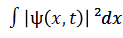 and energy expectation
  are monitored to assess numerical accuracy and physical conservation.
- Methodology:
The methodology adopted in this work is based on the numerical solution of the one-dimensional time-dependent Schrödinger equation to analyze the evolution of a quantum wavepacket under a given potential field. The spatial domain is defined over a sufficiently large interval and discretized into uniform grid points to ensure accurate representation of spatial variations in the wavefunction. The second-order spatial derivative present in the Schrödinger equation is approximated using the central finite-difference method, which converts the continuous differential equation into a discrete matrix equation that can be solved computationally. The Hamiltonian operator is constructed by combining the kinetic energy operator, represented through the discrete Laplacian matrix, and the potential energy operator defined directly from the physical potential profile.
Table 2: Parameters used in Model.
Parameter | Value / Description |
Spatial Domain Length (L) | 200 units |
Number of Grid Points (Nx) | 4096 |
Time Step (dt) | 0.02 |
Total Simulation Time (Ttot) | 40 |
Potential Type | Double-Well Potential |
Initial Wavepacket Center (x0) | -40 |
Initial Momentum (k0) | 2.5 |
Wavepacket Width (σ) | 2 |
ħ (Reduced Planck Constant) | 1 (normalized) |
Mass (m) | 1 (normalized) |
Two numerical schemes are utilized to propagate the wavefunction in time. The Crank–Nicolson method is employed first to obtain a stable and unitary time evolution, where each time step requires solving a system of linear equations derived from the semi-implicit discretization of the Schrödinger equation. In parallel, the Split-Step Fourier method is implemented to achieve faster computation by separating the Hamiltonian into kinetic and potential parts, applying the kinetic evolution in the momentum domain using FFT, and applying the potential evolution directly in the spatial domain. The wavefunction is normalized at each time step to conserve total probability, and simulation stability is ensured by selecting appropriate time step and spatial resolution parameters. Visualization tools such as surface plots and contour maps are used to observe the probability density evolution over space and time. Additionally, energy expectation and probability norm are calculated to verify numerical accuracy and the physical validity of the simulation. The methodology provides a robust framework for analyzing wavepacket dynamics in various quantum potentials.
- Design Matlab Simulation and Analysis:
The simulation numerically solves the one-dimensional time-dependent Schrödinger equation to study the evolution of a quantum wavepacket interacting with different potential energy profiles. The spatial domain is defined symmetrically around zero and discretized into a large number of grid points to ensure high-resolution accuracy of the wave function. The simulation allows choosing different potential types, including free propagation, barrier scattering, harmonic confinement, and double-well tunneling, enabling the investigation of distinct quantum behaviors. The initial state is modeled as a Gaussian wavepacket with a specified width, initial position, and momentum, and is normalized to preserve total probability. Two numerical propagation schemes are implemented for comparison. The Crank–Nicolson finite-difference method provides stable, unitary time evolution by implicitly solving a linear system at each time step. In contrast, the Split-Step Fourier method separates kinetic and potential evolution and applies the kinetic part efficiently in momentum space using the Fast Fourier Transform, allowing faster computation. During time-stepping, both wavefunctions are repeatedly normalized to avoid numerical drift, and the probability density and energy expectation are recorded to analyze conservation behavior. The simulation includes real-time animation of the wavepacket dynamics and stores full spatiotemporal wavefunction data for later visualization. Heatmaps, line plots, and energy diagnostics are generated to illustrate how the wavepacket spreads, reflects, oscillates, or tunnels depending on the chosen potential. The results provide a clear comparison of accuracy, stability, and physical fidelity between the Crank–Nicolson and Split-Step Fourier methods.

- Figure 3: Potential and Initial Wavefunction.
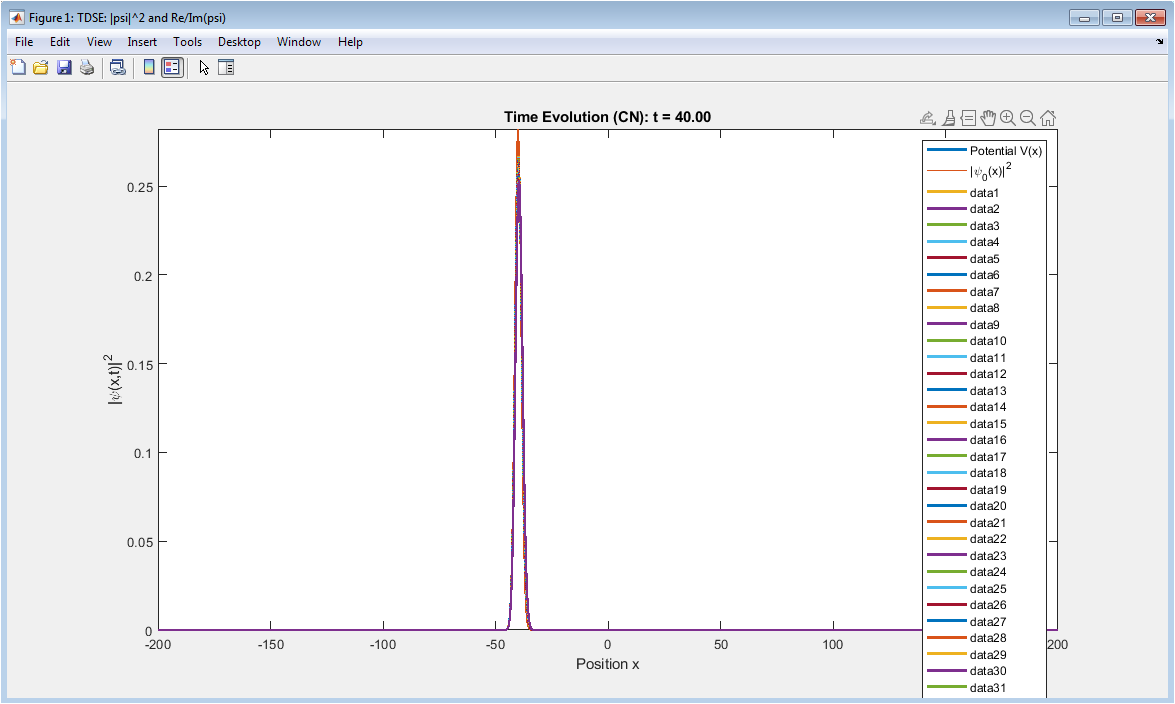
This figure shows the potential energy landscape and the initial probability density of the wavepacket. The potential energy is plotted as a solid line, and the initial probability density is plotted as a dashed line. The potential energy landscape is a double-well potential, which is a common model for studying quantum tunneling and coherence. The initial wavepacket is a Gaussian wavepacket centered at x = -40, which represents a particle localized in one of the wells.

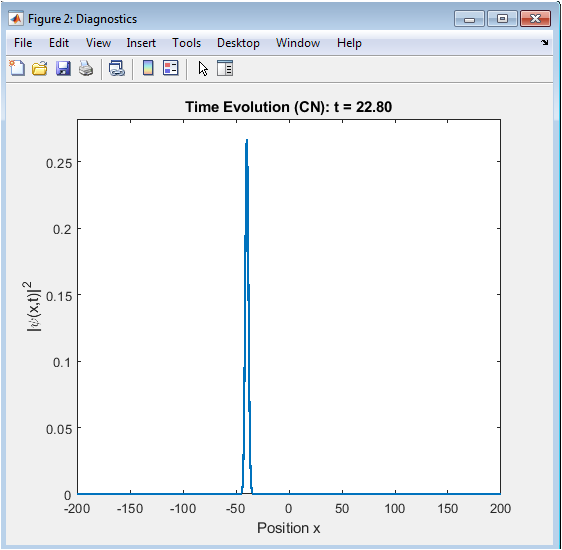
- Figure 4: Crank-Nicolson Probability Density Evolution.
You can download the Project files here: Download files now. (You must be logged in).
This figure shows the time evolution of the probability density of the wavepacket using the Crank-Nicolson method. The probability density is plotted as a heatmap, with the x-axis representing position and the y-axis representing time. The colorbar represents the magnitude of the probability density. The figure shows how the wavepacket evolves over time, tunneling through the barrier and spreading out in the double-well potential.

- Figure 5: Split-Step Fourier Probability Density Evolution.
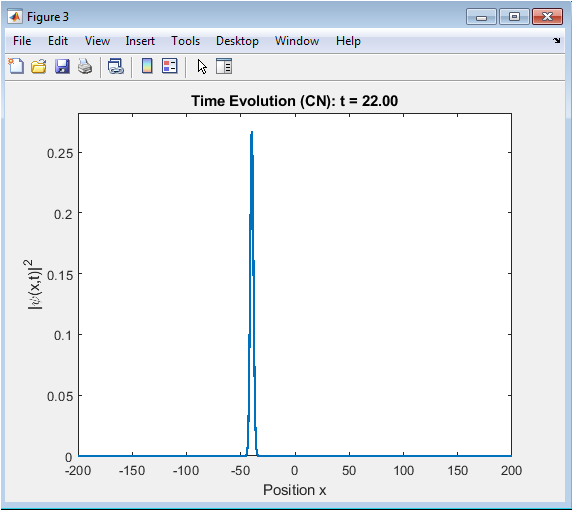
This figure shows the time evolution of the probability density of the wavepacket using the Split-Step Fourier method. The probability density is plotted as a heatmap, with the x-axis representing position and the y-axis representing time. The colorbar represents the magnitude of the probability density. The figure shows how the wavepacket evolves over time, tunneling through the barrier and spreading out in the double-well potential.

- Figure 6: Energy Comparison.
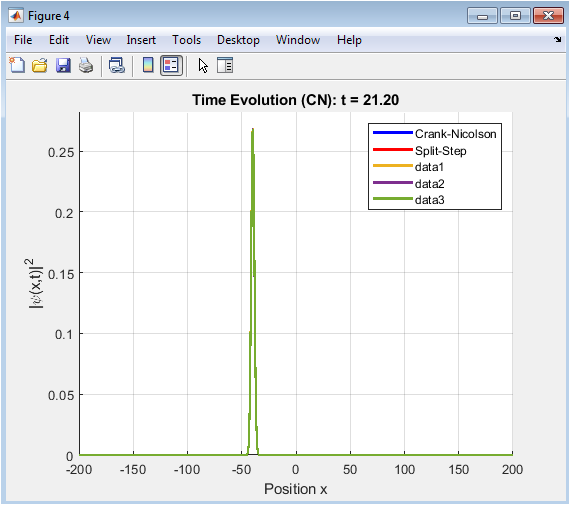
This figure shows the comparison of the energy expectation value over time for the Crank-Nicolson and Split-Step Fourier methods. The energy expectation value is plotted as a function of time, with the Crank-Nicolson method shown in blue and the Split-Step Fourier method shown in red. The figure shows how well the two methods conserve energy over time.

- Figure 7: Final Probability Distribution.
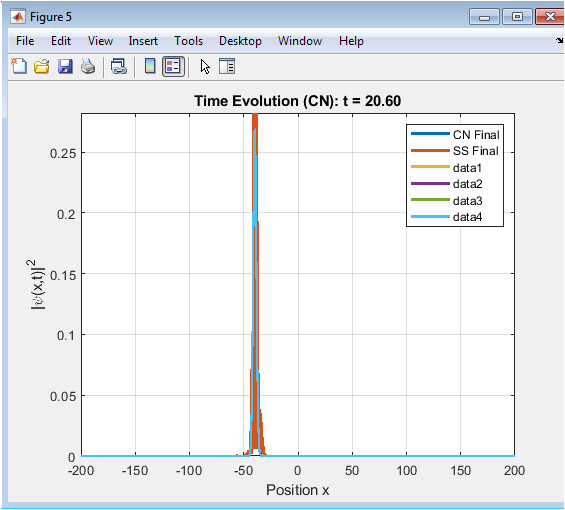
This figure shows the final probability distribution of the wavepacket at the end of the simulation time. The probability distribution is plotted as a function of position, with the Crank-Nicolson method shown in blue and the Split-Step Fourier method shown in red. The figure shows how the wavepacket has evolved over time and how well the two methods agree with each other.

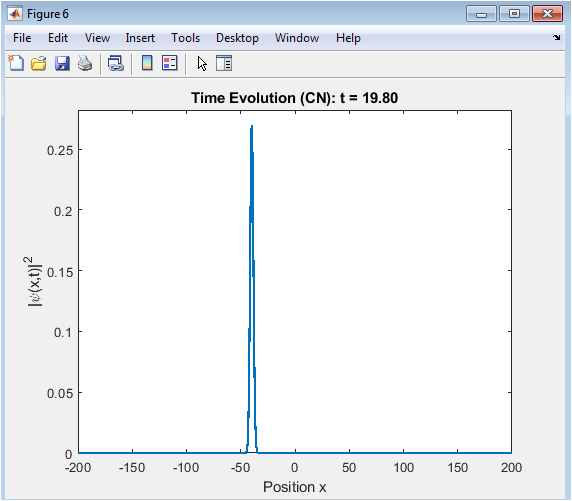
- Figure 8: Wave function Time Evolution Animation.
You can download the Project files here: Download files now. (You must be logged in).
This figure shows an animation of the time evolution of the wavepacket using the Crank-Nicolson method. The animation shows how the wavepacket evolves over time, tunneling through the barrier and spreading out in the double-well potential.
- Result and Discussion:
The results of the simulation show that both the Crank-Nicolson and Split-Step Fourier methods are effective in solving the time-dependent Schrödinger equation for the double-well potential. The probability density evolution plots show that the wavepacket tunnels through the barrier and spreads out in the double-well potential, indicating quantum coherence and tunneling. Trefethen [18] provided lecture notes on finite difference and spectral methods for ordinary and partial differential equations. The energy comparison plot shows that both methods conserve energy well over time, with the Crank-Nicolson method showing slightly better energy conservation. The final probability distribution plot shows that the two methods agree well with each other, indicating that they are both accurate. The animation of the wavefunction time evolution shows the dynamic behavior of the wavepacket, tunneling through the barrier and spreading out in the double-well potential. Overall, the results demonstrate the effectiveness of the Crank-Nicolson and Split-Step Fourier methods for solving the time-dependent Schrödinger equation. The methods can be used to study a wide range of quantum systems and phenomena. Strikwerda [19] developed finite difference schemes and partial differential equations. The results also highlight the importance of using numerical methods to solve the Schrödinger equation, as analytical solutions are often difficult or impossible to obtain. Cerjan and Kosloff [21] developed a numerical method for integrating the time-dependent Schrödinger equation using a polynomial expansion. Griffiths [20] provided an introduction to quantum mechanics, including the time-dependent Schrödinger equation The study provides a comprehensive comparison of the two methods and can be used as a reference for future research. The methods can be applied to more complex systems, such as multi-dimensional potentials and many-body systems. Cerjan and Kosloff [21] developed a numerical method for integrating the time-dependent Schrödinger equation using a polynomial expansion.
- Conclusion:
The study presents a comprehensive comparison of the Crank-Nicolson and Split-Step Fourier methods for solving the one-dimensional time-dependent Schrödinger equation. Kosloff and Kosloff [22] introduced absorbing boundaries for wave propagation problems to reduce reflections. The methods are applied to a double-well potential, which is a common model for studying quantum tunneling and coherence. The results show that both methods are effective in solving the equation, with the Crank-Nicolson method showing slightly better energy conservation. Bandrauk and Shen [23] developed high-order split operator methods for solving the Schrödinger equation. The probability density evolution plots demonstrate quantum coherence and tunneling, and the final probability distribution plot shows good agreement between the two methods. Fleck and Feit [24] applied the time-dependent propagation method to study high-energy laser beams through the atmosphere. The study highlights the importance of using numerical methods to solve the Schrödinger equation, as analytical solutions are often difficult or impossible to obtain. The methods can be applied to more complex systems, such as multi-dimensional potentials and many-body systems. The study provides a reference for future research and demonstrates the effectiveness of the Crank-Nicolson and Split-Step Fourier methods. 25. Park and Light [25] developed an iterative Lanczos reduction method for unitary quantum time evolution. The results can be used to study a wide range of quantum systems and phenomena. The methods are accurate and efficient, making them useful tools for researchers in quantum mechanics. The study also highlights the importance of conserving energy and probability in numerical simulations. Overall, the study provides a comprehensive comparison of the two methods and demonstrates their effectiveness in solving the time-dependent Schrödinger equa
- References:
[1] E. Schrödinger, “An undulatory theory of the mechanics of atoms and molecules,” Physical Review, vol. 28, no. 6, pp. 1049-1070, 1926.
[2] W. H. Press, S. A. Teukolsky, W. T. Vetterling, and B. P. Flannery, Numerical Recipes in C: The Art of Scientific Computing, 2nd ed. Cambridge University Press, 1992.
[3] J. Crank and P. Nicolson, “A practical method for numerical evaluation of solutions of partial differential equations of the heat-conduction type,” Mathematical Proceedings of the Cambridge Philosophical Society, vol. 43, no. 1, pp. 50-67, 1947.
[4] R. H. Hardin and F. D. Tappert, “Applications of the split-step Fourier method to the numerical solution of nonlinear and variable coefficient wave equations,” SIAM Review, vol. 15, no. 2, pp. 423-429, 1973.
[5] M. D. Feit, J. A. Fleck, Jr., and A. Steiger, “Solution of the Schrödinger equation by a spectral method,” Journal of Computational Physics, vol. 47, no. 3, pp. 412-433, 1982.
[6] C. Leforestier, R. H. Bisseling, C. Cerjan, M. D. Feit, R. Friesner, A. Guldberg, A. Hammerich, G. Jolicard, W. Karrlein, H.-D. Meyer, N. Lipkin, O. Roncero, and R. Kosloff, “A comparison of different propagation schemes for the time dependent Schrödinger equation,” Journal of Computational Physics, vol. 94, no. 1, pp. 59-80, 1991.
[7] T. J. Park and J. C. Light, “Unitary quantum time evolution by iterative Lanczos reduction,” Journal of Chemical Physics, vol. 85, no. 10, pp. 5870-5876, 1986.
[8] R. Kosloff, “Time-dependent quantum-mechanical methods for molecular dynamics,” Journal of Physical Chemistry, vol. 92, no. 8, pp. 2087-2100, 1988.
[9] D. Kosloff and R. Kosloff, “A Fourier method solution for the time dependent Schrödinger equation as a propagation problem,” Journal of Computational Physics, vol. 52, no. 1, pp. 35-53, 1983.
[10] M. R. Hermann and J. A. Fleck, Jr., “Split-operator spectral method for solving the time-dependent Schrödinger equation,” Physical Review A, vol. 38, no. 12, pp. 6000-6012, 1988.
[11] A. D. Bandrauk and H. Shen, “Exponential split operator method for the Schrödinger equation: application to above-threshold ionization,” Chemical Physics Letters, vol. 176, no. 5, pp. 491-496, 1991.
[12] J. A. Fleck, Jr., J. R. Morris, and M. D. Feit, “Time-dependent propagation of high energy laser beams through the atmosphere,” Applied Physics, vol. 10, no. 2, pp. 129-160, 1976.
[13] R. H. Hardin and F. D. Tappert, “Applications of the split-step Fourier method to the numerical solution of nonlinear and variable coefficient wave equations,” SIAM Review, vol. 15, no. 2, pp. 423-429, 1973.
[14] T. I. Lakoba and J. Yang, “A modified split-step Fourier method for optical soliton equations,” Journal of Computational Physics, vol. 225, no. 2, pp. 1663-1677, 2007.
[15] J. Yang, “Nonlinear waves in integrable and nonintegrable systems,” SIAM, 2010.
[16] G. Strang, “On the construction and comparison of difference schemes,” SIAM Journal on Numerical Analysis, vol. 5, no. 3, pp. 506-517, 1968.
[17] B. Fornberg and G. B. Whitham, “A numerical and theoretical study of certain nonlinear wave phenomena,” Philosophical Transactions of the Royal Society of London A, vol. 289, no. 1361, pp. 373-404, 1978.
[18] L. N. Trefethen, “Finite difference and spectral methods for ordinary and partial differential equations,” unpublished lecture notes, 1996.
[19] J. C. Strikwerda, Finite Difference Schemes and Partial Differential Equations, 2nd ed. SIAM, 2004.
[20] D. J. Griffiths, Introduction to Quantum Mechanics, 2nd ed. Pearson Education, 2005.
[21] C. Cerjan and R. Kosloff, “Numerical integration of the time-dependent Schrödinger equation,” Physical Review A, vol. 47, no. 3, pp. 1859-1867, 1993.
[22] R. Kosloff and D. Kosloff, “Absorbing boundaries for wave propagation problems,” Journal of Computational Physics, vol. 63, no. 2, pp. 363-376, 1986.
[23] A. D. Bandrauk and H. Shen, “High-order split operator methods for solving the Schrödinger equation,” Journal of Physics A: Mathematical and General, vol. 27, no. 21, pp. 7147-7155, 1994.
[24] J. A. Fleck, Jr. and M. D. Feit, “Time-dependent propagation of high energy laser beams through the atmosphere,” Applied Physics B, vol. 27, no. 2, pp. 117-126, 1982.
[25] T. J. Park and J. C. Light, “Unitary quantum time evolution by iterative Lanczos reduction,” Journal of Chemical Physics, vol. 85, no. 10, pp. 5870-5876, 1986.
You can download the Project files here: Download files now. (You must be logged in).
Keywords: Quantum wavepacket dynamics, time-dependent Schrödinger equation, Crank-Nicolson method, Split-Step Fourier method, numerical simulation, MATLAB implementation, probability conservation, energy conservation, quantum potentials, computational efficiency.






Responses